
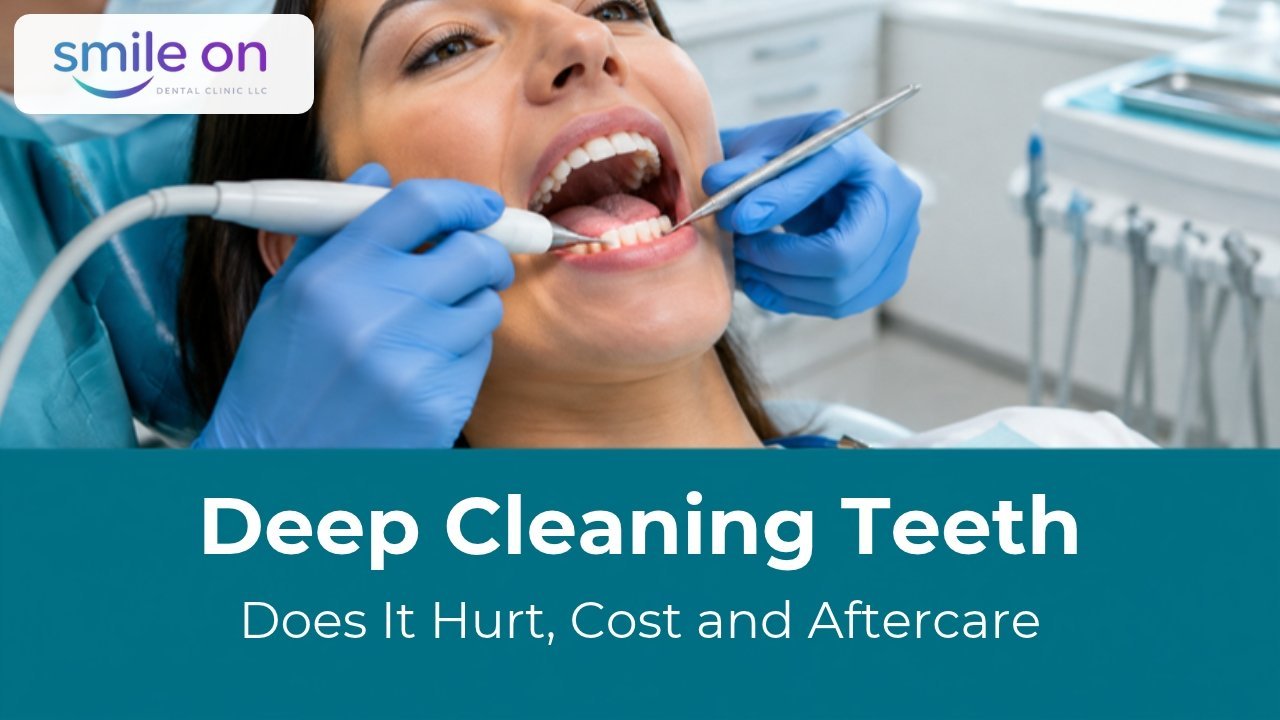
If your dentist has told you that you need a “deep cleaning”, it usually means tartar and bacteria have worked their way below the gumline and a normal scale and polish will not reach them. Deep cleaning, also called scaling and root planing, cleans the roots of the teeth under the gums so inflamed gums can heal and reattach. Most patients have it done under local anaesthetic, in one or two visits, and are back to normal eating within a day or two.
This guide explains when deep cleaning is actually needed, what happens during the appointment, whether it hurts, how to look after your gums afterwards and what it costs in Dubai. It is written by the team at Smile On Dental Clinic in Al Satwa, Dubai, for patients who have been recommended a deep clean and want to know what they are agreeing to.
Been told you need a deep cleaning?
Get a gum assessment with our specialist periodontist at Smile On Dental Clinic, Al Satwa, and a clear plan before any treatment starts.
What is deep cleaning?
Deep cleaning is a non-surgical gum treatment that removes plaque and hardened tartar from the tooth roots below the gumline, then smooths the root surface so bacteria find it harder to stick. The first part is called scaling. The second part, smoothing the roots, is called root planing.
A routine cleaning works on the visible tooth and just under the gum edge. A deep cleaning goes further down into the gap between the gum and the tooth, called a pocket. Healthy pockets are shallow, around 1 to 3mm. When gum disease sets in, the gum pulls away from the tooth and pockets deepen to 4mm or more, which is too deep for a toothbrush, floss or a routine clean to reach.
| Routine cleaning (scale and polish) | Deep cleaning (scaling and root planing) | |
|---|---|---|
| Who it is for | Healthy gums, prevention | Gum disease with pockets of 4mm or more |
| Where it cleans | Tooth surface and just under the gum edge | Tooth roots deep below the gumline |
| Anaesthetic | Usually not needed | Local anaesthetic is normal |
| Visits | One visit, 30 to 45 minutes | One or two visits, often split by side of the mouth |
| Follow-up | Every six months | Gum re-check after 6 to 8 weeks, then usually every 3 to 4 months |
| Price at Smile On | From AED 100 | Gum disease treatment from AED 800 |
When do you actually need a deep cleaning?
You need a deep cleaning when gum disease has caused pockets of 4mm or more, usually alongside bleeding, tartar below the gums or early bone loss on X-rays. It is a diagnosis, not an upsell, and it should always be based on measurements.
At a proper gum assessment, the dentist uses a small measuring probe to check the depth of the pocket around each tooth, notes where the gums bleed, and takes X-rays to see the bone level. Signs that often lead to a deep cleaning recommendation include:
- Gums that bleed when you brush or floss. Bleeding is the earliest sign of inflammation.
- Gums that look red, puffy or have pulled back. Teeth may start to look longer.
- Bad breath or a bad taste that does not go away. Bacteria trapped in deep pockets produce it.
- Teeth that feel slightly loose or have shifted. This suggests the bone supporting them is affected.
- Pockets of 4mm or more on the chart. This is the measurement that confirms it.
If you want to understand the earlier warning signs in more detail, our guide to the signs of gum disease covers them step by step.
What happens during a deep cleaning appointment?
A deep cleaning starts with numbing the area, then cleaning each tooth root below the gums with ultrasonic and hand instruments, and ends with smoothing the roots and rinsing the pockets. Most patients have half the mouth done per visit.
1. Assessment and plan. If it has not been done already, the dentist measures your pockets and takes X-rays so the treatment is planned tooth by tooth.
2. Local anaesthetic. The side being treated is numbed, just as it would be for a filling. You stay awake and can talk to the clinician throughout.
3. Scaling below the gums. An ultrasonic scaler breaks up tartar on the roots while water flushes the debris away. Fine hand instruments then clean the areas the scaler cannot reach.
4. Root planing. The root surfaces are smoothed so that the gum has a clean surface to heal against and bacteria have fewer places to settle.
5. Rinse and check. The pockets are rinsed, and in some cases an antibacterial gel is placed into deeper pockets.
Each half of the mouth typically takes 45 to 90 minutes, depending on how many teeth are affected and how much tartar there is.
Does deep cleaning hurt?
Deep cleaning itself should not hurt, because the area is numbed first. You will feel pressure, vibration and the water spray, but not sharp pain. Once the anaesthetic wears off, most people feel tenderness and some sensitivity for two to four days, which regular painkillers handle well.
A few things make the experience easier:
- Tell the clinic if you are nervous. The team can take breaks and explain each step as they go, and sedation dentistry is available for very anxious patients.
- Eat a proper meal before your appointment, because you will want to wait until the numbness wears off before eating again.
- Plan a quiet evening. You will not need time off work for the next day in most cases.
Recovery and aftercare: what to do after a deep cleaning
After a deep cleaning, keep brushing gently, choose soft foods for a day or two, and avoid anything very hot, very cold or spicy while your gums settle. Most patients feel back to normal within a week.
The first 24 hours. Wait until the numbness has fully worn off before eating, so you do not bite your cheek or tongue. Stick to soft, lukewarm foods such as yoghurt, eggs, soup, rice and pasta. Avoid alcohol and smoking, both of which slow gum healing.
The first week. Brush twice a day with a soft toothbrush, gently along the gumline, and keep flossing even if the gums bleed a little at first. If your dentist prescribed a mouth rinse, use it as directed. A sensitivity toothpaste helps with cold sensitivity, which is common because the root surfaces are now clean and exposed.
What is normal. Mild soreness, slight bleeding when brushing, and sensitivity to cold for a week or two.
When to call the clinic. Swelling that gets worse after the third day, a fever, pus, or pain that painkillers do not control. These are uncommon, but they need checking.
What to expect over the next few weeks. As the inflammation settles, gums often tighten and may look slightly lower than before. This is the gum healing closer to the tooth, and it is a good sign. Some patients notice their breath improves within a week or two.
How much does deep cleaning cost in Dubai?
At Smile On Dental Clinic, gum disease treatment, including deep cleaning, starts from AED 800. The final cost depends on how many areas of the mouth need treatment, how deep the pockets are, and whether you need X-rays and a follow-up re-evaluation.
What changes the price:
- How much of the mouth is involved. Some patients need only one or two areas cleaned, others need the whole mouth.
- Severity. Deeper pockets take longer to clean and may need an antibacterial gel or closer follow-up.
- X-rays. A dental X-ray at Smile On is AED 150 if one is needed to plan treatment.
- Maintenance visits. After a deep clean, most patients move to gum maintenance cleanings every three to four months for a while, instead of every six.
Many UAE insurance plans that include dental cover treat gum treatment as a basic or medically necessary procedure and cover part of the cost, subject to your co-payment and annual limit. Ask the clinic to check your cover before treatment so you know your out-of-pocket amount in advance.
Is deep cleaning necessary, or can you skip it?
If you have confirmed gum disease with deep pockets, skipping treatment usually lets it get worse. Brushing harder at home cannot reach tartar 5 or 6mm below the gums, and the bacteria keep breaking down the gum attachment and the bone underneath. Over time that can lead to loose teeth, gaps and eventually tooth loss, and the treatment needed at that point, such as gum surgery or replacing teeth with dental implants, costs far more.
The good news is that early gum disease responds very well to deep cleaning plus good home care. Many patients see bleeding stop and pockets shrink by the time of their re-check.
That said, you should only have a deep clean when the measurements support it. If a clinic recommends one without probing your gums or showing you X-rays, it is reasonable to ask for those first or get a second opinion.
Are there alternatives to deep cleaning?
For mild gum inflammation without deep pockets, a routine professional cleaning and better brushing and flossing are often enough, and no deep clean is needed. Once pockets have formed, deep cleaning is the standard first treatment, and there is no rinse or toothpaste that replaces it.
Laser-assisted gum treatment is sometimes used alongside deep cleaning to help reduce bacteria in the pockets. For advanced cases where pockets stay deep after healing, a periodontist may discuss further treatment. Either way, the starting point is the same: an accurate gum assessment.
Who carries out deep cleaning at Smile On?
Deep cleaning and gum disease treatment at Smile On Dental Clinic are planned by Dr. Vineetha Varughese, our Specialist Periodontist. Having a gum specialist in the clinic means your pockets are measured properly, treatment is planned tooth by tooth, and your follow-up is handled by the same team. Find out more about our gum disease treatment or meet our periodontist in Dubai.
Bleeding gums or been told you need a deep clean?
Book a gum assessment at Smile On Dental Clinic in Al Satwa, Dubai. Gum disease treatment from AED 800. Open daily, 9am to 9pm.
Frequently Asked Questions
What is the difference between a regular cleaning and a deep cleaning?
A regular cleaning removes plaque and tartar from the tooth surface and just under the gum edge, and is used to keep healthy gums healthy. A deep cleaning cleans the tooth roots further below the gumline and is used to treat gum disease once pockets of 4mm or more have formed.
Does deep cleaning teeth hurt?
The treatment itself should not hurt, because the area is numbed with local anaesthetic. Afterwards most people have tenderness and some sensitivity for two to four days, which regular painkillers manage.
How long does a deep cleaning take?
Each half of the mouth usually takes 45 to 90 minutes. Most patients have the whole mouth done in two visits, about a week apart.
What can I eat after a deep cleaning?
Wait until the numbness wears off, then choose soft, lukewarm foods such as yoghurt, eggs, soup, rice and pasta for a day or two. Avoid very hot, very cold, spicy or crunchy foods, alcohol and smoking while the gums settle.
How much does deep cleaning cost in Dubai?
At Smile On Dental Clinic in Al Satwa, gum disease treatment including deep cleaning starts from AED 800. The final cost depends on how many areas need treatment and how deep the pockets are, and is confirmed after a gum assessment.
Will my gums grow back after a deep cleaning?
Inflamed gums tighten and reattach to the clean root surfaces as they heal, which reduces pocket depth. Gum tissue that has already receded does not grow back on its own, which is why treating gum disease early matters.
How often do I need a cleaning after a deep clean?
Most patients have a re-check 6 to 8 weeks after treatment and then gum maintenance cleanings every three to four months until the gums are stable. Your dentist will tell you when you can return to six-monthly cleanings.