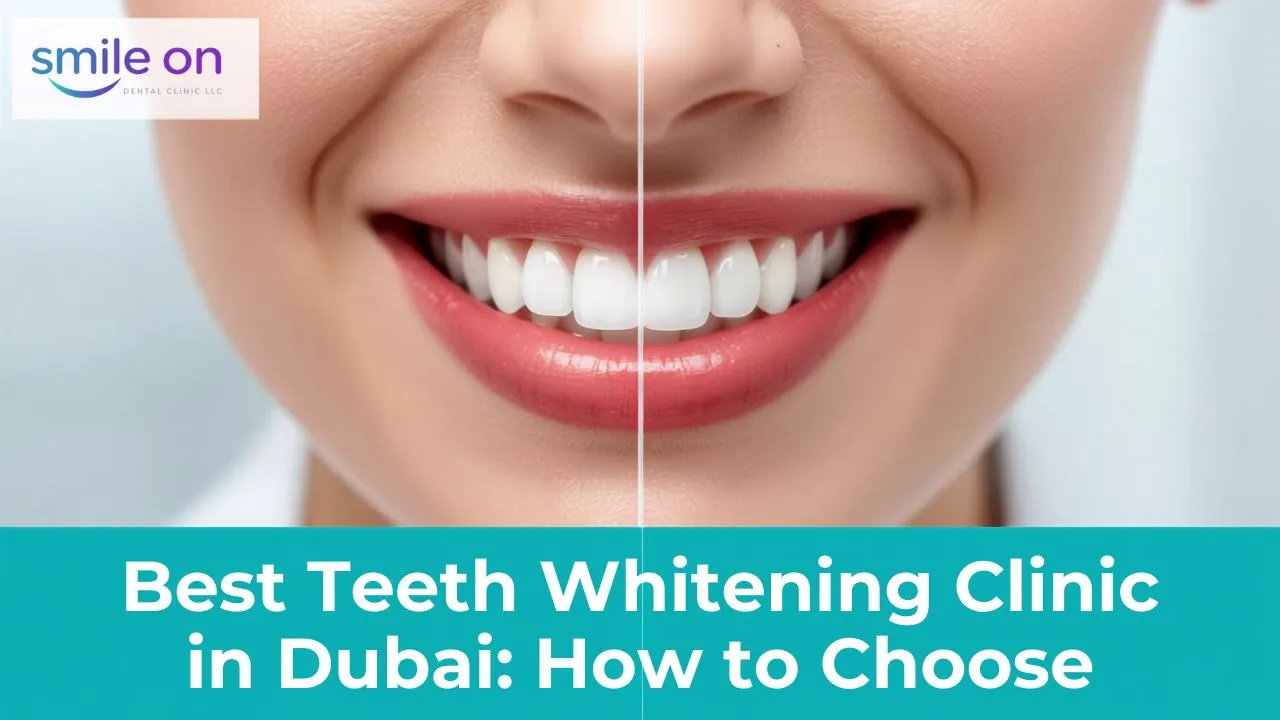
Best Teeth Whitening Clinic in Dubai — How to Choose
6 min read Share: Professional teeth whitening in Dubai can lighten teeth by four to eight shades in a single session. It is one of the most requested cosmetic dental treatments in the city, which also means there is no shortage of clinics offering it, and a wide gap between those that do it well and those that do not. Choosing the right clinic is not complicated, but it does require knowing what questions to ask. This guide walks through the types of professional whitening available in Dubai, what separates a good result from a poor one, and the specific things to check before booking. If you are searching for the best teeth whitening clinic in Dubai or the best Zoom teeth whitening in the city, this is where to start. Cosmetic treatments at Smile On Dental Clinic in Al Satwa are led by Dr. Neha Sachdev, a general dentist holding a diploma in Aesthetic Restorative Dentistry. Types of Professional Teeth Whitening in Dubai Before choosing a clinic, it helps to understand what is available. Professional whitening in Dubai broadly falls into three categories. Treatment Type How It Works Typical Duration Approximate Cost (AED) Zoom Whitening In-office, hydrogen peroxide gel with UV light activation 60 to 90 minutes 1,200 to 2,500 Laser Whitening In-office, peroxide gel activated by laser 45 to 90 minutes 1,500 to 3,000 Custom Home Trays Dentist-made trays with take-home whitening gel 2 to 4 weeks daily use 800 to 1,800 Combined (In-office + Home) In-office session plus take-home maintenance kit Immediate, plus ongoing 1,500 to 3,000 Zoom whitening is the most widely available professional system in Dubai and is what most patients mean when they ask for laser whitening. The two terms get used interchangeably even though they technically use different activation methods. Home tray whitening produces comparable results over a longer period and is often recommended as a maintenance option after an in-office session. Over-the-counter strips sold in pharmacies use much lower concentrations and produce more limited results than professional treatment. Who This Fits: Real Patient Scenarios in Dubai The professional preparing for a specific event. Patients with a wedding, a big presentation, or a milestone celebration coming up tend to want the fastest, most visible result. A single in-office Zoom session delivers a noticeable change immediately, which suits a fixed deadline far better than the two to four weeks a home tray system needs to reach the same shade. The patient with heavy coffee, tea, or shisha habits. Dubai’s coffee and shisha culture means many patients see staining return faster than average. For this group, a combined approach, an initial in-office session followed by a take-home maintenance kit used every few months, holds results better than a single session alone, since the maintenance kit catches new staining before it sets in deeply. The patient who tried whitening before with disappointing results. Some patients have used pharmacy strips or a rushed in-office session elsewhere and saw limited change. This is frequently a sign of intrinsic staining that surface whitening cannot fully address, or of a system used at too low a concentration to make a real difference. A proper clinical assessment identifies which of these is happening before recommending another round of whitening that would disappoint again. What Separates a Good Result From a Poor One Pre-treatment assessment. A dentist should examine your teeth before whitening. Whitening only works on natural tooth enamel, not on crowns, veneers, composite bonding, or white fillings. If you have existing restorations on front teeth, whitening the natural teeth around them creates a mismatch. A clinical check before treatment identifies this and sets realistic expectations. Whitening also does not touch intrinsic staining, the discolouration inside the tooth structure caused by tetracycline antibiotics or fluorosis, for example. A dentist who assesses your teeth first will tell you honestly what whitening can and cannot achieve in your case. Gum protection during treatment. In-office whitening uses high-concentration hydrogen peroxide. Applied correctly, with gums properly isolated and protected, it causes no damage. Applied carelessly, it burns gum tissue. The difference between a dentist who takes this step properly and one who rushes it shows up in how the appointment actually feels. Realistic shade expectations. No dentist should promise a specific shade result without seeing your teeth first. Natural tooth colour varies considerably, and the final result depends on your starting shade, the degree of surface staining, and the whitening system used. A clinic that promises a fixed number of shades before examining you is making a marketing claim, not a clinical one. Post-whitening sensitivity management. Temporary sensitivity after whitening is common and resolves within 24 to 48 hours in most patients. Clinics that prescribe a desensitising treatment before or after the session reduce discomfort significantly. If sensitivity never comes up before treatment, that is worth asking about. Questions to Ask Before You Book Is whitening right for my teeth, or would another treatment give better results? For certain types of discolouration, deep intrinsic staining, uneven colour, or teeth that have not responded to previous whitening, composite bonding or porcelain veneers may be more effective. A dentist who gives you this honest answer is worth trusting. What whitening system do you use, and what concentration? DHA-regulated dental clinics in Dubai use professional-grade whitening products. Knowing the system lets you compare correctly between providers. Is a cleaning recommended before whitening? Whitening produces better and more even results on clean enamel. Most dental clinics recommend a professional cleaning before the session if you have not had one recently. What is included in the price? Ask whether the fee includes a pre-treatment consultation, gum protection during the session, a take-home maintenance kit, and a follow-up if sensitivity occurs. The lowest-priced option often leaves out the most useful parts. How to Make Your Results Last Whitening results are not permanent. Results from a professional in-office session typically last 12 to 18 months with reasonable care. Coffee and tea consumed daily without a straw, red wine, dark-coloured sauces, and
Same Day Dental Implants in Jumeirah — Are You a Candidate?
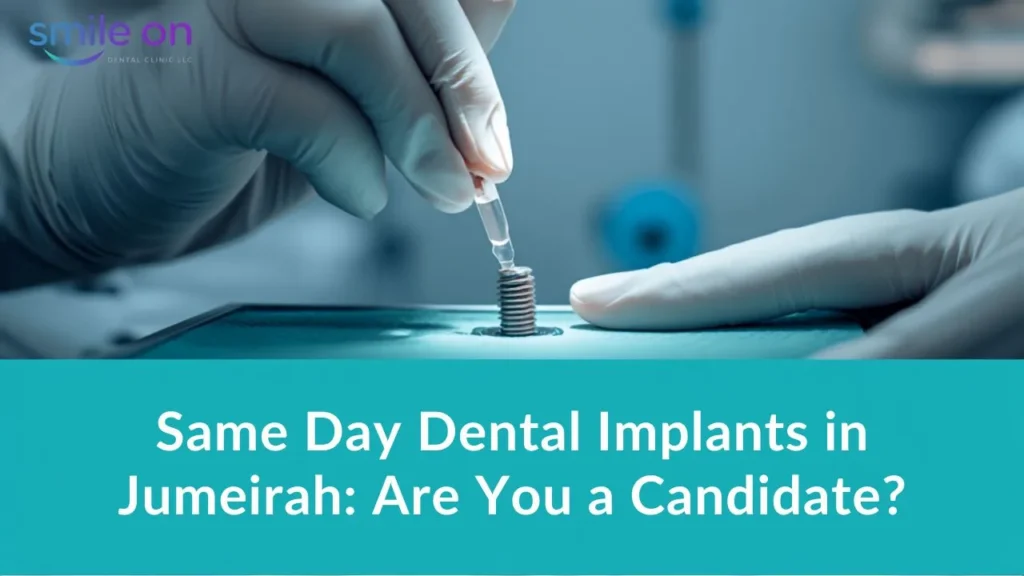
8 min read Share: Same day dental implants let you leave the clinic with a functioning temporary tooth on the same appointment your implant is placed. No waiting three to six months between surgery and restoration. No gap in your smile during healing. For patients who qualify, it is a genuine step forward from conventional implant treatment. The word candidate matters here. Not everyone is suitable for immediate loading, and a clinic that skips that conversation is worth avoiding. If you are researching same day dental implants in Jumeirah, this guide explains exactly who qualifies, what gets assessed at your consultation, what the procedure involves step by step, and what recovery actually feels like in the weeks that follow. At Smile On Dental Clinic in Al Satwa, Dubai, implant treatment is handled by a specialist surgical and restorative team. Dr. Amit Gupta, a DHA-licensed specialist in oral and maxillofacial surgery, places the implant. Dr. Rahul Patel, a DHA-licensed specialist prosthodontist, designs and fits the crown. The clinic is accessible from the Jumeirah area in under 10 minutes. What Are Same Day Dental Implants? Same day dental implants, also called immediate loading implants or teeth in a day, combine two stages that happen months apart in conventional implant treatment: placing the titanium implant into the jawbone and attaching a temporary crown on top. In a standard implant procedure, you receive the implant, then wait three to six months for osseointegration before a crown is placed. Same day treatment loads the implant with a temporary crown immediately, giving you a functional, aesthetic replacement while bone continues to integrate around it. The permanent crown is typically fitted three to six months later, once integration is confirmed. This approach is backed by over a decade of published clinical data showing success rates of 94 to 97 percent at five years for single-tooth same day implants in properly selected patients, comparable to conventional two-stage implants. Who Is a Good Candidate? Same day implants require stricter patient selection than conventional implants. Every case is assessed before the procedure is planned. Adequate bone density and volume. The implant needs sufficient bone to anchor in on day one, since it is loaded immediately. Bone quantity and quality are assessed using a CBCT 3D scan before any procedure. If bone volume is insufficient due to long-term tooth loss or bone resorption, a bone graft may be recommended first, and same day loading may not be appropriate. Healthy gums. Active gum disease creates infection risk that makes immediate loading inadvisable. Patients with a history of gum disease need a clean bill of gum health confirmed clinically before proceeding. No active infection at the implant site. If the tooth being replaced had an active abscess, same day placement requires caution. Dr. Amit Gupta assesses whether immediate placement is safe or whether a healing period is needed first. No systemic conditions affecting bone healing. Uncontrolled diabetes, active cancer treatment, bisphosphonate therapy, and certain autoimmune conditions affect how bone heals. These are not automatic disqualifiers but require detailed clinical review before same day loading is recommended. Non-smoker status. Smoking reduces blood flow to gum and bone tissue, which impairs osseointegration. Patients who smoke carry a materially higher risk of implant failure. The standard recommendation is to stop smoking completely for at least two weeks before and eight weeks after placement. What if you do not qualify? Conventional two-stage implants remain an excellent solution for patients who do not meet immediate loading criteria. Outcomes are clinically equivalent. The main difference is timeline. Dr. Gupta and Dr. Patel will discuss both options and recommend the one that gives the best long-term result for your case. Who This Fits: Real Patient Scenarios in Jumeirah The professional who cannot be without a front tooth for months. Patients in client-facing roles who lose a front tooth to trauma or a failed old filling often cannot accept a visible gap while waiting for a conventional implant to integrate. A same day implant, when the bone and gum health support it, means leaving with a temporary crown in place rather than a removable flipper. The patient who has already lost the tooth years ago. Long-standing tooth loss often means some bone resorption at the site, since bone needs the stimulation of a tooth root to maintain its volume. This is one of the more common reasons a patient is not immediately a same day candidate and needs a bone graft first, something that only becomes clear from the CBCT scan, not from how the gap looks in the mirror. The patient replacing a single back tooth versus a front tooth. Same day loading criteria are somewhat more forgiving for back teeth, since the cosmetic stakes and bite forces during healing differ from a front tooth. Front tooth cases require more conservative bite management during the healing phase to protect the temporary crown, something Dr. Patel discusses in detail before the surgical day. The Same Day Implant Procedure: Step by Step Step 1, pre-surgical planning. A 3D cone beam CT scan maps your bone volume, bone density, nerve position, and sinus proximity with precision a standard X-ray cannot match. This data drives the surgical plan: implant diameter, length, angle, and position are all determined from the scan, not estimated on the day. Where guided surgery is appropriate, a surgical guide translates the digital plan directly into your mouth. Step 2, day of surgery. Under local anaesthesia, Dr. Gupta places the implant, a small titanium screw, into the prepared site in the jawbone. If a tooth is still present, extraction and same day implant placement can often happen in the same appointment, provided bone levels permit. Step 3, temporary crown fitted same day. Once the implant is placed and primary stability confirmed, Dr. Patel attaches a temporary crown via an abutment. You leave with a functional tooth that looks and works normally. Step 4, healing and osseointegration. The temporary crown stays in place for three to six months while the implant
Invisalign Cost in Dubai and UAE: What to Budget in 2026
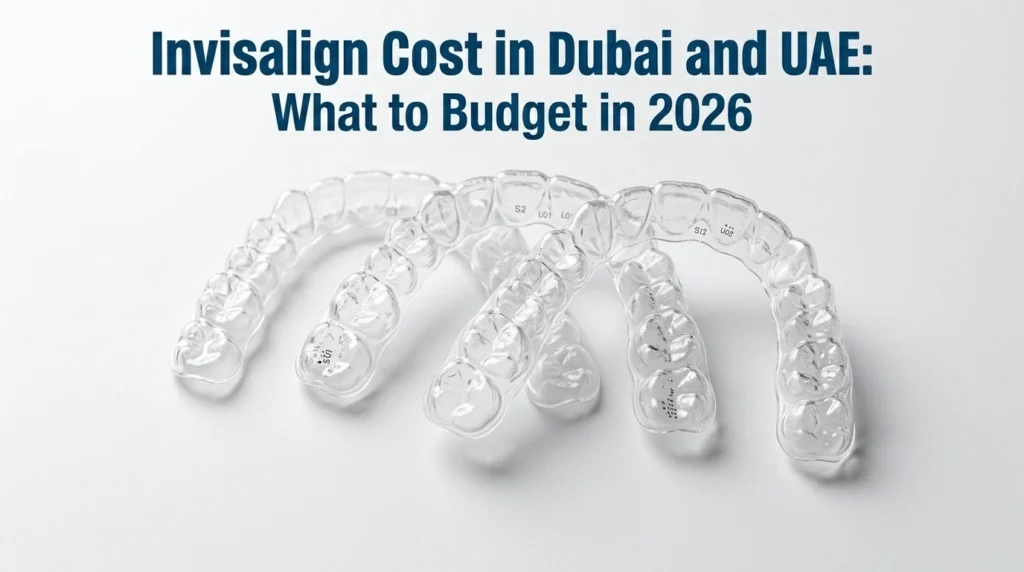
8 min read Share: Invisalign pricing in Dubai ranges from AED 7,000 for a short Lite course to AED 18,000 or more for a full complex case. The range reflects genuinely different product tiers with different scope, not clinics pricing the same thing inconsistently. This guide breaks down what each tier covers, what makes a case cost more, and what a complete quote from a Dubai provider should include. If you’ve already decided on Invisalign and you’re comparing providers, the section on what to ask for in a written quote will be the most immediately useful. Invisalign Cost in Dubai: Price Summary for 2026 Treatment Type Case Complexity Approximate Cost (AED) Invisalign Lite Minor crowding or spacing (up to 20 trays) 7,000 – 10,000 Invisalign Full / Moderate Moderate cases (up to 40+ trays, 1 refinement) 10,000 – 15,000 Invisalign Comprehensive Complex cases (unlimited refinements included) 13,000 – 18,000 Invisalign First (children, ages 6-10) Early interceptive jaw development 6,000 – 12,000 Vivera Retainers (post-treatment) Retention phase 1,500 – 3,000 These are 2026 indicative ranges for Dubai. The final cost depends on the tier assigned to your case after a 3D iTero scan and ClinCheck assessment. Abu Dhabi and Sharjah prices are broadly comparable. The tier determines everything: the number of aligner sets included, how many refinement rounds are covered, and therefore the total treatment scope the price covers. The Different Invisalign Product Tiers Align Technology (the company behind Invisalign) sells treatment at different tiers based on case complexity. The tier your case falls into determines how many aligners are produced and what happens if teeth don’t move exactly as planned. Invisalign Lite:Designed for minor corrections using a small number of aligner trays, typically up to 20. Used for mild crowding, small gaps between teeth, or cases where previous orthodontic treatment has slightly relapsed. Not appropriate for bite correction or moderate-to-complex tooth movement. If a Lite case turns out to need more movement than initially assessed, the provider may need to upgrade the case to a higher tier at additional cost. Invisalign Full (also called Moderate at some clinics):Covers a broader range of tooth movements for moderate cases. A higher number of aligner sets is included, typically with one round of refinements included. This is the most common tier for adult patients with moderate crowding in Dubai. Invisalign Comprehensive:The highest tier. Unlimited refinement aligners are included within the treatment window (typically 5 years from the start date). Used for complex cases requiring significant tooth movement, bite adjustments, or cases that need multiple refinement rounds to achieve the full planned result. If your case genuinely needs this scope, choosing a lower tier to save money upfront often costs more when additional refinements need to be purchased separately. Invisalign First:Specifically for children aged 6-10 with jaw development issues. Uses phase 1 orthodontic principles to guide jaw growth and begin correcting alignment before all permanent teeth have erupted. This is clinical early interceptive treatment, not cosmetic alignment work for children. What Is Typically Included in an Invisalign Package When you receive a quote for Invisalign in Dubai, ask for written confirmation of what is included. The items below vary between clinics and the differences can add AED 2,000-4,000 if they’re charged separately and you don’t find out until mid-treatment. Usually included in a complete Invisalign package: All aligner trays for the planned treatment course. The initial 3D iTero digital scan (or impression alternative, though iTero is now standard at most Dubai providers). The ClinCheck digital treatment plan showing the expected result before any trays are produced. Attachment placement and removal (small composite bumps bonded to specific teeth to help aligners achieve certain movements). Progress appointments throughout treatment. IPR (interproximal reduction, the gentle reshaping between teeth where needed). One round of refinements in Full tier cases. Commonly charged separately: X-rays before treatment begins if not done recently. Vivera retainers post-treatment (AED 1,500-3,000, sometimes included, often not). Additional refinement rounds beyond what the tier includes. Any gum treatment required before Invisalign can start. Emergency appointments for dislodged or broken attachments. The retainer is worth asking about specifically. Some clinics include an initial retainer in the Invisalign package. Others quote the treatment price and add the retainer separately at the end. Since retainers are essential after any orthodontic treatment, the total cost should always include them in your comparison. What Makes Your Case More Expensive Case complexity. This is the single largest driver. A case requiring significant crowding resolution, bite adjustment, or movement across many teeth will be assigned to Comprehensive tier. A case involving mild spacing in the upper front four teeth may qualify for Lite. The case assignment happens after your 3D scan and cannot be fully predicted without one. Number of refinement rounds needed. Some cases require multiple refinement sets to achieve the planned result. Comprehensive cases include unlimited refinements within the treatment window. Full or Moderate cases include one refinement round. If a second refinement is needed and isn’t included, the additional cost is typically AED 2,000-4,000 per refinement. Provider experience level. Invisalign categorises its providers by annual case submission volume. Diamond, Platinum, and Gold tiers reflect increasing levels of experience. Higher-tier providers typically command a premium, and for complex cases, that experience difference affects outcome quality in measurable ways. For Lite cases, provider tier matters less. For Comprehensive cases, it matters considerably. Clinic location and overheads. A Dubai clinic in DIFC, Downtown, or Palm Jumeirah carries significantly higher operational costs than a clinic in Al Satwa, Bur Dubai, or Al Barsha. The same case, the same tier, and the same quality of orthodontist can cost AED 2,000-4,000 more at a high-overhead location. This is a real cost difference worth factoring in when comparing quotes. Dubai vs Abu Dhabi vs Sharjah: Does Location in the UAE Affect Price? Invisalign aligner sets are priced within a standard range by Align Technology across the UAE, so the variation in final cost comes from clinic overheads, provider tier, and what each clinic includes in the
All-on-4 vs All-on-6 Dental Implants: Which Full Arch Option Should You Choose?
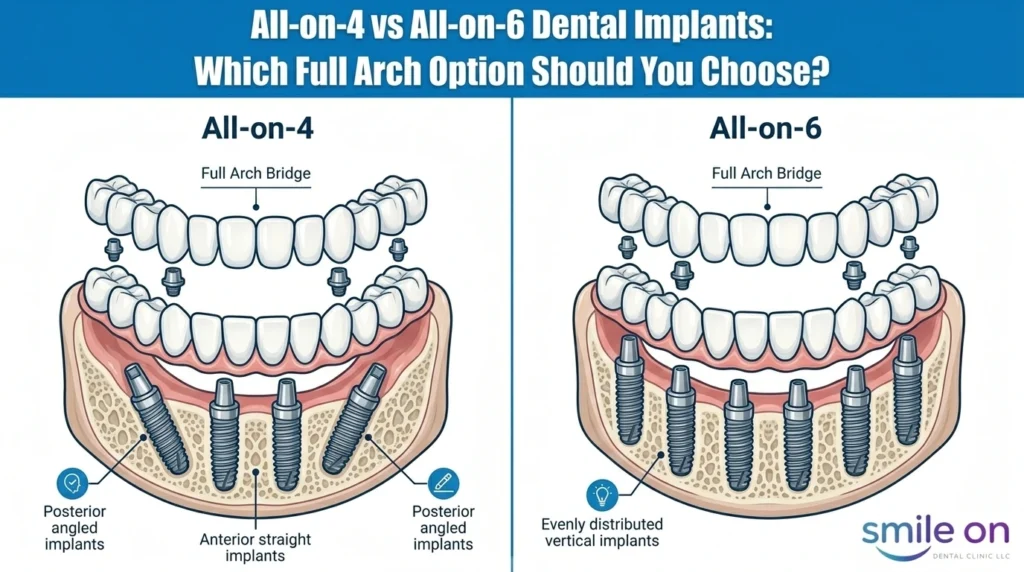
6 min read Share: All-on-4 and All-on-6 both replace a full row of teeth using a fixed bridge supported by a small number of implants. You don’t remove them. You care for them like natural teeth. The difference is how many implants anchor the bridge, where they sit in the jaw, and which clinical situations each one is designed for. If you’re researching full arch implants in Dubai, this is the comparison you need before your consultation. What All-on-4 and All-on-6 Actually Mean Both treatments replace every tooth in one arch (upper jaw, lower jaw, or both) using a fixed bridge that is permanently screwed onto implant posts placed in the jaw. The bridge is not a denture. It does not come out. It functions and looks like natural teeth. All-on-4: Four titanium implant posts are placed in the jaw. The two front implants sit straight. The two rear implants are angled at approximately 30-45 degrees. The angling achieves two things: it allows the rear implants to anchor into a longer section of available bone, and it avoids the areas at the back of the jaw where bone is often thinner, or where sinus anatomy in the upper jaw limits vertical implant depth. All-on-6: Six titanium implants are placed, typically distributed more evenly across the arch. The additional implants provide more support points for the bridge and spread the chewing load across a wider area of the jaw. In both cases, the bridge placed on top is fixed permanently at the implant connections. Core Differences at a Glance Factor All-on-4 All-on-6 Number of implants per arch 4 6 Rear implant angulation 30-45 degrees Typically straight or minimal angle Bone density requirement Works with moderate bone loss Requires more available bone volume Chewing load distribution Across 4 points Across 6 points Suitability for patients with bone loss Better suited May require bone grafting if volume is low Approximate cost per arch (Dubai, 2025) AED 25,000 – 55,000 AED 30,000 – 65,000 Upper jaw with sinus proximity Yes — angled implants avoid the sinus floor May require sinus lift in lower-volume cases All-on-4: The Logic Behind the Angled Implants All-on-4 was developed to make full arch implant treatment possible for patients who had been told they didn’t have sufficient bone for conventional implants. The angling technique lets the rear implants engage a longer stretch of available bone, bypassing the areas of maximum resorption. This matters clinically because patients who have worn dentures for years, or who have lost teeth due to advanced gum disease, often have significant bone loss in the regions where teeth used to be. The All-on-4 concept, developed by Dr. Paulo Malo, uses the bone that remains, positioned at an angle, rather than first grafting in new bone. For many patients, this eliminates the need for bone grafting that would otherwise be required before any implants could be placed. That reduces total treatment time, the number of surgical procedures, and the overall cost compared to a grafting-plus-conventional-implant plan. All-on-6: When More Support Points Make a Difference Adding two more implants distributes the load of chewing across six anchor points rather than four. For patients with adequate bone volume, this provides: Better long-term load distribution. Each implant carries less individual force when six are sharing the load. Over years of chewing, this can be beneficial for the bone around each implant and for the mechanical integrity of the bridge-to-implant connections. A wider structural base for the bridge. With six support points, the prosthetic engineering of the bridge has more structural options, which can simplify the design and reduce mechanical stress at each connection point. Reduced risk of full arch failure. In the unlikely event that one implant fails to integrate, a six-implant bridge has more redundancy than a four-implant bridge. This is a relevant consideration for patients with risk factors such as a history of smoking or uncontrolled diabetes. Where All-on-6 is particularly appropriate: Upper jaw cases in patients with good bone volume. The maxilla (upper jaw) has different bone quality characteristics to the lower jaw and often benefits clinically from the additional anchor points. Patients with strong bite forces, such as those who grind or clench their teeth. More implants distributing that force is a measurable advantage over time. Cases where the surgeon assesses that four anchor points won’t provide optimal long-term stability given that patient’s specific bone density and jaw anatomy. Bone Density Is the Real Deciding Factor The choice between All-on-4 and All-on-6 is driven by clinical assessment, not personal preference. It is determined primarily by your bone volume and density as revealed by a CBCT (cone beam CT) scan. A CBCT scan gives the implant surgeon a three-dimensional view of the entire jaw. It shows exactly how much bone is available at each proposed implant site, where bone density is adequate for secure implant placement, and where anatomical structures (the inferior alveolar nerve in the lower jaw, the sinus floor in the upper jaw) limit implant positioning and depth. After reviewing the CBCT, the clinical picture generally falls into one of three situations: Bone is moderate to significantly reduced across the arch. All-on-4 is typically recommended. The angling technique makes the most of available bone without requiring grafting. Bone volume is good across the arch. All-on-6 may be recommended to provide optimal load distribution and the strongest long-term structural foundation. Bone loss is very severe. Neither All-on-4 nor All-on-6 may be immediately viable. Bone grafting or sinus lift surgery may need to come first, extending the treatment timeline. No responsible implant clinic should quote you for either treatment without first reviewing a CBCT scan. If you receive a quote before a scan has been done, ask for it to be completed before the treatment plan is finalised. Cost Comparison in Dubai Treatment Approximate Cost per Arch (AED) All-on-4 AED 25,000 – AED 55,000 All-on-6 AED 30,000 – AED 65,000 Bone grafting if required AED 1,500 – AED 8,000 (extent-dependent) CBCT scan AED 300 – AED
Invisalign vs Braces in Dubai: Which One Should You Actually Choose?
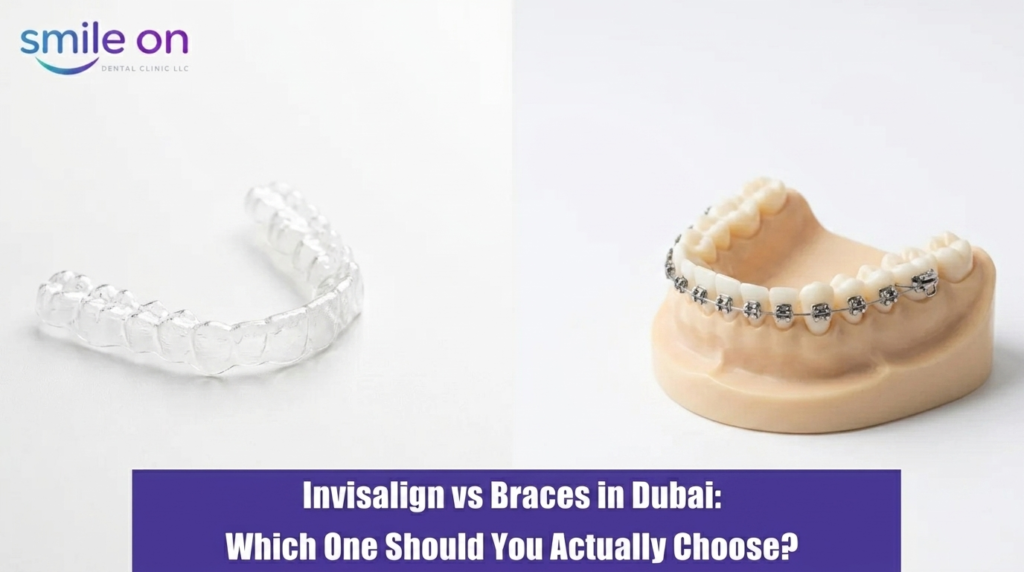
7 min read Share: The answer is not whichever felt more comfortable to discuss at your last consultation. It depends on your specific case type, how reliably you will wear a removable device, and what your treatment needs to achieve. Clear aligners have improved significantly and now handle a much broader range of cases than they did a decade ago. Fixed braces haven’t gone anywhere: they still offer more precise mechanical control for certain case types and remove the compliance variable entirely. This guide is written for patients in Dubai who are weighing both options and want an honest clinical comparison, not marketing copy for either system. The Short Answer Invisalign is the stronger choice for mild to moderate crowding and spacing in adult patients who will reliably wear aligners for 20-22 hours every day. Fixed braces are the stronger choice for complex bite correction, cases requiring precise three-dimensional tooth movement, children and teenagers, or any patient whose compliance with a removable device is uncertain. Most cases fall somewhere in the middle, which is why the consultation matters more than any comparison article. How Each System Actually Moves Teeth Understanding the mechanism helps you ask better questions at your appointment. How Invisalign moves teeth: Invisalign produces a series of custom-fitted clear plastic trays using a 3D digital scan of your teeth. Each tray is slightly different from the last, designed to nudge teeth incrementally toward the target position. You wear each tray for 1-2 weeks, then advance to the next. The total number of trays depends on case complexity. Small tooth-coloured composite attachments are often bonded to specific teeth to help the aligners grip for more demanding movements. How fixed braces move teeth: Metal, ceramic, Damon, or lingual braces all operate on the same principle: brackets bonded directly to the tooth surfaces, connected by an archwire. The orthodontist applies progressive tension to the wire at each adjustment appointment, moving teeth through the bone over time. The bracket-and-wire system gives direct mechanical control over each tooth’s position, angle, and rotation throughout the treatment period. Head-to-Head: The Full Comparison Factor Invisalign (Clear Aligners) Fixed Braces Visibility during treatment Nearly invisible Visible (lingual braces are the exception) Removability Removed for eating and cleaning Fixed for the entire treatment period Case complexity range Mild to moderate (best results) Mild to severe Compliance requirement High — 20-22 hours daily wear required None — fixed in place Cleaning your teeth Straightforward — remove tray, brush normally More involved — interdental brushing around brackets Comfort after adjustments Lower initial soreness when changing trays Tightness for 24-48 hours after wire adjustment Adjustment visits Less frequent for tray progression Every 4-8 weeks depending on brace type Complex bite correction Less predictable More predictable Treatment time (mild cases) Comparable to fixed braces Comparable Treatment time (complex cases) Longer, less predictable Faster, more predictable What happens if you lose it Disrupts programmed movement N/A — nothing to lose Cost in Dubai (AED) 7,000 – 18,000 5,000 – 25,000 (varies by type) For a full price comparison by braces type, see: How Much Do Braces Cost in Dubai? When Invisalign Produces Better Results Mild to moderate crowding. Clear aligners handle cases where teeth are mildly overlapping or misaligned very effectively. Invisalign’s ClinCheck planning software allows the orthodontist to model the exact expected tooth movements before treatment begins, so you can see the planned digital result before any trays are produced. Spacing between teeth. Gaps between teeth, including diastema (the space between upper front teeth), respond well to aligner treatment across most case types. Lifestyle-conscious adults who will actually comply. If you are in a client-facing role, travel regularly, or have personal reasons where fixed hardware during treatment is genuinely difficult, and you are the kind of person who will wear the aligners for 20-22 hours every day for 12-18 months, Invisalign delivers excellent results on appropriate cases. Oral hygiene priority. Because aligners are removed for eating and brushing, maintaining gum and tooth health during treatment is considerably easier than with fixed braces. For patients with a history of gum sensitivity or previous gum treatment, this is a meaningful clinical advantage. Certain relapse cases. Patients who have had orthodontic treatment before and experienced mild relapse (teeth moving back slightly) often use a shorter Invisalign Lite course for correction. When Fixed Braces Produce More Predictable Results Complex bite correction. Overbite, underbite, crossbite, and open bite cases that have a skeletal component, or that require significant bite change alongside tooth movement, are handled more predictably with fixed braces. The mechanical control available with bonded brackets exceeds what aligners can reliably achieve for three-dimensional bite correction. Significant tooth rotation. Rotating round-rooted teeth, particularly lower premolars, requires sustained torquing force that fixed braces apply continuously. Aligners apply rotational force intermittently, which can make full rotation of certain teeth less reliable. Vertical tooth movement. Intruding a tooth (pushing it further into the jaw) or extruding it (pulling it down) is a movement that fixed braces handle more directly than aligners in most cases. Children and teenagers. Fixed braces are the standard recommendation for younger patients because compliance with removable aligners at this age is genuinely unreliable. One forgotten aligner tray sets treatment back. Braces on the teeth remove that variable. Invisalign First is designed for younger patients with specific jaw development needs, but fixed braces remain the primary recommendation for most children. Complex cases where budget is a constraint. Metal braces at AED 5,000-10,000 offer the most clinical capability per dirham. For cases where aligners may struggle, fixed braces are both more effective and more affordable. The Compliance Issue Nobody Explains Clearly This is the part of the Invisalign decision that clinic websites often downplay. Invisalign works as planned when worn for 20-22 hours per day, every day. Not 18 hours. Not “most days.” Consistent full-duration wear is what produces the tooth movement that the ClinCheck software predicted. In practice, patients underestimate how frequently the trays come out: meals, drinks other than water, social events, moments of
Which Braces Type Should You Choose? A Dubai Orthodontist’s Guide
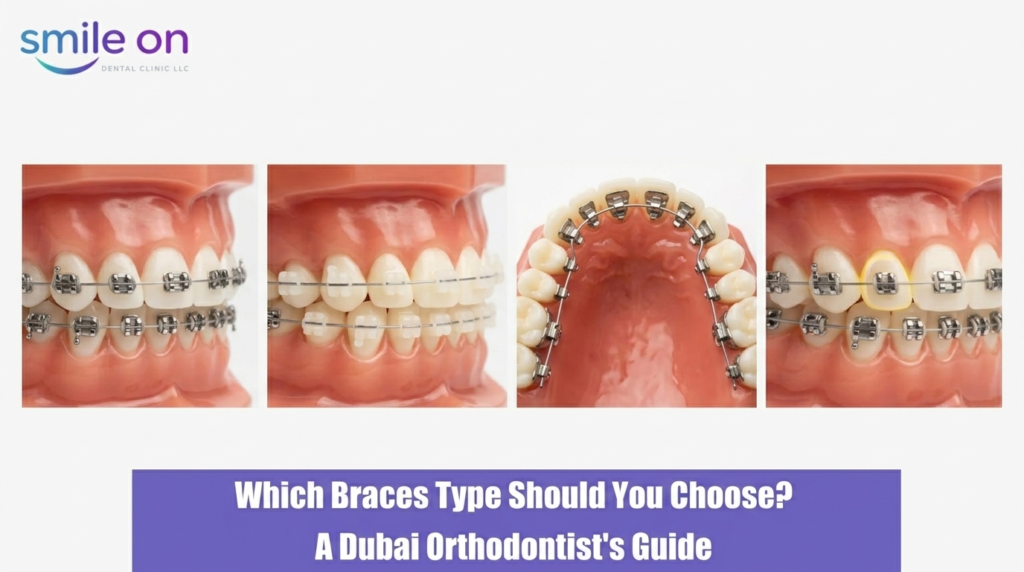
9 min read Share: The braces decision isn’t really about which type looks best on a website. It’s about which system will move your specific teeth correctly, fit your lifestyle throughout treatment, and give you a stable result that holds years later. Dubai patients have five main options: metal braces, ceramic braces, Damon braces, lingual braces, and Invisalign. They overlap in some situations and are completely wrong for others. This guide breaks down exactly who each one is for, written from an orthodontic practice perspective. If you’re trying to decide before booking an orthodontic consultation in Dubai, this is where to start. The Five Types of Braces Available in Dubai Before going into detail, here’s the summary comparison. Braces Type Visibility Best Case Type Approx. Cost (AED) Adjustment Interval Metal braces Visible Any complexity 5,000 – 10,000 Every 4-6 weeks Ceramic braces Low Mild to moderate 7,000 – 13,000 Every 4-6 weeks Damon braces Low to moderate Mild to complex 8,000 – 14,000 Every 8-10 weeks Lingual braces Invisible (behind teeth) Mild to complex 15,000 – 25,000 Every 4-8 weeks Invisalign Nearly invisible Mild to moderate 7,000 – 18,000 1-2 week tray changes These are total treatment costs per case, not per arch. For a full price breakdown by type and what drives the final figure, see our detailed braces cost guide. Metal Braces: The Most Reliable Option for Complex Cases Metal braces are the default in orthodontic treatment for a reason. They handle the widest range of case complexity, give the orthodontist the most precise control over each tooth’s movement, and cost less than every other option. The trade-off is visibility. Modern metal brackets are significantly smaller than older designs. They are not invisible, but they are not the hardware-heavy look most adults remember from school either. Who metal braces genuinely suit: Children and teenagers are the primary group. Compliance with removable devices at this age is unreliable. Metal braces are fixed, which means treatment happens whether the patient stays disciplined or not. Adults with complex cases: severe crowding, significant bite problems (overbite, underbite, crossbite, open bite), or teeth requiring precise three-dimensional movement. Some case types simply need the mechanical control that fixed brackets provide better than clear aligners. Budget-conscious patients. Metal braces at AED 5,000-10,000 for a full treatment course offer the highest clinical capability per dirham of any orthodontic option available in Dubai. Where metal braces fall short: Visibility is the obvious limitation. For adults in client-facing roles, the idea of fixed visible braces for 18 months is often unworkable. In those cases the conversation moves to ceramic, Damon Clear, lingual, or Invisalign, depending on what the case actually supports clinically. Ceramic Braces: Fixed Treatment with Less Visual Impact Ceramic braces work identically to metal braces mechanically. Brackets are bonded to the front of each tooth, an archwire connects them, and the wire is adjusted progressively to move teeth. The difference is the bracket material: ceramic or composite in a tooth-coloured or clear shade that blends with the tooth surface. At a normal conversational distance, ceramic braces are noticeably less visible than metal. Up close, they are clearly there. Who ceramic braces suit: Adults who want fixed orthodontic treatment with reduced visibility. Clinically, the results are identical to metal braces for most case types. If you’re comfortable with something visible at close range but unobtrusive across a room, ceramic is a solid choice. Patients with moderate case complexity who don’t qualify for Invisalign and don’t want lingual braces. The honest trade-off: Ceramic brackets can stain. Coffee, tea, turmeric, and red wine will discolour the elastic ligatures holding the wire in place between appointments. The brackets themselves are more resistant, but the ligatures yellow visibly within a few weeks of heavy consumption. Ligatures are replaced at each adjustment appointment, which limits how permanent any staining becomes. Ceramic is also slightly more brittle than metal. It is not fragile in normal use, but it requires a little more care than metal hardware. Damon Braces: Fewer Appointments, Consistent Comfort Damon braces are a type of self-ligating bracket. The key difference from both metal and ceramic braces is the elimination of elastic ligatures. The Damon bracket has a built-in sliding mechanism that holds the archwire without ties. Less friction in the system means teeth can move with lighter, more continuous forces. This typically translates to less soreness after adjustments, fewer emergency appointments for snapped ligatures, and adjustment intervals of 8-10 weeks rather than the 4-6 week intervals needed with conventional braces. The Damon difference in practice: For appropriate cases, Damon braces can reduce total treatment time. The clinical research shows modest reductions rather than dramatic ones, typically 1-4 months depending on the case type. The more consistent benefit for most patients is fewer clinic visits and more comfortable adjustments throughout treatment. Damon is available in metal and clear (ceramic) versions. Damon Clear combines the self-ligating mechanism with a more discreet bracket appearance. At Smile On Dental Clinic, Damon braces are part of the fixed orthodontic options available under Dr. Jeffrey Manuel’s care. At your consultation, he assesses whether the self-ligating mechanism provides a meaningful clinical advantage for your specific case or whether conventional brackets are equally appropriate. Who Damon braces suit: Patients whose cases would suit conventional metal or ceramic braces, who also have scheduling constraints that make fewer appointments valuable. Adults who found adjustment soreness significant with conventional braces in the past. Patients who want fixed treatment efficiency without the cost premium of lingual braces. Lingual Braces: Completely Hidden, the Most Technically Demanding Lingual braces are bonded to the inside surfaces of the teeth rather than the front. From any external angle, nothing is visible. For patients in public-facing roles, television, legal advocacy, media, or anyone for whom visible orthodontic hardware during treatment is genuinely unacceptable, lingual braces are the only fixed option that offers complete invisibility. What makes lingual braces different: Every bracket is custom-fabricated for the individual tooth surface it will bond to. The inner tooth surfaces
Porcelain Veneers vs Composite Bonding in Dubai: Which One Is Right for You?
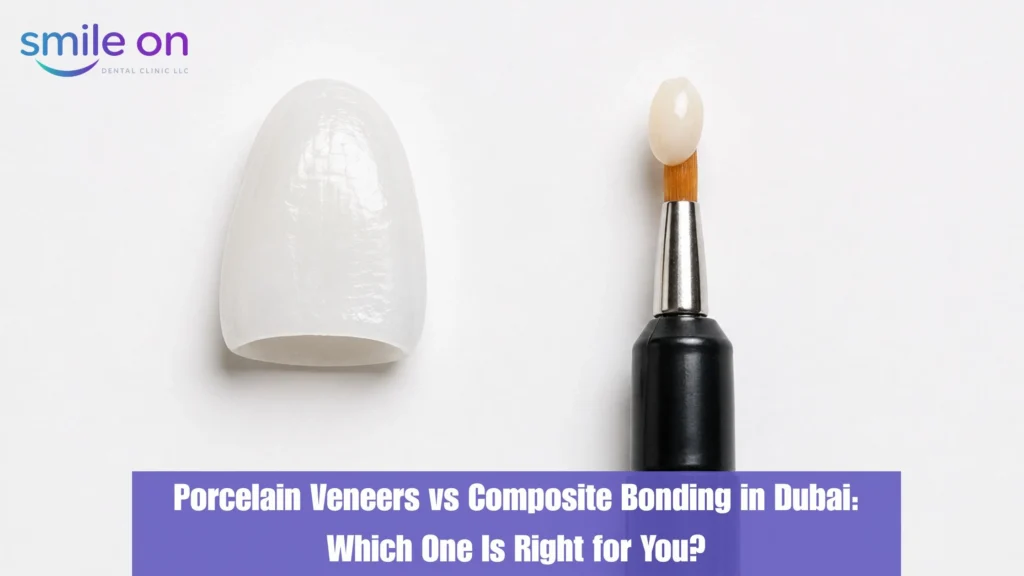
6 min read Share: Porcelain veneers and composite bonding are both legitimate cosmetic dental treatments that can dramatically improve how your smile looks. They are not interchangeable options they serve different cases, carry different costs, and involve very different levels of commitment to your natural teeth. The problem is that most Dubai clinic websites describe both treatments in glowing terms without telling you when one genuinely outperforms the other. This guide does that instead. Honest criteria, real trade-offs, and a clear framework for deciding which one makes sense for your specific situation. What Each Treatment Actually Is Porcelain veneers are thin ceramic shells typically 0.3 to 0.7mm thick custom-fabricated in a dental laboratory to precise specifications for your teeth. Each veneer is bonded to the front surface of a prepared tooth. To accommodate the veneer’s thickness, a thin layer of natural enamel is permanently removed from the tooth surface before bonding. The result is fixed, highly durable, and colour-stable over many years. Composite bonding uses a tooth-coloured resin material applied directly to your tooth in the dental chair. The dentist builds it up by hand in layers, sculpts it to the desired shape, hardens it with a UV curing light, and polishes it to a natural finish. No laboratory is involved. In most cosmetic bonding cases, no enamel is removed the resin is applied on top of your existing tooth surface. Both treatments change how your teeth look. The material, process, permanence, and cost are fundamentally different. Head-to-Head Comparison Porcelain Veneers Composite Bonding Material Ceramic (lab-fabricated) Composite resin (chair-side) Appointments needed 2–3 (consultation, prep, fit) 1–2 Enamel removal Yes — irreversible Usually none Lifespan 12–18 years 4–7 years Stain resistance Excellent Moderate (can stain over time) Repairability Cannot be patched — full replacement if damaged Repairable chair-side Reversibility No — enamel removal is permanent Yes — can be removed without damage Cost per tooth (Dubai) AED 2,000 – AED 4,500 AED 600 – AED 1,800 Best for Full arch, dramatic colour change, long-term investment Isolated repairs, younger patients, conservative cases Cost Comparison: What You’ll Actually Pay in Dubai Cosmetic dental treatment is priced per tooth in Dubai, which means the total cost scales with how many teeth you’re treating. Composite Bonding Cost in Dubai: A single tooth starts from around AED 600 for a minor repair. Full treatment of six upper front teeth typically runs AED 4,500–AED 10,000 depending on the extent of reshaping per tooth and the clinic. Porcelain Veneers Cost in Dubai: A single porcelain veneer typically costs AED 2,000–AED 4,500 depending on the material (e-max vs zirconia vs feldspathic porcelain) and the clinic’s overhead. Six upper veneers therefore runs AED 12,000–AED 27,000. Full upper and lower veneer treatment (10–16 teeth) can reach AED 25,000–AED 45,000+. The honest cost calculation isn’t just today’s price. If composite bonding needs replacing after five to six years (which it typically does for full arch treatment), the total ten-year cost can match or exceed porcelain veneers. For isolated one or two tooth repairs, composite is almost always the more economical choice even accounting for the occasional touch-up. When Porcelain Veneers Are the Right Choice Porcelain veneers make the most clinical and financial sense when: You’re treating six or more teeth and want uniformity. Composite resin’s ability to maintain a consistent colour and translucency across multiple teeth diminishes over time as staining develops at slightly different rates. Porcelain stays consistent. You need a dramatic colour change. If your natural teeth are significantly discoloured particularly tetracycline staining or intrinsic discolouration porcelain veneers can achieve a complete colour transformation that composite cannot sustain long-term. You want a 15-year result, not a five-year result. For patients who want to make the investment once and not revisit it for over a decade, porcelain is the appropriate material. You’re committed to the treatment. Porcelain veneers are not reversible. The enamel removed during preparation cannot grow back, so the teeth will always need to be covered. If you’re comfortable with that long-term commitment, porcelain offers the best durability. You’re planning a full smile makeover. For Hollywood Smile cases involving eight or more teeth, porcelain veneers are the standard material of choice among specialist cosmetic dentists in Dubai. When Composite Bonding Is the Right Choice Composite bonding is the better clinical decision when: The problem is isolated to one or two teeth. A chip, a gap between two front teeth, a slightly shorter tooth these are exactly the cases composite bonding was designed for. The result is seamless, the appointment is the same day, and no healthy enamel is touched. You’re under 25 and want to preserve your options. Removing enamel for veneers is permanent. For younger patients whose aesthetic preferences may evolve, starting with reversible composite bonding preserves the choice to upgrade later without having already committed to permanent tooth preparation. Your budget doesn’t support porcelain right now. Composite bonding can deliver a genuinely excellent cosmetic result for significantly less money. It is not a compromise treatment in the right hands and for the right case, composite bonding looks exceptional. You want the result today. No laboratory involvement means no two-to-three-week wait between appointments. Most composite bonding cases are completed in a single session. Your case is conservative. If the underlying teeth are healthy and structurally sound, starting with a treatment that doesn’t require their preparation is almost always the more sensible clinical choice. Can You Combine Both Treatments? Yes, and in practice many smile makeover cases at Smile On Dental Clinic do exactly this. Porcelain veneers on the upper front six teeth combined with composite bonding on less prominent teeth, or composite bonding to close a gap while the patient decides whether to proceed to a full veneer case these are common, practical approaches that balance aesthetics, cost, and clinical conservation. The key is that the treatment plan should be driven by your teeth and your goals, not by which treatment the clinic is more set up to sell. Questions to Ask at Your Consultation Before you
Wisdom Tooth Extraction Cost in Dubai: What to Expect Before, During, and After
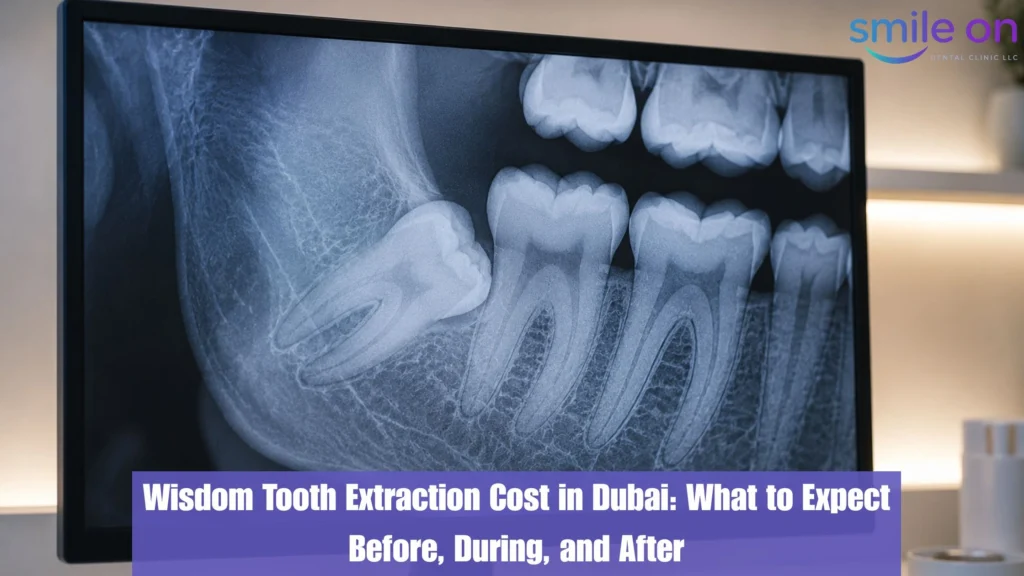
5 min read Share: Wisdom tooth pain has a way of making dental decisions urgent. Most people searching for extraction costs in Dubai aren’t browsing casually they’re in discomfort, they’ve been told the tooth needs to come out, and they want to know what they’re getting into and what it’s going to cost before they book anywhere. This guide gives you straight answers. What the procedure involves, what determines the price in Dubai, the difference between a simple extraction and a surgical one, and what the recovery actually looks like without the clinical language that makes it harder to understand than it needs to be. Why Wisdom Teeth Cause Problems Wisdom teeth are the third molars the last teeth to erupt, typically between the ages of 17 and 25. Because they arrive last, there often isn’t enough space for them to emerge properly. When they can’t come through fully, they become “impacted” either trapped under the gum, partially erupted, or growing at an angle that pushes against the adjacent molar. Impacted wisdom teeth cause problems in several predictable ways: recurring infection in the gum tissue around the partially erupted tooth, decay on the adjacent second molar, cyst formation around an unerupted tooth, or persistent jaw pain that’s difficult to locate without an X-ray. Not every wisdom tooth needs to come out. Fully erupted, properly aligned wisdom teeth that can be cleaned effectively are fine to leave. The decision to extract should be based on a proper clinical assessment and X-ray not just because the tooth exists. Simple vs Surgical Extraction: What’s the Difference? This distinction matters because it’s the biggest single factor in what you’ll pay. Simple extraction applies to a wisdom tooth that has fully erupted above the gumline, is accessible, and can be removed with forceps in a straightforward procedure. It typically takes 20–40 minutes, requires only local anaesthetic, and has a relatively quick recovery. Surgical extraction is required when the tooth is impacted partially or fully submerged in the gum or jawbone, growing at an angle, or positioned in a way that makes simple removal impossible. The oral surgeon makes a small incision in the gum, may need to section the tooth into pieces for removal, and closes the site with dissolvable sutures. This takes longer, involves more post-operative care, and costs more. The type of extraction you need is determined by your X-ray, which is why a dental assessment before quoting is essential. Any clinic quoting you a price for wisdom tooth removal without seeing your X-ray is guessing. Wisdom Tooth Extraction Cost in Dubai: What to Expect Prices in Dubai in 2026 typically fall within these ranges: Extraction Type Approximate Cost Per Tooth Simple extraction (erupted tooth) AED 400 – AED 900 Surgical extraction (partially impacted) AED 900 – AED 2,000 Surgical extraction (fully impacted/bony) AED 1,500 – AED 3,000 All four wisdom teeth (surgical, combined) AED 4,000 – AED 9,000 What is typically included: What is often charged separately: Always ask for a written cost breakdown that covers all of the above before proceeding. A clinic that can’t give you a clear itemised quote before the procedure isn’t well-organised enough to be trusted with the procedure itself. What to Expect on the Day Most wisdom tooth extractions at a competent Dubai clinic are far less dramatic than patients expect. Here’s the actual sequence. Local anaesthetic is administered around the affected area. You will feel pressure during the procedure but not pain. If you feel sharp pain at any point, you tell the dentist immediately —you should always be adequately numb before the procedure begins. For a simple extraction: The dentist loosens the tooth using an elevator instrument, then removes it with forceps. The socket is cleaned and you bite on gauze for 20–30 minutes to control initial bleeding. For a surgical extraction: An incision is made in the gum to expose the tooth and any surrounding bone. The tooth may be divided into sections to allow safer removal. The site is thoroughly cleaned, and dissolvable sutures close the incision. The whole procedure typically takes 45 minutes to an hour for a complex impacted tooth. Sedation options are available for patients who experience significant dental anxiety. IV sedation allows you to remain conscious but fully relaxed and amnesiac you won’t remember the procedure. This is arranged in advance and requires someone to drive you home. Recovery: What Actually Happens After Extraction Recovery from wisdom tooth extraction in Dubai is broadly predictable. The first 48–72 hours are the most uncomfortable; after that, most patients return to normal activity. The first 24 hours: Some bleeding is normal and controlled with gauze pressure. Swelling begins and peaks around day 2–3. Rest, keep your head elevated, and avoid strenuous activity. Do not rinse forcefully, use a straw, or smoke — all of these disturb the blood clot forming in the socket, which is how “dry socket” (a painful complication) develops. Days 2–5: Swelling is at its peak around day 2–3 then gradually reduces. Soft foods, gentle saltwater rinses from day 2 onwards, and prescribed pain relief and antibiotics if given. Most people with desk jobs return to work within 2–3 days; physical jobs may require 4–5 days. After one week: Dissolvable sutures begin to dissolve. Most patients feel largely normal. A follow-up appointment checks that healing is progressing without infection. Dry socket occurs when the blood clot is dislodged before the socket heals, leaving nerve and bone exposed. It causes intense, identifiable pain 3–5 days after extraction that is distinctly worse than normal post-procedure soreness. It is treatable contact your clinic immediately if you think this is happening rather than waiting. What Patients in Sharjah and Abu Dhabi Should Know Wisdom tooth extraction prices in Sharjah are generally similar to Dubai, sometimes modestly lower. Patients in Abu Dhabi sometimes travel to Dubai for specialist oral surgery, particularly for complex impacted cases requiring a maxillofacial surgeon. The same advice applies regardless of emirate: the type of impaction determines the
Hollywood Smile Cost in Dubai: What You Actually Pay and What It Includes
6 min read Share: The term “Hollywood Smile” gets used constantly in Dubai dental marketing, but it rarely comes with a straight answer on what it actually costs or what the treatment involves. Price quotes you’ll find online range from AED 10,000 to well over AED 40,000 for what appears to be the same treatment. That range isn’t deceptive it reflects genuinely different materials, scope of work, and levels of clinical planning. This guide breaks down what a Hollywood Smile makeover actually consists of, what drives the cost up or down in Dubai, what questions to ask before you commit to any clinic, and what realistic results look like. What Is a Hollywood Smile Makeover? A Hollywood Smile is not a single treatment. It is a full smile redesign a combination of cosmetic procedures planned and delivered together to transform the appearance of your teeth from multiple angles simultaneously. Depending on the starting point of your teeth and the result you want, a Hollywood Smile makeover at a Dubai clinic will typically involve some combination of: Porcelain veneers on the upper front six to ten teeth (sometimes lower teeth too) thin ceramic shells bonded to the front surface of each tooth, custom-made to shape, size, and colour specification. Teeth whitening either before veneers are placed on the remaining natural teeth, or as a standalone treatment if fewer veneers are involved. Composite bonding sometimes used in combination with or instead of veneers for less severe cases or specific teeth. Gum contouring if the gum line is uneven or sits too low or high, reshaping it is often part of the overall plan to make the smile look balanced. Digital Smile Design (DSD) a planning tool used in more thorough makeovers where your facial proportions, lip line, and tooth dimensions are mapped digitally to design the result before any preparation begins. This is not universal across clinics, but it meaningfully reduces the risk of a result that looks unnatural. The combination used depends on your specific teeth, the result you want, and the clinical assessment from your dentist. A quote from any clinic should specify exactly what’s included not just say “Hollywood Smile.” What Determines the Cost of a Hollywood Smile in Dubai? Several variables pull the final price significantly in either direction. Number of Teeth Treated The single biggest cost driver. A six-veneer upper arch treatment costs very differently from ten upper and eight lower veneers. Most patients treat six to eight upper front teeth. The quote must specify how many teeth are being treated. Veneer Material Full porcelain (e-max or zirconia) veneers offer the most natural translucency, the strongest durability, and the longest lifespan typically 15 years or more with proper care. These sit at the higher end of the cost range. Composite veneers (direct bonding applied chair-side) cost significantly less and can be completed in one appointment, but they stain more easily over time and typically last four to seven years before needing replacement. Some clinics quote “Hollywood Smile” using composite and some using porcelain these are not the same investment. Whether Digital Smile Design Is Included Digital Smile Design adds planning time and technology to the process. Clinics that include it in the package will charge more, but it significantly reduces the chance of a result that doesn’t suit your face or looks artificial. It is worth asking whether DSD is part of the package before comparing prices. Preparatory Work Required If you need gum contouring, pre-treatment teeth cleaning, or any extractions before veneers can be placed, these are often priced separately. If you have existing crowns, fillings, or misaligned teeth that need addressing before the cosmetic work begins, expect additional cost. Clinic Location and Overhead Clinics in DIFC, Downtown Dubai, and Palm Jumeirah carry higher overheads, which is reflected in pricing. Clinics in Al Satwa and Jumeirah typically offer the same materials and clinical quality at a more accessible price point, particularly for patients who have done their research and know what to look for. Realistic Price Ranges for Dubai in 2026 Treatment Scope Approximate Range 6 upper composite veneers AED 6,000 – AED 12,000 6 upper porcelain (e-max) veneers AED 12,000 – AED 20,000 8–10 upper porcelain veneers AED 18,000 – AED 30,000 Full upper and lower porcelain AED 28,000 – AED 45,000+ These ranges are indicative. Your actual cost depends on every factor above, confirmed in a proper clinical consultation. What Realistic Hollywood Smile Results Look Like The name “Hollywood Smile” implies the ultra-bright, perfectly uniform look associated with American celebrity dentistry. That aesthetic is achievable but it is not the only result, and for many patients it is not the right result. A well-executed smile makeover should look like your teeth, improved not like someone else’s teeth placed in your mouth. The size, shape, and shade of the veneers should be proportional to your facial features, skin tone, and lip line. Veneers that are too wide, too long, or too white for a patient’s face look cosmetically obvious, which is the opposite of what most people want. The clinics doing this work well will show you what you’re getting before any preparation begins either through a wax mock-up placed over your existing teeth in the chair, or through a Digital Smile Design simulation that maps your actual facial proportions. If a clinic is willing to start prep without showing you a preview first, slow down. Ask to see real patient before and after cases from the clinic not images sourced from veneer manufacturers or stock libraries. The cases should look like people with real faces, not advertisements. What to Confirm Before Booking a Hollywood Smile Consultation Before committing to a deposit at any clinic, get clear answers to these questions: How many teeth are included in this quote? The number is non-negotiable information it must be stated in writing. What material are the veneers made from? Composite vs porcelain is a fundamental difference in longevity, aesthetics, and cost. Both are legitimate; neither should
How Much Do Braces Cost in Dubai? A Full Price Comparison for 2026
10 min read Share: Orthodontic braces in Dubai cost between AED 5,000 and AED 25,000 for a full course of treatment. That range reflects the difference between standard metal braces for a straightforward case and custom lingual braces for a complex one. Invisalign falls somewhere in the middle at AED 7,000 to AED 18,000 depending on the number of aligners required. Those numbers are useful as a starting point, but what actually determines where you land on that spectrum? And more practically, how do you compare quotes from different clinics without getting confused by what is included versus what gets charged on top? This guide covers the real cost of every type of braces available in Dubai in 2026, what drives the price up or down, what to look for in a quote, and how to get the most value out of your investment. Braces Cost in Dubai: The Complete Breakdown Here is a realistic price comparison for every type of orthodontic braces available in Dubai, based on current market rates across clinics in Jumeirah, Al Satwa, Bur Dubai, and Dubai Marina. Braces Type Cost Range (AED) Treatment Time Visibility Best For Metal braces 5,000 to 10,000 12 to 24 months Visible Complex cases, children, budget-conscious adults Ceramic braces 7,000 to 13,000 12 to 24 months Low (tooth-coloured) Adults wanting fixed braces with reduced visibility Damon braces (self-ligating) 8,000 to 14,000 10 to 22 months Low to moderate Patients wanting fewer adjustment visits, more comfort Lingual braces 15,000 to 25,000 12 to 30 months Invisible (behind teeth) Professionals, public-facing roles, complete discretion Invisalign 7,000 to 18,000 6 to 18 months Nearly invisible Mild to moderate cases, lifestyle flexibility Invisalign First (kids) 6,000 to 12,000 6 to 18 months Nearly invisible Children age 6 to 10 with early alignment issues These are total treatment costs, not per-arch prices. However, what is included varies by clinic. The section below on evaluating quotes will help you compare accurately. Metal Braces: AED 5,000 to AED 10,000 Metal braces remain the most reliable, most versatile, and most affordable orthodontic option. Modern metal brackets are significantly smaller and lower-profile than the ones you might remember from the early 2000s. They handle the widest range of case complexity, including severe crowding, deep overbites, crossbites, and open bites that other systems struggle with. The cost difference within the range comes down to case complexity (a mild spacing case requires fewer appointments than a severe crowding case with bite correction), the bracket system used (standard twin brackets versus self-ligating), and the clinic’s location and overheads. Metal braces are the default recommendation for children and teenagers. They are durable, effective, and straightforward. For adults on a budget who are comfortable with visible braces, they also provide excellent value. Ceramic Braces: AED 7,000 to AED 13,000 Ceramic braces use the same mechanical system as metal braces but with brackets made from tooth-coloured ceramic or clear composite material. From a normal conversational distance, they are significantly less noticeable. The functional difference is minimal. The aesthetic difference is meaningful. The cost premium over metal braces reflects the material cost of ceramic brackets and slightly more careful handling required during adjustments (ceramic is harder but more brittle than steel). Ceramic brackets can stain if you consume large amounts of coffee, tea, turmeric, or red wine. The elastic ligatures holding the wire in place are particularly prone to discolouration between adjustment appointments. If you want the clinical reliability of fixed braces with reduced visual impact, ceramic is the established compromise. Damon Braces: AED 8,000 to AED 14,000 Damon braces use a self-ligating bracket design that eliminates the need for elastic ties. A built-in slide mechanism holds the archwire, reducing friction as teeth move. This translates to potentially faster treatment for certain case types, fewer adjustment visits (every 8 to 10 weeks rather than every 4 to 6 weeks with conventional braces), and a generally more comfortable experience with less tightness after adjustments. Damon braces are available in both metal and clear versions. The clear Damon brackets combine the self-ligating efficiency with a more discreet appearance. At Smile On Dental Clinic, Damon braces are one of the fixed orthodontic options offered under Dr. Jeffrey Manuel’s care. The cost premium over standard metal braces is justified by the bracket technology and the reduced total number of clinical visits required over the treatment period. Lingual Braces: AED 15,000 to AED 25,000 Lingual braces are bonded to the back surfaces of the teeth, making them completely invisible from the front. They are the only fixed orthodontic option that offers genuine invisibility during the entire treatment period. The significantly higher cost reflects three factors. First, the brackets are custom-fabricated for every individual tooth, which involves lab fees and precision manufacturing. Second, lingual orthodontics is more technically demanding, requiring specialised training and more chair time per appointment. Third, fewer orthodontists in Dubai offer lingual treatment compared to labial (front-surface) options, which limits supply. Lingual braces suit professionals in client-facing roles, public speakers, media personalities, and anyone for whom visible orthodontic hardware during treatment is genuinely unacceptable. There is a one-to-three-week speech adaptation period as the tongue adjusts to the brackets on the inner surfaces. Invisalign: AED 7,000 to AED 18,000 Invisalign uses a series of custom-made, removable clear plastic trays to move teeth incrementally. Each tray is worn for one to two weeks before advancing to the next. The trays are nearly invisible when worn and are removed for eating, brushing, and flossing. The cost range is wide because Invisalign offers tiered packages based on complexity. Invisalign Lite (for minor adjustments) uses fewer trays and costs AED 7,000 to AED 10,000. Invisalign Comprehensive (for moderate to complex cases requiring more trays and longer treatment) runs AED 12,000 to AED 18,000. Invisalign’s clinical effectiveness has improved substantially. For mild to moderate crowding, spacing, and certain bite corrections, outcomes are comparable to fixed braces. For complex cases involving significant bite correction, vertical tooth movement, or rotation of round-rooted premolars, fixed braces remain