Most orthodontists recommend a child’s first orthodontic check around age 7. At that age the adult front teeth and first molars are coming through, so problems with jaw growth, bite and crowding can be spotted early. Not every child needs treatment at 7, but an early check means you know whether to act now, wait and monitor, or plan braces later. When early treatment is needed, the main options are Myobrace, Invisalign First and traditional braces, and each suits a different age and problem.
This guide explains when your child should see an orthodontist, the signs to look out for, and how Myobrace, Invisalign First and braces compare.
Wondering if your child needs orthodontic treatment?
Book an orthodontic check with our specialist team at Smile On Dental Clinic, Al Satwa. Pediatric consultation AED 150.
When should a child first see an orthodontist?
Around age 7 is the recommended time for a first orthodontic check. By then most children have a mix of baby and adult teeth, which lets an orthodontist judge how the jaws are growing and whether the adult teeth will have enough room.
The first visit is usually just an assessment. In most cases, the outcome is one of three:
- No treatment needed, with routine check-ups as normal
- Monitor growth and review every six to twelve months
- Early (interceptive) treatment to guide jaw growth or correct a habit while the child is still growing
Starting at the right time can make later treatment shorter and simpler, and in some cases avoid the need for extractions or more complex braces as a teenager.
Signs your child may need an orthodontist
Book an orthodontic check if you notice any of these:
- Crowded, overlapping or crooked teeth, or adult teeth coming through behind baby teeth
- Large gaps between teeth
- Front teeth that stick out, or lower teeth that sit in front of the upper teeth
- A bite where the teeth do not meet properly, such as an open bite at the front or a crossbite at the side
- Mouth breathing, especially at night, or snoring
- Thumb or finger sucking beyond age 5
- Tongue thrusting, where the tongue pushes against the teeth when swallowing or speaking
- Losing baby teeth very early or very late
- Difficulty chewing or jaw clicking
Habits like mouth breathing, thumb sucking and tongue thrusting matter because they can affect how the jaws grow and where the teeth end up.
Myobrace vs Invisalign First vs braces: how they compare
| Myobrace | Invisalign First | Traditional braces | |
|---|---|---|---|
| Typical age | Around 5 to 12 | Around 6 to 10, with a mix of baby and adult teeth | Usually 11 and up, once most adult teeth are in |
| What it does | Corrects habits such as mouth breathing and tongue thrusting that affect jaw growth | Clear aligners that expand the arches and straighten the front teeth early | Brackets and wires that move each tooth precisely |
| How it is worn | Removable, worn 1 to 2 hours a day plus overnight | Removable, worn about 20 to 22 hours a day | Fixed, worn all the time |
| Visibility | Worn mostly at home and at night | Nearly invisible | Visible, though ceramic options are less noticeable |
| Child’s involvement | Needs daily exercises and consistent wear | Needs consistent wear | No daily effort to wear, but extra cleaning |
| Price at Smile On | AED 2,500 | Price on consultation | Metal braces from AED 1,000 for installation |
Myobrace: correcting the cause early
Myobrace is a removable appliance combined with simple daily exercises. It is designed to correct the habits behind many orthodontic problems, such as mouth breathing, tongue thrusting and incorrect swallowing, so that the jaws can develop properly and the adult teeth have more room. Children wear it for an hour or two during the day and while they sleep.
It works best in younger children, while the jaws are still growing, and it relies on the child wearing it consistently and doing the exercises. At Smile On, Myobrace treatment costs AED 2,500 and is managed by Dr. Minu Mumtaz O.V. and our orthodontic team. Read more on our Myobrace for kids page.
Invisalign First: clear aligners for younger children
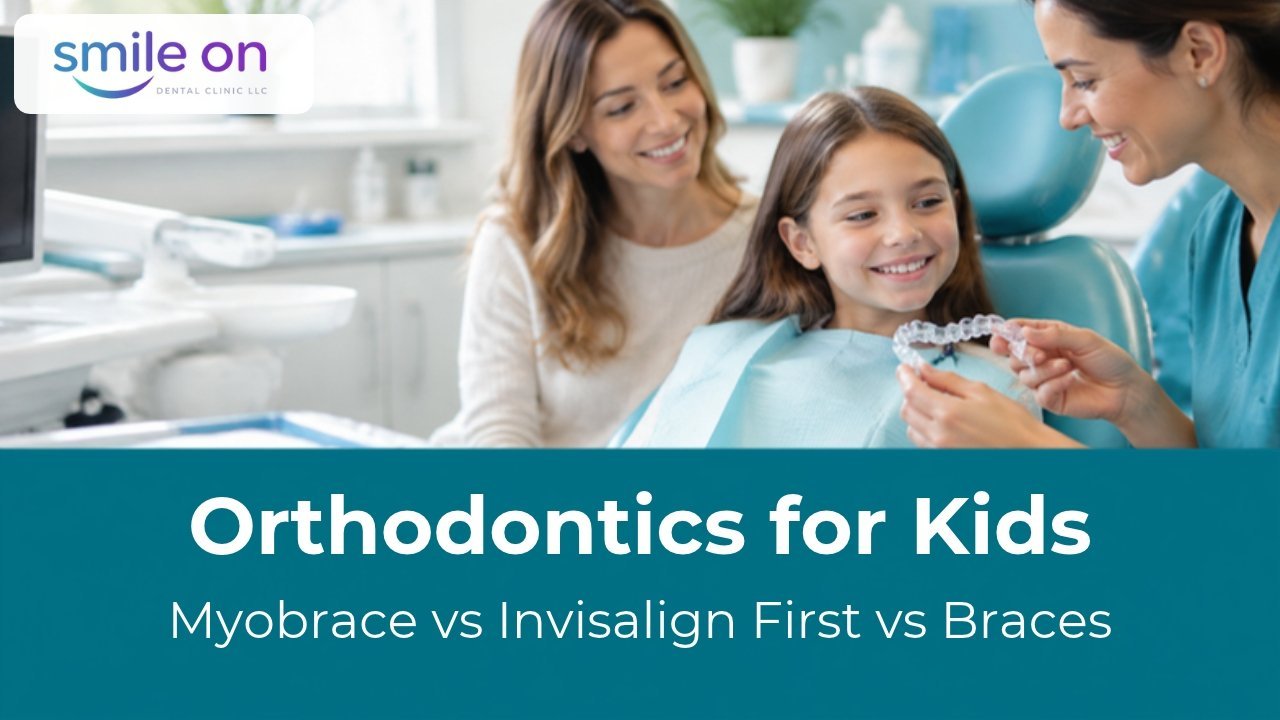
Invisalign First is a version of Invisalign designed for children who still have a mix of baby and adult teeth. The clear aligners can widen narrow arches to make space for incoming adult teeth and straighten front teeth that are coming through crooked. Because they are removable, children can eat normally and brush and floss easily, which helps keep teeth healthy during treatment.
It suits children who will wear the aligners for most of the day and are happy to follow the routine. Invisalign First at Smile On is planned by Dr. Jeffrey Manuel, our Specialist Orthodontist, and is priced on consultation after an assessment. Find out more on our Invisalign First page.
Traditional braces: the standard option for older children
Once most of the adult teeth have come through, usually from around age 11, traditional braces become the main option for straightening teeth and correcting the bite. They are fixed, so they work all the time without relying on the child remembering to wear them, and they can handle a wide range of problems. Ceramic (tooth-coloured) braces are available for a less noticeable look.
Some children have early treatment with Myobrace or Invisalign First first, then a shorter course of braces or aligners as a teenager. At Smile On, metal braces start from AED 1,000 for installation. See our metal and ceramic braces page for more.
How to choose the right option for your child
The right choice depends on your child’s age, which teeth have come through, what is causing the problem, and how well they will manage a removable appliance. As a rough guide:
- Habits like mouth breathing or tongue thrusting, in a younger child: Myobrace is often the starting point
- Narrow arches or crowded front teeth in a child with mixed teeth: Invisalign First may suit
- Most adult teeth in, with crowding or bite problems: braces or Invisalign are usually recommended
The best way to know is an orthodontic assessment, where the specialist checks your child’s teeth, jaw growth and habits and explains what, if anything, needs doing now.
What happens at your child’s orthodontic check
At Smile On, a first orthodontic check for a child is relaxed and child-friendly. The specialist looks at the teeth and bite, checks how the jaws are growing, asks about habits such as thumb sucking or mouth breathing, and may take X-rays or photos if needed. You leave with a clear explanation and, if treatment is recommended, a plan with costs. A pediatric consultation is AED 150.
If your child is nervous about dental visits, our guide on how to keep your child calm during their first dental visit has practical tips.
Give your child’s smile the right start
Book an orthodontic check at Smile On Dental Clinic in Al Satwa, Dubai. Myobrace, Invisalign First and braces under one roof. Open daily, 9am to 9pm.
Frequently Asked Questions
At what age should my child see an orthodontist?
Around age 7 is recommended for a first orthodontic check. Many children will not need treatment yet, but an early check shows whether to treat now, monitor growth, or plan treatment later.
What is the difference between Myobrace and Invisalign First?
Myobrace corrects habits such as mouth breathing and tongue thrusting that affect jaw growth, and is worn for a couple of hours a day plus overnight. Invisalign First uses clear aligners worn most of the day to widen the arches and straighten teeth in children with a mix of baby and adult teeth.
How much does Myobrace cost in Dubai?
At Smile On Dental Clinic in Al Satwa, Myobrace treatment costs AED 2,500.
Is Invisalign First better than braces for children?
It depends on the child’s age and problem. Invisalign First suits younger children with mixed teeth who will wear aligners consistently. Braces are usually better for older children once most adult teeth are in, or for more complex bite problems.
Does early orthodontic treatment mean my child will not need braces later?
Not always. Early treatment can make later treatment shorter and simpler, or sometimes avoid it, but some children still need a short course of braces or aligners as teenagers.
Can thumb sucking affect my child’s teeth?
Yes. Thumb or finger sucking beyond around age 5 can push the front teeth forward and affect how the jaws develop. An orthodontic check can show whether it has caused changes that need correcting.