Quick answer: An endodontist is a dentist with two to three extra years of specialist training in root canals and tooth pain. You should see one in Dubai if a root canal has failed, the tooth has curved or blocked canals, you have a cracked tooth, or you have been told the tooth must come out. Specialist root canal treatment in Dubai typically costs AED 1,500 to AED 4,000 for a molar and AED 2,500 to AED 5,000 for retreatment.
Key takeaways
- Most simple root canals can be done well by a general dentist. Complex cases are where a specialist makes the difference.
- An endodontist can often save a tooth another dentist has recommended removing.
- A 2010 systematic review found 86% to 93% of root-treated teeth were still in place 2 to 10 years later.
- Saving your own tooth with a root canal and crown usually costs less than replacing it with an implant.
- In Dubai, check that the clinician is DHA licensed as a Specialist Endodontist, not only a dentist who offers root canals.
Tooth pain or a root canal that has not settled?
Book an assessment with our Specialist Endodontist, Dr. Arun Devarajan, at Smile On Dental Clinic in Al Satwa, Dubai. Same-day appointments for acute pain where possible.
What Is an Endodontist?
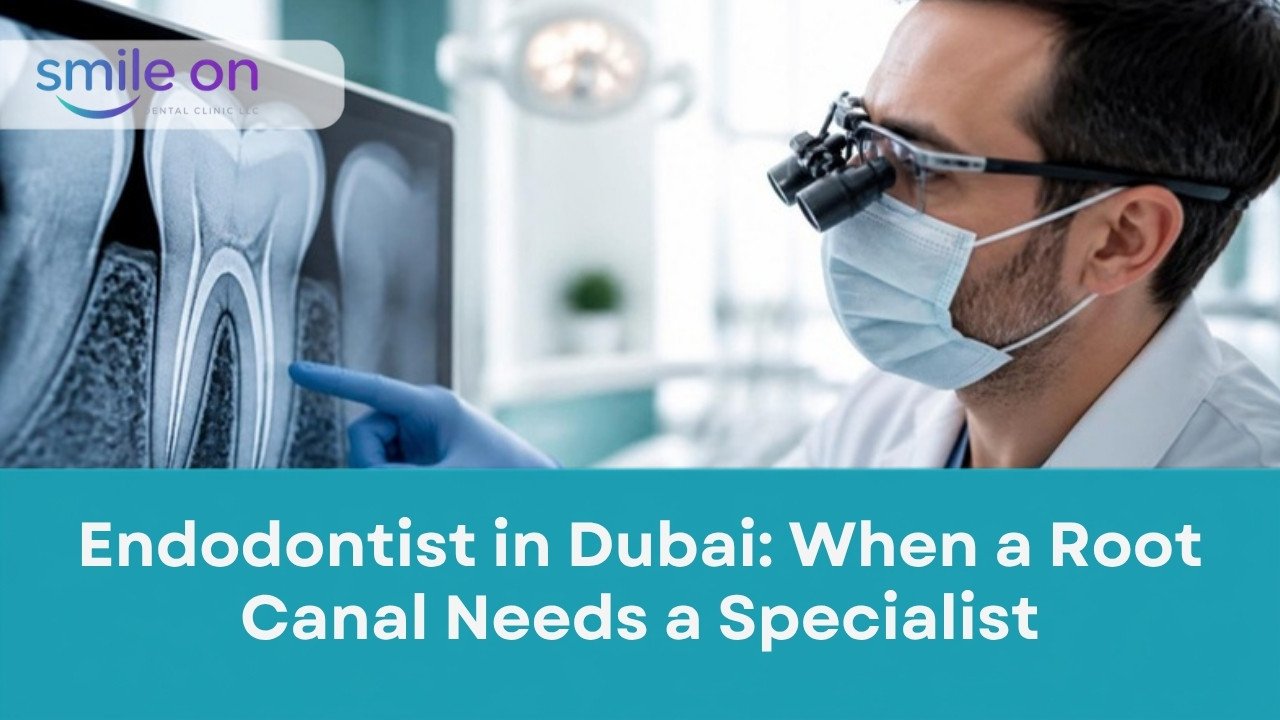
An endodontist is a dental specialist who diagnoses and treats problems inside the tooth: the pulp, the nerve, and the root canals. After dental school, an endodontist completes two to three more years of postgraduate training focused entirely on root canal treatment, tooth pain, and saving teeth.
In Dubai, a Specialist Endodontist holds a specialist licence from the Dubai Health Authority (DHA). A general dentist can also perform root canals, and many do simple cases very well. The difference is that an endodontist spends their whole working week on this one area, so they see far more of the difficult cases.
Endodontist vs General Dentist: What Is the Difference?
The main difference is training and focus. Both can treat a simple root canal. An endodontist is the one to see when the case is complex or has already failed once.
| General dentist | Specialist Endodontist | |
|---|---|---|
| Training after dental school | None required for root canals | 2 to 3 years of specialist training |
| Typical root canal cases | Front teeth and straightforward premolars | Molars, curved or blocked canals, retreatment |
| Failed root canals | Often refers on | Core part of their work |
| Root-end surgery (apicoectomy) | Rarely performed | Performed in suitable cases |
| Imaging | Standard X-rays | X-rays plus 3D CBCT for complex anatomy |
| Diagnosing unclear tooth pain | Initial assessment | Specialist diagnosis of cracks and hidden canals |
If your dentist suggests a referral, it is not a sign that something has gone wrong. It usually means they want the best chance of saving the tooth.
When Should You See an Endodontist?
You should see an endodontist when a root canal is likely to be difficult, when an earlier one has failed, or when the cause of tooth pain is unclear. These are the most common reasons for referral:
- A root canal that has failed. Pain, swelling, or infection returning months or years after treatment
- Molar teeth. Back teeth have three or four canals, sometimes more, and some are hard to find
- Curved, narrow, or blocked canals. Common in older patients and teeth with large old fillings
- A cracked tooth. Pain when biting or releasing, which can be hard to pinpoint
- Tooth pain with no obvious cause. Sensitivity or aching that a normal X-ray does not explain
- Dental trauma. A tooth that has been knocked, chipped to the nerve, or pushed out of place
- You have been told to extract the tooth. A specialist opinion can often find a way to save it
- Infection that will not clear. Where root-end surgery may be needed
What an Endodontist Can Do That Saves Teeth
Endodontists offer a small set of treatments, all aimed at keeping your natural tooth.
Root canal treatment. The infected or inflamed pulp is removed, the canals are cleaned and shaped, and the tooth is sealed. At Smile On, this is done with rotary nickel-titanium instruments and digital X-rays, and most cases take one or two visits. Our root canal treatment page explains the steps.
Root canal retreatment. If a previous root canal has failed, the old filling material is removed, the canals are cleaned again, and any missed canal is found and treated. Missed or poorly cleaned canals are a common reason first treatments fail.
Apicoectomy (root-end surgery). When infection persists at the tip of the root despite treatment, a small procedure under local anaesthetic removes the root tip and the infected tissue and seals the end of the root. It is usually completed in one appointment.
Cracked tooth and trauma assessment. An endodontist can work out whether a crack has reached the nerve, whether the tooth can be saved, and what kind of treatment or crown will protect it.
How Much Does Specialist Root Canal Treatment Cost in Dubai?
Root canal treatment in Dubai typically costs AED 800 to AED 2,000 for a front tooth and AED 1,500 to AED 4,000 for a molar. Retreatment of a failed root canal usually costs AED 2,500 to AED 5,000. A crown to protect the tooth afterwards is charged separately.
| Treatment | Typical Dubai range (AED) | Notes |
|---|---|---|
| Front tooth (1 canal) | 800 to 2,000 | Usually the simplest case |
| Premolar (1 to 2 canals) | 1,200 to 2,500 | Depends on canal shape |
| Molar (3 to 4 canals) | 1,500 to 4,000 | Most common specialist case |
| Retreatment (any tooth) | 2,500 to 5,000 | Removing old material adds time |
| Apicoectomy | Quoted after assessment | Depends on the tooth and access |
| Crown after root canal | 1,500 to 3,500 | Strongly advised for back teeth |
| CBCT 3D scan, if needed | 300 to 600 | Used for complex anatomy |
At Smile On Dental Clinic, you receive a full cost breakdown before any treatment starts. Root canal treatment is not cosmetic, so plans with dental cover often contribute to it. Check your policy, and ask our front desk about instalment options.
Root canal or implant: which costs more?
Saving the tooth is usually cheaper. A molar root canal and crown together typically cost AED 3,000 to AED 7,500 in Dubai. Removing the tooth and replacing it with a dental implant usually costs AED 4,500 to AED 8,000 or more, takes several months, and may need a bone graft. Your own tooth, when it can be saved, also feels and works the most naturally.
How Long Does a Root-Treated Tooth Last?
A well-treated and well-restored tooth can last for many years, often for life. A 2010 systematic review by Ng and colleagues found that 86% to 93% of root-treated teeth were still in place 2 to 10 years after treatment.
The same research group found that tooth survival was better when the tooth was restored with a permanent crown or onlay rather than left with a temporary filling. That is why a specialist will usually recommend a crown on a back tooth soon after the root canal is finished. Our dental crowns are designed by our prosthodontic team to protect the tooth from cracking.
What to Expect at a Specialist Endodontic Appointment
Your first visit is about finding the exact cause of the problem before any treatment starts.
- History and symptoms. When the pain started, what triggers it, and any past treatment on the tooth.
- Tests and imaging. Cold and bite tests, digital X-rays, and a 3D CBCT scan if the root anatomy is complex or the infection is unclear.
- Diagnosis and options. The endodontist explains whether the tooth can be saved, the success chances, and the alternatives, including extraction.
- Written quote. You receive the full cost, including any crown, before deciding.
- Treatment. Under local anaesthetic, usually in one or two visits. Most patients feel pressure rather than pain.
- Follow-up. A review X-ray at a later visit checks that the area around the root is healing.
Most people return to work the same day. Mild tenderness when biting for a few days is normal.
Typical Patient Scenarios
The failed root canal from years ago. A 45-year-old had a root canal on a lower molar eight years ago. The tooth has started to ache and a small gum boil has appeared. A CBCT scan shows a canal that was missed the first time. Retreatment cleans and seals it, and the tooth settles within weeks.
The tooth that was going to be extracted. A 52-year-old was told her upper premolar could not be saved. A specialist assessment finds the infection is at the root tip only. An apicoectomy keeps the tooth and avoids an implant.
The mystery pain. A 33-year-old has sharp pain when he bites on one side, but X-rays look normal. Testing finds a crack in a back tooth that has not yet reached the nerve. A crown placed early protects the tooth and avoids a root canal altogether.
Questions to Ask Before Choosing an Endodontist in Dubai
- Are you DHA licensed as a Specialist Endodontist? This can be checked on the DHA website.
- Will you use a CBCT scan for my tooth? It helps with molars, retreatment, and unclear pain.
- What are the realistic chances of saving this tooth? A good specialist will be honest when a tooth cannot be saved.
- Does the quote include the crown? Ask for the total cost of saving the tooth, not just the root canal.
- How many visits will it take, and what happens if pain returns?
Endodontics at Smile On Dental Clinic, Al Satwa
Smile On Dental Clinic is a DHA-licensed multi-specialty clinic on 2nd December Street in Al Satwa, close to Jumeirah, Sheikh Zayed Road, and Bur Dubai. Our endodontics service is led by Dr. Arun Devarajan, our Specialist Endodontist, who treats complex root canals, retreatment of failed cases, calcified and curved canals, apicoectomy, and dental trauma. Treatment is planned with digital X-rays and CBCT 3D imaging where needed, and crowns are designed by our prosthodontic team so the tooth is protected for the long term. If you are anxious about treatment, sedation dentistry is available. You can also read our guide to root canal treatment in Dubai for the full procedure.
Book a specialist endodontic assessment
Smile On Dental Clinic, Al Satwa, Dubai. Clear diagnosis, honest advice on whether the tooth can be saved, and a written quote. Call 04 347 2102 or WhatsApp 055 896 1826.
Frequently Asked Questions
What is the difference between an endodontist and a dentist?
An endodontist is a dentist who has completed two to three extra years of specialist training in root canal treatment and tooth pain. General dentists can treat simple root canals, while endodontists handle complex cases, failed treatments, and root-end surgery.
Do I need a referral to see an endodontist in Dubai?
No. You can book directly with a Specialist Endodontist. Your general dentist may also refer you if they think the case is complex.
How much does an endodontist charge for a root canal in Dubai?
Root canal treatment in Dubai typically costs AED 800 to AED 2,000 for a front tooth and AED 1,500 to AED 4,000 for a molar. Retreatment usually costs AED 2,500 to AED 5,000. A crown is charged separately.
Can an endodontist save a tooth another dentist said to extract?
Often, yes. Many teeth recommended for extraction because of infection or a failed root canal can be saved with retreatment or an apicoectomy. A specialist will tell you honestly if the tooth cannot be saved.
Is a root canal by an endodontist painful?
It is done under local anaesthetic, so most patients feel pressure rather than pain. Mild tenderness when biting for a few days afterwards is normal. Sedation is available for anxious patients.
How long does a root canal take with a specialist?
Most root canals take one or two visits of about 60 to 90 minutes each. Retreatment and complex molars can take longer.
What is an apicoectomy?
An apicoectomy is minor surgery under local anaesthetic to remove the tip of a root and the infected tissue around it. It is used when infection persists after a root canal and is usually done in one appointment.
Is a root canal better than an implant?
When the tooth can be saved, a root canal and crown is usually cheaper, quicker, and keeps your natural tooth. An implant is the better option when the tooth is badly cracked or cannot be restored.
Sources
- Ng YL, Mann V, Gulabivala K. Tooth survival following non-surgical root canal treatment: a systematic review of the literature. International Endodontic Journal, 2010;43(3):171-189.
- Ng YL, Mann V, Gulabivala K. A prospective study of the factors affecting outcomes of non-surgical root canal treatment: part 2: tooth survival. International Endodontic Journal, 2011;44(7):610-625.