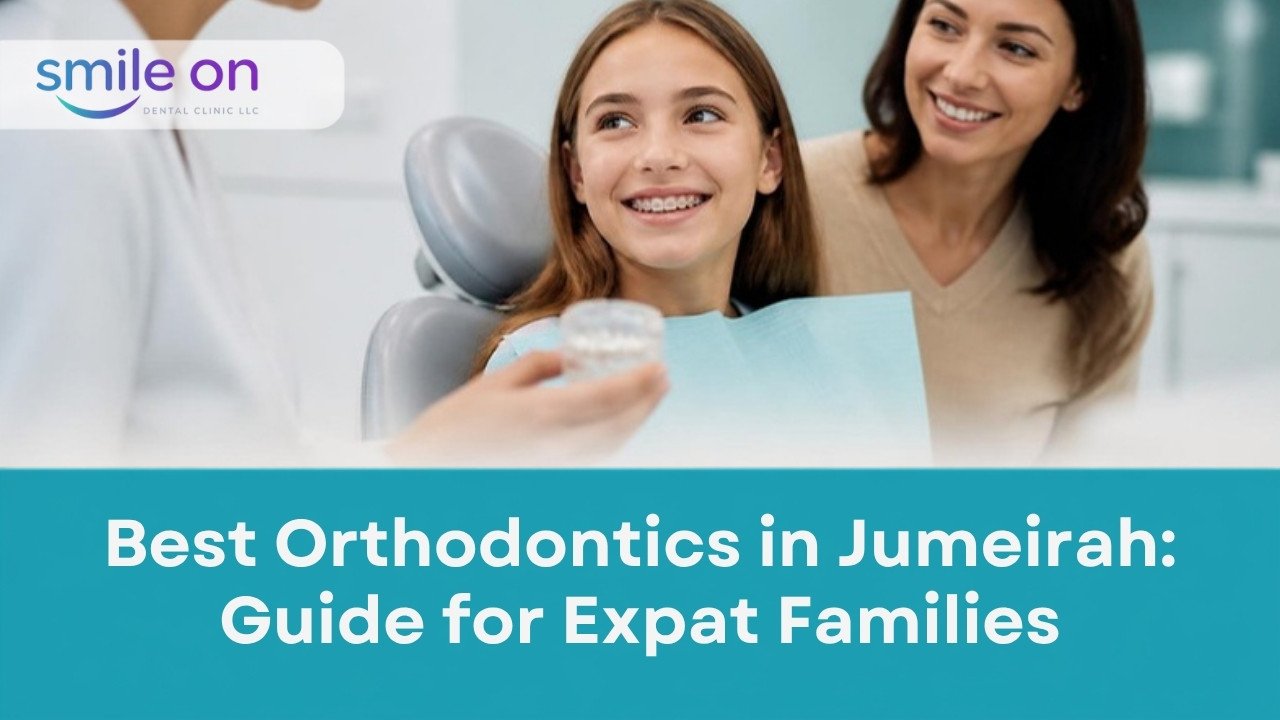
Quick answer: The best orthodontic care for a Jumeirah family is a clinic where a DHA-licensed Specialist Orthodontist plans treatment around your child’s growth stage. Children should have a first check by age 7. In Dubai, early treatment such as Myobrace costs about AED 3,000 to AED 6,000, and teen braces or Invisalign usually cost AED 5,000 to AED 20,000.
Key takeaways
- The American Association of Orthodontists recommends a first orthodontic check no later than age 7.
- Most children do not need treatment at 7. The check is about timing, so problems are caught while the jaw is still growing.
- Treatment often happens in two phases: early growth guidance at 6 to 10, then braces or aligners once the adult teeth are in.
- Expat families should plan around school holidays, home-leave travel, and the chance of moving before treatment ends.
- Ask whether the clinician treating your child is a registered Specialist Orthodontist, not only a certified aligner provider.
Not sure if your child needs an orthodontist yet?
Book a children’s orthodontic check at Smile On Dental Clinic in Al Satwa, a short drive from Jumeirah. Our Specialist Orthodontist, Dr. Jeffrey Manuel, will tell you honestly whether to treat now, later, or not at all.
What “Best Orthodontics” Means for a Family
For a family, the best orthodontic clinic is the one that gets the timing right for each child, not the one with the most advertising. A seven-year-old with a crossbite, a twelve-year-old with crowding, and a parent who wants discreet aligners need very different plans, and ideally the same team should be able to see all three.
Three things matter most. First, a DHA-licensed Specialist Orthodontist should diagnose and plan the treatment. Any dentist can become a certified aligner provider, but a specialist has completed several extra years of training in how teeth and jaws grow. Second, the clinic should treat children often, because planning for a growing face is different from planning for an adult. Third, the clinic should be honest about when to wait. Starting too early can mean longer, more expensive treatment for no extra benefit.
At Smile On Dental Clinic, children’s orthodontic cases are planned by Dr. Jeffrey Manuel, our Specialist Orthodontist, with early habit-correction treatment managed alongside our Specialist Pediatric Dentist, Dr. Hashmit Kaur.
When Should Your Child First See an Orthodontist?
Your child should have a first orthodontic check no later than age 7. This is the recommendation of the American Association of Orthodontists. By this age most children have a mix of baby and adult teeth, which is enough for an orthodontist to see how the bite and jaws are developing.
A check at 7 does not mean braces at 7. For most children, the orthodontist will simply monitor growth and see them again in 6 to 12 months. The value of the visit is catching the smaller group of problems that are much easier to fix while the jaw is still growing.
Book a check sooner if you notice:
- Baby teeth lost much earlier or later than other children the same age
- Crowded, overlapping, or widely spaced front teeth
- Upper teeth that sit behind the lower teeth (a crossbite)
- The jaw shifting to one side when your child bites
- Mouth breathing, snoring, or a lisp
- Thumb or finger sucking after age 5
- Difficulty chewing or frequent cheek biting
Orthodontic Treatment by Age
Orthodontic treatment for children usually follows the stage of tooth and jaw development rather than a fixed age. This table shows what typically happens at each stage.
| Age | Stage | Common treatment | Main goal |
|---|---|---|---|
| Around 7 | First check | Monitoring, sometimes no treatment at all | Spot problems early and plan timing |
| 6 to 10 | Mixed teeth (Phase 1) | Myobrace, Invisalign First, palatal expanders | Guide jaw growth, correct habits and crossbites |
| 11 to 15 | Most adult teeth in (Phase 2) | Metal, ceramic, or Damon braces, Invisalign for Teens | Straighten teeth and correct the bite |
| 15 to 18 | Late teens | Braces or Invisalign, retainers | Finish alignment before growth stops |
| Adults | Growth complete | Braces, Invisalign, lingual braces | Straighten teeth, often around existing dental work |
Phase 1 and Phase 2 Treatment Explained
Phase 1 is early treatment while a child still has baby teeth. Phase 2 is full treatment once the adult teeth have come through. Not every child needs both, and many need neither.
Phase 1 (around 6 to 10 years). The aim is to guide growth, not to make the teeth perfectly straight. Examples include widening a narrow upper jaw, correcting a crossbite, or retraining mouth breathing and tongue habits with an appliance such as Myobrace. Phase 1 can make later treatment shorter and simpler, and in some cases removes the need for it.
Phase 2 (usually 11 to 15 years). Once most adult teeth are in, braces or aligners move each tooth into its final position and fine-tune the bite. This is what most people picture when they think of orthodontics. Teenage years are a good time for it because growth is still active, which helps bite correction.
A good orthodontist will explain clearly why a child needs Phase 1 now rather than waiting. If the answer is vague, ask for a second opinion.
How Much Does Children’s Orthodontic Treatment Cost in Dubai?
Children’s orthodontic treatment in Dubai usually costs AED 3,000 to AED 6,000 for early Myobrace treatment and AED 5,000 to AED 20,000 for full braces or aligners. These are the ranges at Smile On Dental Clinic. The final figure depends on the appliance, how complex the case is, and how long treatment takes.
| Treatment | Typical age | Approximate cost at Smile On (AED) | Typical length |
|---|---|---|---|
| Myobrace | 6 to 10 | 3,000 to 6,000 | 12 to 24 months |
| Invisalign First | 6 to 10 | 10,000 to 16,000 | Varies by case |
| Metal braces | 11+ | 5,000 to 10,000 | 12 to 24 months |
| Ceramic braces | 11+ | 7,000 to 13,000 | 12 to 24 months |
| Damon braces | 11+ | 8,000 to 14,000 | 10 to 22 months |
| Invisalign for Teens | 11 to 17 | 12,000 to 20,000 | Varies by case |
What should be included. Ask for a written quote that covers all adjustment visits, any replacement aligners, emergency repairs, and the retainer at the end. At Smile On, our Invisalign quotes include progress appointments and the final retainer.
Insurance. Many UAE health plans exclude orthodontic treatment or cap it at a low amount, and cover for children varies widely between policies. Check your policy before treatment, and ask our front desk to help with any claim paperwork.
Paying over time. Most families spread the cost across the treatment. Payment plans are available at Smile On, so ask about them at your consultation.
Braces or Invisalign for Teenagers?
Both work well for most teenagers. The right choice depends on the bite problem and on how reliably your teenager will wear aligners.
| Factor | Braces (metal, ceramic, Damon) | Invisalign for Teens |
|---|---|---|
| Best for | Complex bites, rotations, cases needing precise control | Mild to moderate crowding and spacing |
| Wear | Fixed, so they work 24 hours a day | Must be worn 20 to 22 hours a day |
| Appearance | Visible, though ceramic is tooth coloured | Almost invisible |
| Food | Avoid hard and sticky foods | Removed for meals |
| Sport | Mouthguard needed for contact sports | Removed for sport, mouthguard still advised |
| Main risk | Plaque around brackets if brushing is poor | Slow progress if aligners are left out |
If your teenager often forgets things or plays a lot of contact sport, fixed braces are usually the safer choice. If they are organised and self-conscious about their smile, aligners can be a better fit. Our guide to Invisalign vs braces in Dubai compares the two in more detail.
What Expat Families Should Plan For
Expat families face practical questions that local guides rarely cover. Plan for these before treatment starts.
Moving before treatment ends. Many families in Dubai relocate within two or three years. If a move is possible, tell the orthodontist at the first visit. Braces can usually be continued by another orthodontist abroad, but they may change the appliance or charge their own fees. Ask for full records to take with you, including scans, X-rays, photographs, and the treatment plan. Aligners can be easier to transfer between countries because the plan is digital.
Summer and home-leave travel. Long summer trips are common for Dubai families. Braces need adjusting every 6 to 8 weeks, so plan visits before and after you travel. With aligners, ask for extra sets to take with you, and pack the previous set as a backup in case one is lost.
School term timing. Fitting braces at the start of the summer holiday gives children time to adjust to the soreness and new eating habits before school starts. Short reviews can usually be booked after school hours.
Retainers after you leave. Retainers keep teeth straight for life. Before you move, make sure your child has a spare retainer and knows how often to wear it.
Typical Family Scenarios
These examples show how treatment decisions usually go for families in Jumeirah and nearby areas.
The seven-year-old with a crossbite. A parent notices their son’s jaw shifts sideways when he bites. A check confirms a crossbite caused by a narrow upper jaw. A short Phase 1 treatment widens the jaw while it is still growing, avoiding a more difficult correction in his teens.
The ten-year-old who breathes through her mouth. A daughter snores and keeps her mouth open during the day, and her front teeth are starting to crowd. Myobrace retrains her breathing and tongue posture over about 18 months, and the orthodontist reviews whether she still needs braces later.
The thirteen-year-old moving in two years. A family expects to relocate to the UK. The orthodontist recommends Invisalign for Teens, because the digital plan and aligner sets are simpler to transfer, and provides a full records pack before the move.
The parent who wants treatment too. A mother who wore braces as a teenager has seen her teeth drift. She starts clear aligners at the same time as her son starts braces, so the family visits together.
Questions to Ask an Orthodontist in Jumeirah
Ask these at any consultation, including ours.
- Is the clinician treating my child a DHA-licensed Specialist Orthodontist? This can be checked on the DHA website.
- Does my child need treatment now, or can we wait? Ask what would happen if you waited 12 months.
- What exactly is included in the quote? Check adjustments, replacements, emergency repairs, and retainers.
- What happens if we move abroad mid-treatment? Ask about records and how transfers are handled.
- How often will we need appointments, and are after-school slots available?
- What happens if a bracket breaks or an aligner is lost?
Orthodontics at Smile On Dental Clinic, Near Jumeirah
Smile On Dental Clinic is a DHA-licensed multi-specialty clinic on 2nd December Street in Al Satwa, a short drive from Jumeirah 1, Jumeirah 2, and Jumeirah 3. Children’s orthodontic cases are planned by Dr. Jeffrey Manuel, our Specialist Orthodontist and Medical Director, and early habit treatment is managed with our Specialist Pediatric Dentist. We offer the full range in one clinic: Myobrace, Invisalign First, metal and ceramic braces, Damon braces, Invisalign, and retainers. That means siblings and parents can all be treated by the same team. You can see our full range of orthodontic treatments in Dubai.
Book a family orthodontic consultation
Smile On Dental Clinic, Al Satwa, Dubai, close to Jumeirah. One visit gives you a clear plan for each child and a written quote. Call 04 347 2102 or WhatsApp 055 896 1826.
Frequently Asked Questions
What age should my child first see an orthodontist?
By age 7, as recommended by the American Association of Orthodontists. Most children will not need treatment then, but the check shows whether the bite and jaws are developing normally and when treatment, if any, should start.
How much do braces cost for children in Dubai?
At Smile On Dental Clinic, metal braces cost about AED 5,000 to AED 10,000 and ceramic braces about AED 7,000 to AED 13,000. Early treatment with Myobrace costs about AED 3,000 to AED 6,000. You receive a written quote after the consultation.
Is Invisalign suitable for children?
Yes. Invisalign First is designed for children aged 6 to 10, and Invisalign for Teens suits most teenagers. It works best for children who will reliably wear aligners for 20 to 22 hours a day.
What is Phase 1 orthodontic treatment?
Phase 1 is early treatment, usually between ages 6 and 10, that guides jaw growth and corrects habits such as mouth breathing. It can make later braces shorter or unnecessary. Not every child needs it.
Can we continue braces if we move abroad?
Usually yes. Another orthodontist can take over treatment, although they may change the appliance or charge their own fees. Tell your orthodontist about a possible move at the start, and ask for a full set of records before you leave.
Does insurance cover children’s orthodontics in the UAE?
It depends on the policy. Many UAE plans exclude orthodontics or cap it at a low amount. Check your policy before treatment starts and ask the clinic to help with claim paperwork.
How long does orthodontic treatment take for teenagers?
Most teenagers wear braces or aligners for 12 to 24 months, followed by retainers. Complex bite problems can take longer.
Do I need a referral to see an orthodontist in Dubai?
No. You can book a consultation with a Specialist Orthodontist directly. Your general dentist may still suggest a check if they notice a problem.
Sources
- American Association of Orthodontists. Orthodontics for Children: Developing a Healthy Smile. aaoinfo.org.