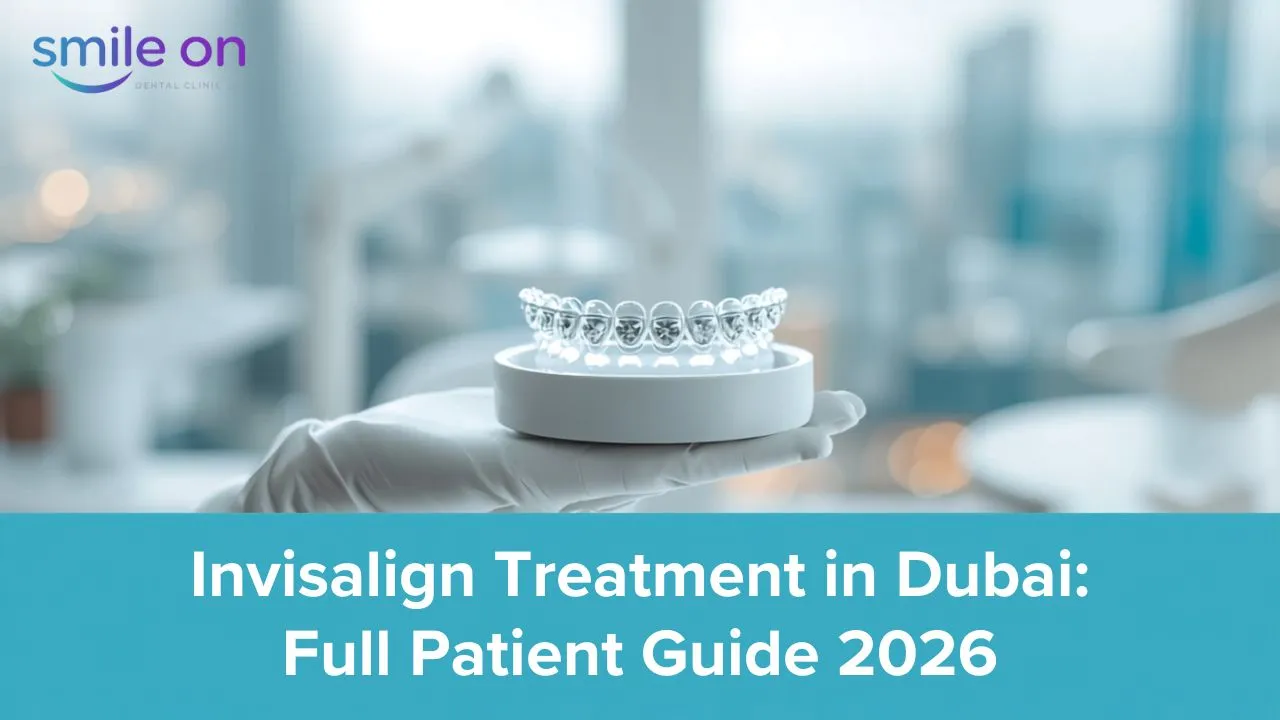
Invisalign Treatment in Dubai — Full Patient Guide 2026
7 min read Share: Invisalign is the most popular orthodontic treatment in Dubai for adults and teenagers who want to straighten their teeth without metal brackets or wires. If you’re considering it, you likely already know the basic concept. What’s less clear is what the treatment actually looks like from start to finish: what happens at each appointment, how long each stage takes, what your daily routine looks like for months in between, and what it actually feels like to live with aligners through a Dubai summer, travel, and client meetings. This guide walks through Invisalign treatment in Dubai step by step, from the first consultation to the retention phase. All information reflects how treatment is delivered at Smile On Dental Clinic in Al Satwa, Dubai, under the supervision of Dr. Jeffrey Manuel, Specialist Orthodontist and Medical Director. Dr. Jeffrey Manuel is a DHA-licensed specialist orthodontist and a certified Invisalign provider. He has practised in the UAE since 2008 and personally reviews and plans every Invisalign case at Smile On before aligners are manufactured. How Invisalign Treatment Works Invisalign moves your teeth using a series of custom-made, removable clear plastic aligners. Each set is worn for one to two weeks, applying gentle and controlled pressure to shift teeth a small amount at a time. Simple cases might involve 20 to 30 sets. Complex cases can require 50 or more. The aligners are made from SmartTrack material. No wires, no brackets, no monthly tightening appointments. Step 1: Initial Consultation and 3D Scan Your treatment starts with a clinical assessment covering a physical examination of your teeth, bite, and jaw; a review of existing dental work; and a 3D digital scan using iTero technology. The scan builds a precise digital model of your teeth and generates a Smile Simulation, an animation showing how your teeth are expected to look after treatment, before any aligners are ordered. For a full pricing breakdown by case type, see our Invisalign cost guide for Dubai and UAE. Step 2: The ClinCheck Treatment Plan After your scan, Dr. Jeffrey Manuel submits your case to Align Technology, who produce a ClinCheck: a detailed 3D simulation mapping every planned tooth movement from start to finish. You review the ClinCheck with Dr. Manuel at a follow-up appointment and can ask questions about specific movements. Once approved, Align Technology fabricates your aligner series, a process that typically takes two to three weeks. Step 3: Receiving Your Aligners When your aligners arrive, Dr. Manuel checks the fit of your first sets, places attachments if your plan requires them, and walks you through the daily routine. Attachments are small, tooth-coloured composite bumps bonded to specific teeth to help aligners achieve movements that smooth plastic alone cannot manage. Not every case needs them. Who This Fits: Real Patient Scenarios From Dubai The professional who cannot have a visibly different smile at work. Client-facing roles, on-camera work, and frequent presentations make discretion a genuine priority, not a vanity concern. Invisalign is close to invisible at conversation distance, and most colleagues never notice unless told. This is the single most common reason working adults in Dubai choose aligners over fixed braces. The adult with a relapsed teenage orthodontic result. Patients who wore braces years ago and stopped wearing their retainer often see mild crowding return over time. These cases look simple but frequently involve subtle rotation that a careful ClinCheck review catches and a rushed one misses, which is where a specialist orthodontist’s eye matters even on what looks like a minor case. The patient juggling frequent travel. Dubai’s business travel culture means many patients are on planes monthly. Aligners handle this well since there is no appointment dependency between visits the way there is with fixed braces, though switching to a new set a day or two off schedule due to travel does not meaningfully affect the outcome as long as you get back on track quickly. Step 4: Wearing Your Aligners, the Daily Routine The 20 to 22 hour rule. Aligners must be worn for 20 to 22 hours each day. Falling below this regularly causes teeth to stop tracking correctly, extending your treatment or requiring additional aligner series. What you remove them for. Remove aligners before eating or drinking anything other than plain water. Hot drinks distort the plastic. Food and sugary drinks trapped against the aligner surface accelerate decay. Cleaning your aligners. Rinse with cool water when you remove them. Clean with a soft toothbrush and clear soap, not toothpaste, which clouds the plastic over time. Switching sets. Most patients move to a new set every week. Follow the plan. Switching too early means the current aligner has not completed its planned movement. Managing discomfort. Each new set creates noticeable pressure for the first two to three days. Over-the-counter pain relief manages it for most patients. Step 5: Progress Check Appointments You will see Dr. Manuel every six to eight weeks throughout treatment. These 20 to 30 minute appointments verify teeth are tracking correctly, check attachment integrity, and answer your questions. If a tooth is not tracking as planned, Dr. Manuel adjusts the approach early, which is far simpler than addressing it at the end of treatment. Step 6: Refinements Refinements are additional aligner series produced when your original series is complete but teeth have not fully reached the planned position. They are common and not a sign something went wrong. If refinements are needed, a new iTero scan is taken, a new ClinCheck produced, and a short additional series manufactured, adding four to twelve weeks to your timeline. Whether refinements are included in your original fee is worth confirming in writing before you start. Step 7: Retention Treatment ends when your teeth reach the planned position. Retention begins immediately. Teeth have a biological tendency to drift toward their original positions, and retainers prevent this long term. After Invisalign at Smile On, options typically include clear plastic retainers, worn full-time initially and then nightly, and fixed bonded retainers. Our guide to
Invisalign in Abu Dhabi vs Dubai — What’s the Difference?
6 min read Share: If you are based in Abu Dhabi and researching Invisalign treatment, at some point you will ask whether it is worth making the trip to Dubai. It is a reasonable question. Both cities have multiple certified Invisalign providers, but there are real differences in the provider landscape, cost ranges, specialist availability, and practical treatment experience. This guide is written for patients in Abu Dhabi who want an honest comparison, not a sales pitch for either city. What matters is where you get the best outcome for your specific case, with a provider who is the right fit, at a cost that is fair. If you are looking for Invisalign in Abu Dhabi and wondering whether Dubai offers better options, read on. Invisalign treatment at Smile On Dental Clinic in Al Satwa, Dubai, is led by Dr. Jeffrey Manuel, Specialist Orthodontist and Medical Director, a graduate of A.B. Shetty Memorial Institute of Dental Sciences who has practised orthodontics in the UAE since 2008. The Provider Landscape: Dubai vs Abu Dhabi Dubai has a significantly larger number of Invisalign-certified providers than Abu Dhabi. Align Technology’s published provider data consistently shows Dubai with more Diamond and Platinum certified providers than any other city in the Middle East. Diamond status is awarded to practices completing 100 or more cases per year; Platinum requires 50 or more. Higher case volume generally correlates with greater experience across a broader range of complexity. That said, volume alone does not mean better clinical care. A Platinum provider who specialises in orthodontics and genuinely understands tooth movement will produce better outcomes than a Diamond provider who uses Invisalign as one treatment among dozens without deep specialist expertise. Abu Dhabi has a growing number of certified providers, particularly in areas like Al Reem Island, Khalidiyah, and near Cleveland Clinic Abu Dhabi. The pool is smaller than Dubai’s but includes some well-credentialled practices. The specialist distinction, whether the treating doctor is a specialist orthodontist with postgraduate training or a general dentist who is also Invisalign-certified, is the more important variable between cities. Who This Fits: Real Patient Scenarios From Abu Dhabi The patient with a complex bite case. Someone with a genuine overbite or crossbite alongside crowding benefits most from a specialist orthodontist’s ClinCheck planning, regardless of which city that specialist practises in. If a local Abu Dhabi consultation has not clearly explained the bite mechanics of the plan, a second opinion from a Dubai specialist is often worth the drive for a case this involved. The patient with straightforward mild crowding. A small gap or minor rotation on the front teeth is a case most certified providers, in either city, can handle competently. For this group, proximity and an Abu Dhabi provider they already trust is a perfectly reasonable choice, and the travel to Dubai is not clinically necessary. The patient who works in Dubai but lives in Abu Dhabi. Many professionals who commute already pass through Dubai regularly for work, which removes the travel objection entirely. For this group, timing Invisalign appointments around an existing commute is often more convenient than finding time for a separate trip from Abu Dhabi specifically for dental care. Cost Comparison: Abu Dhabi vs Dubai Invisalign pricing in both cities sits in the same general range, but Dubai’s more competitive market tends to produce a wider spread with more options at the mid-market level. Case Type Abu Dhabi Range (AED) Dubai Range (AED) Invisalign Lite (minor correction) 8,000 to 14,000 7,000 to 12,000 Invisalign Moderate 12,000 to 18,000 10,000 to 16,000 Invisalign Comprehensive 15,000 to 22,000 12,000 to 20,000 These are indicative 2026 ranges. Final cost depends on case assessment, the provider’s tier, what is included in the fee, and clinic location within each city. Pricing in Abu Dhabi has historically run slightly higher for equivalent treatment, partly because the competitive pressure from Dubai’s larger provider pool keeps prices lower across the market. What Is Clinically the Same in Both Cities Invisalign is a branded product manufactured by a single company, Align Technology. The aligner material (SmartTrack), the ClinCheck treatment planning software, and the fabrication process are identical regardless of where the treatment happens. A ClinCheck approved by a specialist orthodontist in Dubai produces the same quality of aligners as one approved in Abu Dhabi. Clinical outcome quality is driven almost entirely by the treating doctor: their orthodontic expertise, how carefully they plan the ClinCheck, how actively they manage tooth tracking through the process, and how they handle refinements when needed. The city itself has no bearing on that variable. Practical Considerations for Abu Dhabi Patients Travel time to Dubai. Depending on where you are based in Abu Dhabi, the trip to Al Satwa, Dubai takes between 75 and 120 minutes each way. For a treatment that requires an appointment every six to eight weeks, this adds up to four to eight trips over the course of a typical 12 to 18 month case. For many patients this is manageable, especially if the Dubai provider has a significantly higher level of expertise or if a specialist’s input genuinely justifies the travel. The key decision point. Is the Dubai provider meaningfully better for your specific case? If you are managing a complex bite issue or a case requiring specialist orthodontic input, the answer can genuinely be yes. If your case is straightforward mild crowding that any competent certified provider can handle, proximity and convenience are reasonable deciding factors. Financing and Payment Plans Whether you choose a Dubai or Abu Dhabi provider, most established clinics offer structured payment plans rather than requiring the full Invisalign fee upfront. A typical structure spreads payment across three or four milestones tied to your treatment progress, an initial payment at consultation, a second once the ClinCheck is approved, and the remainder across progress appointments. This is worth confirming with any provider you shortlist, since it is rarely advertised in detail and payment structures do vary between clinics in both cities. When Dubai Makes Sense for
Best Invisalign Dentist in Dubai — 5 Things to Check
8 min read Share: Dubai has hundreds of Invisalign-certified providers. Searching for the best Invisalign in Dubai returns a mix of clinics, aggregator lists, and promotional pages that do not make your decision any easier. The better question is not which clinic has the best marketing. It is how to evaluate a provider before committing to 12 to 18 months of treatment and a fee that typically runs AED 8,000 to AED 18,000 or more. These five checks will cut through the noise. They apply whether you are comparing your first shortlist or reconsidering a quote you have already received. If you have been searching for the best Invisalign dentist in Dubai or the best Invisalign clinic in Dubai, this is the framework to use, followed by real scenarios of who tends to fit which kind of provider, and what to actually ask before you commit. Check 1: Specialist Orthodontist or General Dentist? This is the most important distinction, and the one most patients do not ask about. Any licensed dentist in Dubai can become a certified Invisalign provider by completing Align Technology’s training programme. That training covers the system: how to submit cases, use the ClinCheck software, and deliver aligners. It does not replace the three or more years of postgraduate specialist training that a specialist orthodontist completes after dental school. A specialist orthodontist’s entire professional focus is on tooth movement and bite correction. They understand how teeth respond to force, how to manage cases when tracking goes off plan, and how to recognise when a case is more complex than it first appears. For mild cases involving minor crowding or small gaps, a competent GP provider is a reasonable choice. For anything involving bite correction, overbite, underbite, crossbite, open bite, or for complex adult cases with existing dental work, a specialist orthodontist is the more reliable option. How to verify. Ask directly whether the treating doctor is a DHA-licensed specialist orthodontist. The DHA public website allows verification. The license will specify “Specialist, Orthodontics” if relevant. At Dr. Jeffrey Manuel’s practice, this is confirmed both on the clinic’s doctor page and on his DHA registration, and worth checking for any provider you are considering, not just this one. Who This Fits: Real Patient Scenarios in Dubai The adult with mild crowding who wants the fastest, most affordable route. Someone with minor spacing or slight crowding on the front teeth, no bite issues, and no history of previous orthodontic work is often a straightforward Invisalign Lite case. A competent GP-certified provider handles this comfortably, and there is no strong clinical reason to insist on a specialist orthodontist for a case this simple, though a specialist will still do it well. The adult with a previous orthodontic relapse. Patients who wore braces as a teenager and stopped wearing retainers often see their teeth drift back years later. These cases look mild on the surface but frequently involve subtle rotation the untrained eye misses. A specialist orthodontist is better placed to read the relapse pattern accurately and plan a ClinCheck that actually corrects it rather than partially masking it. The patient managing a bite issue alongside crowding. Anyone with an overbite, underbite, crossbite, or open bite, even a mild one, benefits from a specialist’s assessment. Bite correction with clear aligners requires more nuanced force application than straightening alone, and a provider without deep orthodontic training is more likely to under-plan the case, leading to a result that looks fine cosmetically but does not resolve the underlying bite mechanics. Check 2: What Certification Level Means and What It Does Not Align Technology awards certification tiers based on case volume. Tier Cases Per Year Gold 25+ Platinum 50+ Diamond 100+ Diamond Plus / Black Diamond 200 to 400+ Higher certification means more cases completed, and more experience with a wider range of complexity is a reasonable inference from that. That said, a Diamond provider who is a general dentist working across multiple treatment types may have less orthodontic depth than a Platinum provider who is a specialist orthodontist and focuses primarily on alignment cases. Use certification as a baseline filter, not the deciding factor. A provider who is both a high-tier certified Invisalign provider and a specialist orthodontist is where both signals line up. Check 3: Does the Clinic Use an iTero Scanner? The iTero Element is the 3D digital intraoral scanner used in Invisalign treatment planning. It creates a precise digital model of your teeth in a few minutes, with no impression trays, no impression material, no discomfort. More importantly, the iTero scanner includes Outcome Simulator technology that shows you an animated prediction of how your teeth will look after treatment. You see the result before any aligners are ordered. This is the starting point for an informed patient decision. Clinics that still use physical impressions rather than digital scanning are working with less precise data, which can affect ClinCheck accuracy. If a clinic you are considering does not use iTero scanning, ask why and whether they use an alternative digital system. At Smile On Dental Clinic, iTero digital scanning is included at the initial consultation. Check 4: Who Reviews the ClinCheck, and How? The ClinCheck is the 3D simulation that maps every planned tooth movement in your case from start to finish. It is produced by Align Technology’s clinical team based on the scan data, but it requires review and modification by the treating doctor before aligners are manufactured. This is where cases succeed or fail. A ClinCheck that is not reviewed critically by an experienced orthodontist may contain planned movements the teeth will not actually make, or that will need multiple refinement rounds to correct. Ask at your consultation: will you show me the ClinCheck before the aligners are ordered, and can you explain what movements are planned and why. A provider who walks you through the ClinCheck at a dedicated review appointment is treating you as an informed patient. A provider who sends aligners without a ClinCheck review session
Transparent Braces in Dubai: Types, How They Work, and What to Expect
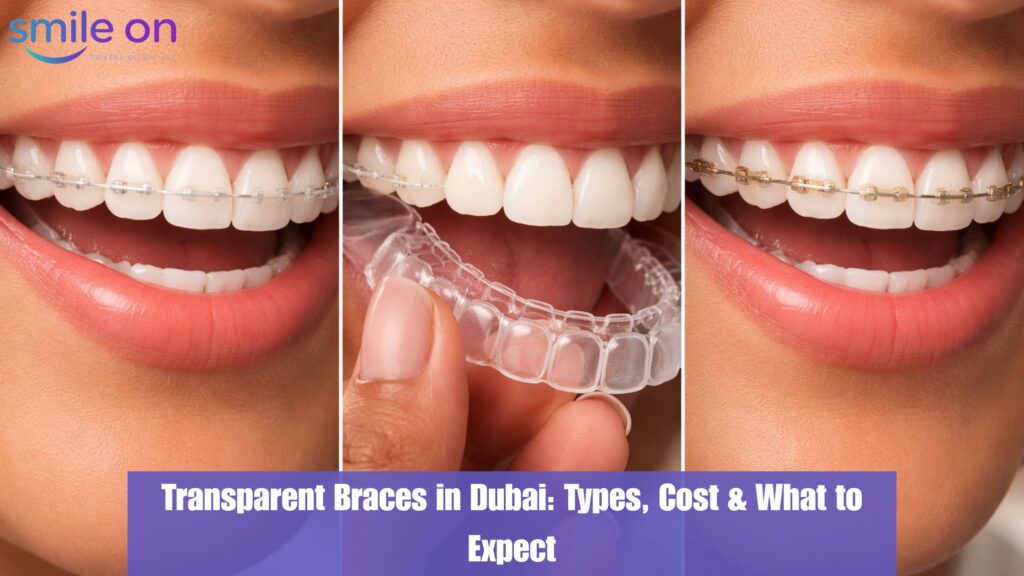
8 min read Share: If you have been putting off orthodontic treatment because you do not want a mouth full of metal, you are not alone. Most adults in Dubai who search for transparent braces already know they want straighter teeth. What they are not always clear on is that transparent braces is not a single product. It is a category that includes three genuinely different treatment types, each with distinct advantages, limitations, and price points. Understanding the difference before your consultation saves time and helps you ask better questions. What Are Transparent Braces and What Types Are Available? Transparent braces is a broad term that refers to any orthodontic system designed to be less visible than traditional metal brackets and wires. Within that category, there are three distinct options: Ceramic braces are fixed brackets and wires bonded to the front of the teeth, just like metal braces. The difference is that the brackets are made from tooth-coloured ceramic or clear composite material, making them significantly less noticeable than metal. They are still visible on close inspection but blend with the natural tooth colour from normal conversational distance. Lingual braces are fixed braces in the same mechanical sense, but the brackets and wires are bonded to the inside surfaces of the teeth, facing the tongue. From the outside, they are genuinely invisible. Nobody can see them when you speak, smile, or laugh. Clear aligners are removable, transparent plastic trays worn over the teeth to gradually shift them into alignment. They are classified as transparent braces because they are virtually invisible when worn correctly. Invisalign is the most widely known system in Dubai, though several alternatives including Spark and ClearCorrect are available. Each of these works differently, suits different clinical cases, and involves a different day-to-day experience. The right choice depends on what your teeth need corrected, how important complete invisibility is to you, and what lifestyle commitments you are prepared to make. Ceramic Braces: What They Are and Who They Suit Ceramic braces work exactly the same way as metal braces. Brackets are bonded to the front surfaces of the teeth and connected by an archwire that is periodically adjusted to move the teeth progressively into the correct position. The only material difference is the bracket itself, which is made from tooth-coloured ceramic or clear composite rather than stainless steel. The result is a bracket that blends with the natural enamel and is significantly less noticeable than metal, particularly from normal distances. Most ceramic braces also use white or tooth-coloured wires to reduce visibility further. Under close inspection or in certain lighting, they are visible. On a video call or across a conference table, most people would not notice them. Ceramic braces suit patients who need fixed orthodontic treatment but want a less conspicuous look than metal. They handle the same clinical complexity as metal braces, including moderate to severe crowding, bite correction, and rotation of teeth, which is a broader range than most clear aligner systems manage reliably. The main practical consideration is staining. The ceramic brackets themselves are stain-resistant, but the elastic ligatures holding the wire can pick up colour from coffee, tea, red wine, and certain foods. Regular appointments for adjustments manage this, but patients who consume a lot of staining drinks should be aware of it. At Smile On Dental Clinic, ceramic braces are available as a clear fixed option for patients who need the clinical strength of braces with reduced visual impact. The Damon brace system, which uses self-ligating technology to reduce friction and bracket bulk, is also available and provides a notably lower-profile result than traditional ceramic brackets. Lingual Braces: The Option Nobody Sees at All Lingual braces are the only fixed orthodontic treatment that is genuinely invisible from the outside. The brackets are custom-fabricated to fit the inside surface of each individual tooth, and the archwire runs along the back surfaces, facing the tongue. When you smile, speak, or open your mouth normally, nothing is visible. This makes lingual braces particularly well suited to professionals, public speakers, performers, and anyone for whom visible orthodontic hardware during treatment is not acceptable. They are also the right choice for patients who want the clinical reliability of fixed braces for complex corrections while maintaining complete aesthetic discretion. The trade-off is adjustment. Because the brackets are positioned close to the tongue, there is an initial adaptation period of one to three weeks during which speech may feel slightly different and the tongue needs time to adjust to the new contact points. Most patients move through this phase without lasting difficulty, but it is a genuine experience that ceramic braces and aligners do not create. Lingual braces are more technically demanding to place and adjust than front-surface braces, which means they are typically performed by orthodontists with specific training in the system. They are priced higher than both metal and ceramic braces as a result. Smile On Dental Clinic offers lingual braces as a discreet fixed treatment option. If complete invisibility during treatment is your priority and your case requires the control that only fixed braces can provide, lingual braces are the most appropriate choice. Clear Aligners: When They Count as Transparent Braces Clear aligners qualify as transparent braces because they are nearly invisible when worn. A properly fitted aligner tray sits snugly against the teeth and is visible only on very close inspection under direct light. In normal social, professional, and photographic contexts, most people will not notice them. The defining characteristic that separates aligners from ceramic and lingual braces is removability. Aligners come out for eating, drinking anything other than water, brushing, and flossing. This makes them the most lifestyle-compatible orthodontic option for most adults. There are no food restrictions and oral hygiene is not complicated by brackets and wires. The clinical trade-off is that removability creates a compliance dependency that fixed braces do not have. Aligners must be worn for twenty to twenty-two hours each day for treatment to progress as planned. Patients who
Clear Aligners: How They Work, What They Cost, and Whether They’re Right for You
7 min read Share: You have probably seen clear aligners advertised everywhere. Transparent trays, no metal, removable for meals, finished in months. The pitch is compelling. But before you book a consultation, it helps to understand what clear aligners actually do, what they genuinely cannot do, and what you are committing to when you say yes to treatment. This guide covers everything you need to make an informed decision. No fluff, no sales pressure. What Are Clear Aligners and How Do They Work? Clear aligners are a series of custom-made, transparent plastic trays worn over the teeth to gradually move them into a corrected position. Each tray is slightly different from the last, applying controlled pressure to specific teeth at specific points in the treatment plan. You wear each tray for one to two weeks before progressing to the next one in the series. The aligners are fabricated from digital scans of your teeth taken at your first appointment. An orthodontist or specialist dentist uses dedicated software to map out every planned tooth movement from your current position to the final result. You can typically see a simulation of the expected outcome before treatment begins. The most widely used clear aligner system is Invisalign, though multiple other systems are available in Dubai including Spark, ClearCorrect, and various branded alternatives. The underlying technology across systems is broadly similar. What differs is the material quality, precision of the treatment planning software, and the level of specialist oversight involved. Clear Aligners vs Traditional Braces: The Real Differences Both treatments move teeth using controlled force over time. The mechanism is the same. The experience is not. Visibility. Clear aligners are nearly invisible when worn correctly. Traditional braces use metal or ceramic brackets bonded to the teeth with visible wires. If aesthetics during treatment matter to you, aligners have a clear advantage. Removability. Aligners come out for meals, brushing, and flossing. This means no food restrictions and easier oral hygiene maintenance throughout treatment. Braces are fixed and require more careful cleaning around brackets and wires. The trade-off is that removability requires discipline. Aligners only work when they are in your mouth. Comfort. Aligners exert pressure on teeth during each tray change, which causes temporary soreness for a day or two. Braces can cause irritation to the cheeks and lips from brackets and wires, particularly in the first few weeks. Neither is pain-free, but the nature of the discomfort is different. Complexity range. Braces are more effective for cases involving significant bite correction, large tooth movements, or rotations of certain teeth. Clear aligners handle mild to moderate alignment cases very well. For complex orthodontic presentations, braces often remain the more reliable choice. Your orthodontist will tell you honestly which option suits your specific case.Treatment time. Mild to moderate aligner cases in Dubai typically run between six and eighteen months. Traditional braces are generally quoted at eighteen to twenty-four months, though complex cases in both categories can take longer. The biggest factor in aligner treatment time is compliance. Patients who wear their trays consistently achieve their results faster. Patients who do not wear them enough extend their treatment, sometimes significantly. Who Is a Good Candidate for Clear Aligners? Clear aligners are well suited to adults and older teenagers with mild to moderate orthodontic concerns. Good candidates typically have: Clear aligners are generally not the best option for patients with severe crowding, significant bite problems affecting jaw function, teeth that require complex rotational movements, or patients who are not confident they can maintain the required wear time. Braces in these cases are not a lesser alternative. They are the clinically correct one. Children under twelve are typically not ideal candidates because their jaws are still developing. Invisalign First, a specific system designed for younger patients with mixed dentition, is an exception and is discussed separately. The only reliable way to determine whether you are a candidate is through a clinical assessment with an orthodontist or specialist dentist who can evaluate your teeth, bite, and jaw relationship properly. How Long Does Clear Aligner Treatment Take? Treatment duration depends primarily on how much tooth movement is needed and how consistently the aligners are worn. For mild cases involving minor crowding or small gaps, treatment commonly completes in six to nine months. For moderate cases, twelve to eighteen months is a typical timeframe. Complex cases can extend to twenty-four months or beyond, at which point traditional braces may be a more predictable choice. The compliance factor is where many patients underestimate the impact of their own behaviour. Clear aligners need to be worn for twenty to twenty-two hours every day. That leaves a window of two to four hours for eating, drinking anything other than water, and cleaning your teeth. When patients wear aligners for fewer hours than prescribed, teeth do not move as planned, and treatment extends. Some patients require additional trays and additional months beyond the original estimate. This is not a reason to avoid aligners. It is a reason to be honest with yourself about whether you will commit to wearing them before you start. What Affects the Cost of Clear Aligners in Dubai? Clear aligner treatment in Dubai typically ranges from AED 7,000 to AED 25,000. That is a wide range, and understanding what drives the variation helps you compare quotes meaningfully rather than choosing on price alone. Case complexity. Mild cases requiring fewer trays and less total movement are less expensive than moderate or complex cases. The number of aligners manufactured determines a significant portion of the overall cost. The aligner system used. Branded systems like Invisalign are priced differently from other clear aligner providers. Within Invisalign, there are tier levels ranging from Invisalign Lite for straightforward cases to Invisalign Comprehensive for full treatment. Each tier carries a different price point. Your orthodontist should explain which tier is appropriate for your case and why. What is included in the quoted price. Some clinics quote only the aligner trays. Others include the 3D digital scan, all