The braces decision isn’t really about which type looks best on a website. It’s about which system will move your specific teeth correctly, fit your lifestyle throughout treatment, and give you a stable result that holds years later.
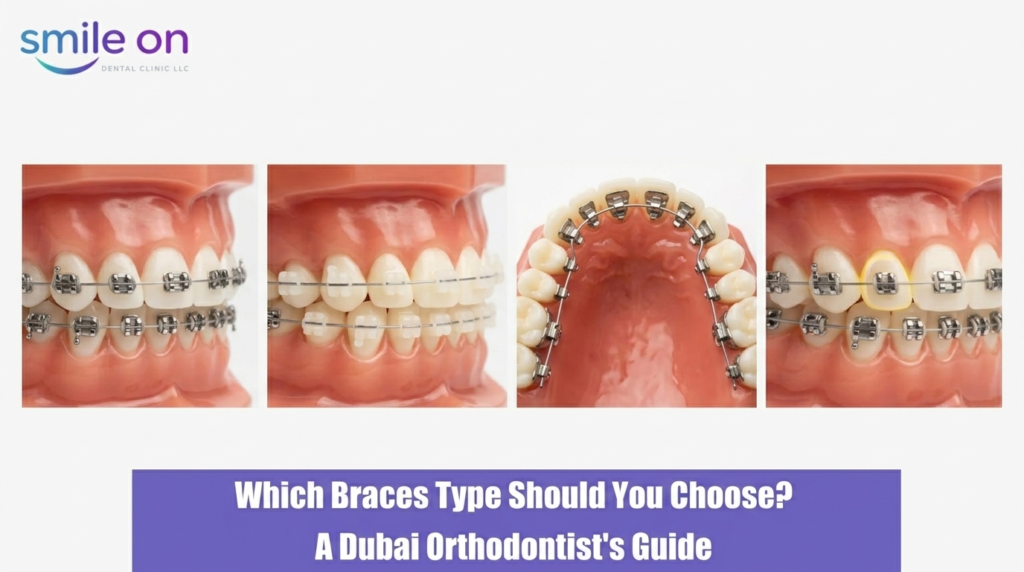
Dubai patients have five main options: metal braces, ceramic braces, Damon braces, lingual braces, and Invisalign. They overlap in some situations and are completely wrong for others. This guide breaks down exactly who each one is for, written from an orthodontic practice perspective.
If you’re trying to decide before booking an orthodontic consultation in Dubai, this is where to start.
Ready to find out which is right for your teeth?
Book a consultation at Smile On Dental Clinic in Al Satwa. We assess your teeth properly and give you a written recommendation with rationale before you decide anything.
The Five Types of Braces Available in Dubai
Before going into detail, here’s the summary comparison.
| Braces Type | Visibility | Best Case Type | Approx. Cost (AED) | Adjustment Interval |
|---|---|---|---|---|
| Metal braces | Visible | Any complexity | 5,000 – 10,000 | Every 4-6 weeks |
| Ceramic braces | Low | Mild to moderate | 7,000 – 13,000 | Every 4-6 weeks |
| Damon braces | Low to moderate | Mild to complex | 8,000 – 14,000 | Every 8-10 weeks |
| Lingual braces | Invisible (behind teeth) | Mild to complex | 15,000 – 25,000 | Every 4-8 weeks |
| Invisalign | Nearly invisible | Mild to moderate | 7,000 – 18,000 | 1-2 week tray changes |
These are total treatment costs per case, not per arch. For a full price breakdown by type and what drives the final figure, see our detailed braces cost guide.
Metal Braces: The Most Reliable Option for Complex Cases
Metal braces are the default in orthodontic treatment for a reason. They handle the widest range of case complexity, give the orthodontist the most precise control over each tooth’s movement, and cost less than every other option. The trade-off is visibility.
Modern metal brackets are significantly smaller than older designs. They are not invisible, but they are not the hardware-heavy look most adults remember from school either.
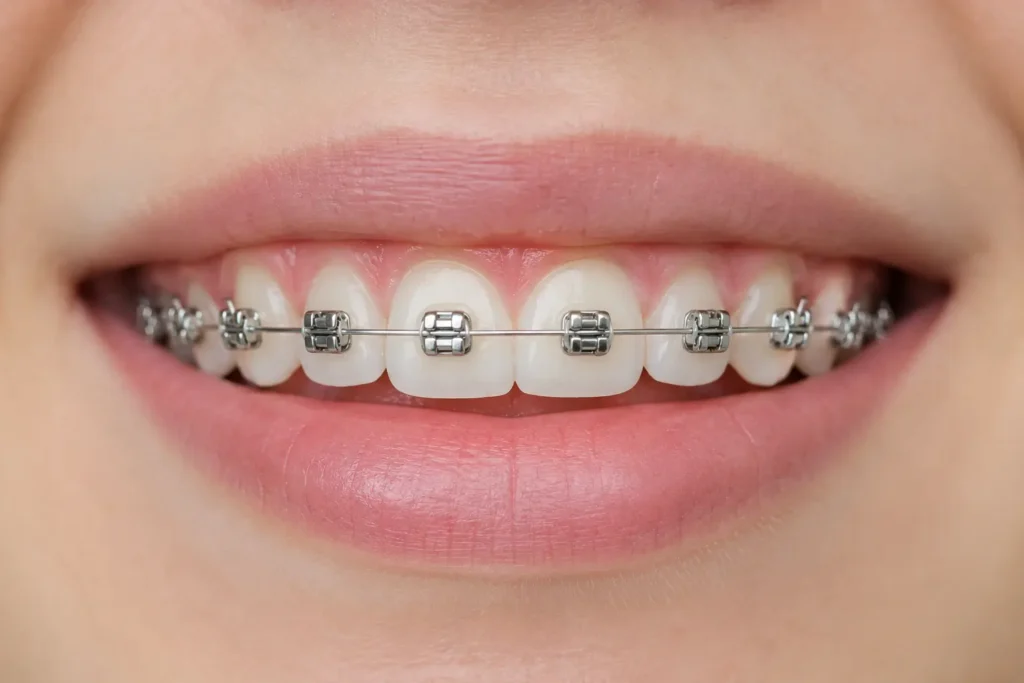
Who metal braces genuinely suit:
Children and teenagers are the primary group. Compliance with removable devices at this age is unreliable. Metal braces are fixed, which means treatment happens whether the patient stays disciplined or not.
Adults with complex cases: severe crowding, significant bite problems (overbite, underbite, crossbite, open bite), or teeth requiring precise three-dimensional movement. Some case types simply need the mechanical control that fixed brackets provide better than clear aligners.
Budget-conscious patients. Metal braces at AED 5,000-10,000 for a full treatment course offer the highest clinical capability per dirham of any orthodontic option available in Dubai.
Where metal braces fall short:
Visibility is the obvious limitation. For adults in client-facing roles, the idea of fixed visible braces for 18 months is often unworkable. In those cases the conversation moves to ceramic, Damon Clear, lingual, or Invisalign, depending on what the case actually supports clinically.
Ceramic Braces: Fixed Treatment with Less Visual Impact
Ceramic braces work identically to metal braces mechanically. Brackets are bonded to the front of each tooth, an archwire connects them, and the wire is adjusted progressively to move teeth. The difference is the bracket material: ceramic or composite in a tooth-coloured or clear shade that blends with the tooth surface.
At a normal conversational distance, ceramic braces are noticeably less visible than metal. Up close, they are clearly there.
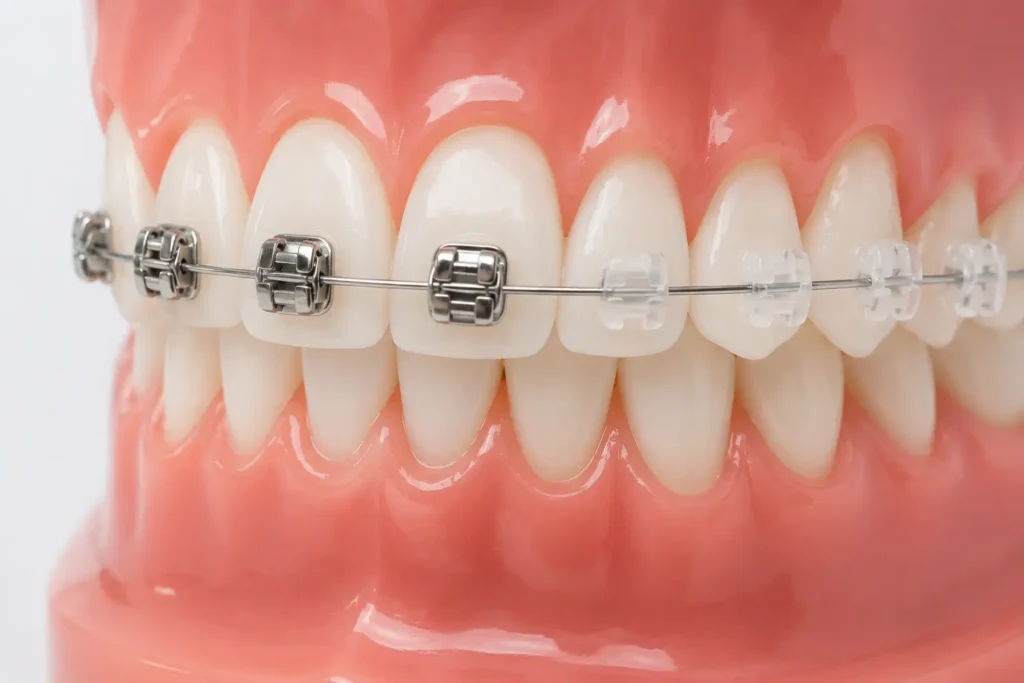
Who ceramic braces suit:
Adults who want fixed orthodontic treatment with reduced visibility. Clinically, the results are identical to metal braces for most case types. If you’re comfortable with something visible at close range but unobtrusive across a room, ceramic is a solid choice.
Patients with moderate case complexity who don’t qualify for Invisalign and don’t want lingual braces.
The honest trade-off:
Ceramic brackets can stain. Coffee, tea, turmeric, and red wine will discolour the elastic ligatures holding the wire in place between appointments. The brackets themselves are more resistant, but the ligatures yellow visibly within a few weeks of heavy consumption. Ligatures are replaced at each adjustment appointment, which limits how permanent any staining becomes.
Ceramic is also slightly more brittle than metal. It is not fragile in normal use, but it requires a little more care than metal hardware.
Damon Braces: Fewer Appointments, Consistent Comfort
Damon braces are a type of self-ligating bracket. The key difference from both metal and ceramic braces is the elimination of elastic ligatures. The Damon bracket has a built-in sliding mechanism that holds the archwire without ties.
Less friction in the system means teeth can move with lighter, more continuous forces. This typically translates to less soreness after adjustments, fewer emergency appointments for snapped ligatures, and adjustment intervals of 8-10 weeks rather than the 4-6 week intervals needed with conventional braces.
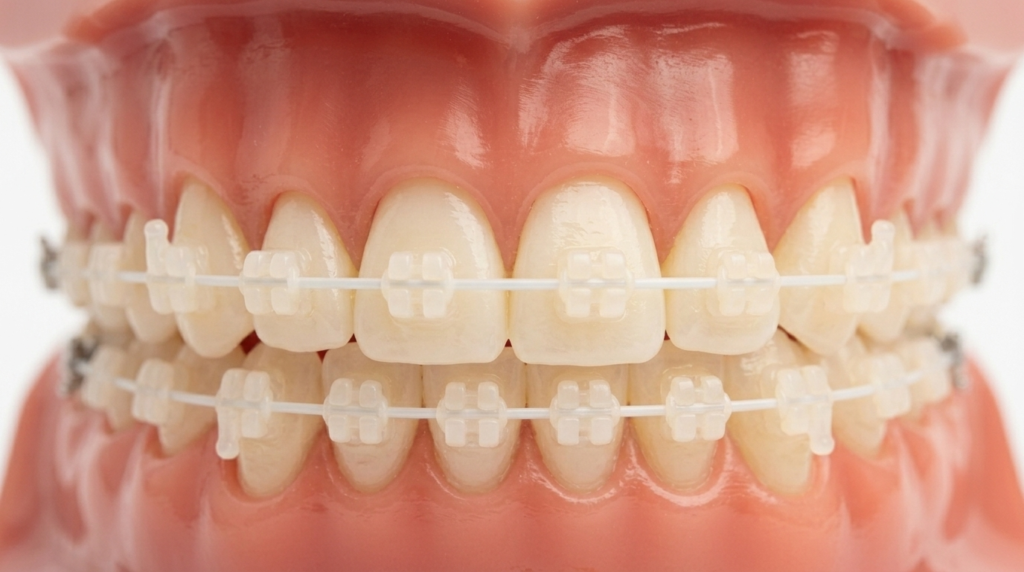
The Damon difference in practice:
For appropriate cases, Damon braces can reduce total treatment time. The clinical research shows modest reductions rather than dramatic ones, typically 1-4 months depending on the case type. The more consistent benefit for most patients is fewer clinic visits and more comfortable adjustments throughout treatment.
Damon is available in metal and clear (ceramic) versions. Damon Clear combines the self-ligating mechanism with a more discreet bracket appearance.
At Smile On Dental Clinic, Damon braces are part of the fixed orthodontic options available under Dr. Jeffrey Manuel’s care. At your consultation, he assesses whether the self-ligating mechanism provides a meaningful clinical advantage for your specific case or whether conventional brackets are equally appropriate.
Who Damon braces suit:
Patients whose cases would suit conventional metal or ceramic braces, who also have scheduling constraints that make fewer appointments valuable. Adults who found adjustment soreness significant with conventional braces in the past. Patients who want fixed treatment efficiency without the cost premium of lingual braces.
Lingual Braces: Completely Hidden, the Most Technically Demanding
Lingual braces are bonded to the inside surfaces of the teeth rather than the front. From any external angle, nothing is visible. For patients in public-facing roles, television, legal advocacy, media, or anyone for whom visible orthodontic hardware during treatment is genuinely unacceptable, lingual braces are the only fixed option that offers complete invisibility.
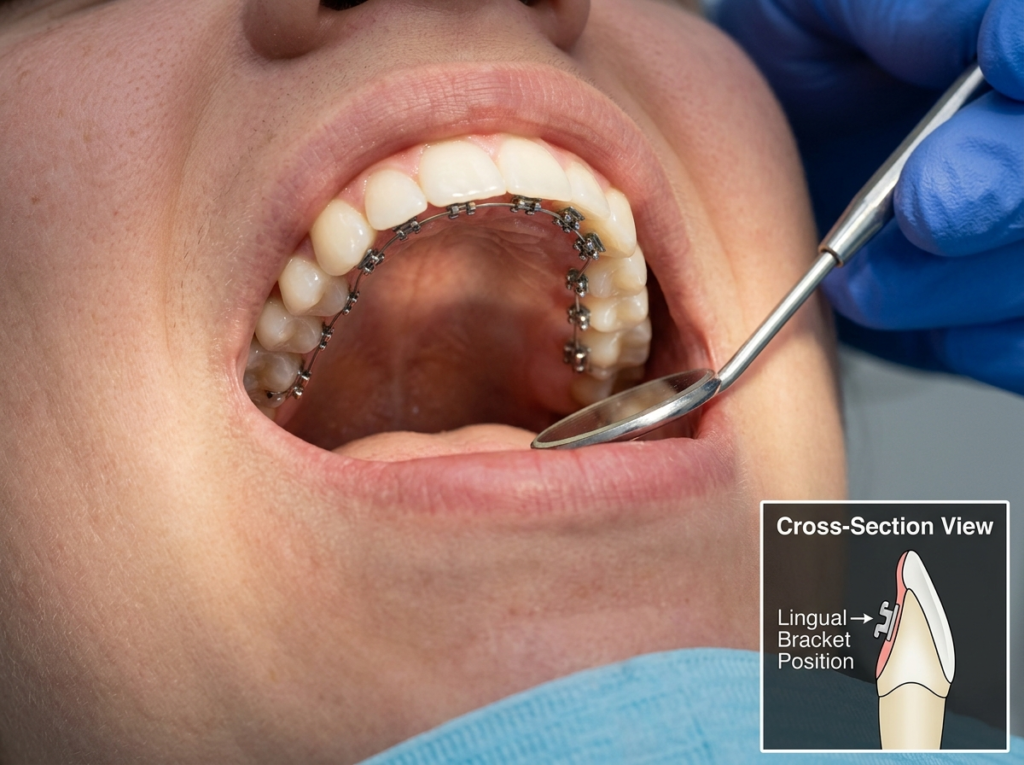
What makes lingual braces different:
Every bracket is custom-fabricated for the individual tooth surface it will bond to. The inner tooth surfaces are not uniform like the outer surfaces; they vary significantly between patients and teeth. Lingual bracket fabrication involves lab work and CAD/CAM manufacturing that doesn’t apply to conventional braces.
The clinical technique is also more demanding. Working in the confined space behind the teeth requires specialised training. Not every orthodontist in Dubai offers lingual treatment. Those who do have specific postgraduate experience in this approach, and this is reflected in the cost: AED 15,000-25,000 for a full treatment course.
The adaptation period:
Your tongue sits against the inner tooth surfaces at rest and during speech. When brackets are placed on those surfaces, your tongue encounters them constantly. The first 1-3 weeks of lingual treatment involve a speech adaptation period. Certain sounds, particularly sibilants (s and sh sounds), will be affected until the tongue adjusts. Most patients find speech normalises within 2-4 weeks.
Who lingual braces suit:
Professionals in client-facing, media, or public roles where visible fixed hardware during treatment is not an option. Patients who have ruled out or don’t qualify for Invisalign but require complete discretion. Adults willing to pay the premium for the only fixed treatment that delivers true invisibility.
Invisalign: Clear Aligners When the Case Supports Them
Invisalign uses a series of custom-made, removable clear plastic trays to move teeth incrementally. Each tray is worn for 1-2 weeks before advancing to the next. The trays are nearly invisible when worn, removed for eating and cleaning, and replaced with progressively repositioned trays throughout treatment.
Where Invisalign works well:
Mild to moderate crowding. Spacing between teeth, including diastema. Class I malocclusions where the primary issue is tooth position rather than jaw relationship. Cases where the patient is a compliant adult who will commit to 20-22 hours of daily wear without exception.
Invisalign has improved substantially and now handles a much broader range of cases than it did ten years ago.
Where fixed braces remain more predictable:
Complex bite correction: significant overbites, underbites, crossbites with a skeletal component, and open bites. Significant vertical tooth movement: intruding or extruding specific teeth requires precision that aligners can struggle with. Rotation of round-rooted teeth, particularly lower premolars, where conventional braces offer more reliable mechanical control.
The compliance requirement:
Invisalign requires 20-22 hours of daily wear. This is not a guideline. Trays worn for 15-16 hours a day produce suboptimal tooth movement that doesn’t match the treatment plan. With fixed braces, compliance is not a variable. With Invisalign, it is the single biggest determinant of whether treatment finishes on time.
At Smile On Dental Clinic, Dr. Jeffrey Manuel assesses Invisalign candidacy against the full picture: case complexity, lifestyle compliance reliability, and whether aligners or fixed braces will deliver a more predictable result for your specific situation.
How to Choose the Right Braces: A Practical Framework
Use this before your consultation. It won’t replace the clinical assessment, but it will help you arrive with clearer questions.
Step 1: How complex is your case?
If you have mild crowding, small spacing, or minor alignment issues, you have the full range of options open to you. If your bite is significantly off, you have deep crowding, or a previous dentist has mentioned jaw or skeletal factors, fixed braces will likely be recommended over aligners regardless of preference.
Step 2: How important is discretion during treatment?
Visibility not a concern: metal or Damon braces offer the best clinical flexibility at the most accessible price.
Low visibility with fixed treatment: ceramic or Damon Clear.
Complete invisibility with fixed treatment: lingual braces only.
Near-invisibility with removability: Invisalign, if your case supports it.
Step 3: What does your schedule look like?
If frequent clinic visits are difficult, Damon braces (8-10 week intervals) reduce in-chair time compared to conventional braces. Invisalign changes are done at home without a clinic visit for the tray progression itself, though monitoring appointments are still required.
Step 4: How honest can you be about compliance?
If you travel frequently, have irregular mealtimes, or know from experience that you are inconsistent with removable devices, fixed braces remove that variable entirely and deliver more predictable results.
What Happens at Your Orthodontic Consultation at Smile On Dental Clinic
Your consultation with Dr. Jeffrey Manuel, Smile On Dental Clinic’s specialist orthodontist, is a clinical assessment, not a sales appointment.
During the consultation, Dr. Manuel will conduct a full clinical examination of your teeth, bite, and jaw relationship. He will review digital records including an OPG panoramic X-ray and lateral cephalometric X-ray to assess tooth positions, root angles, and jaw relationships accurately.
After that, he presents which treatment options your case clinically supports, with honest information about treatment time, what the process involves for each option, and what the expected result looks like.
You are not expected to decide on the day. The consultation gives you a complete clinical picture so you can make a properly informed decision without pressure.
Book a Dental Consultation
Al Satwa, Dubai
Frequently Asked Questions
Which type of braces works fastest in Dubai?
Treatment time depends more on case complexity than brace type. Damon self-ligating braces show modest time reductions for certain cases in clinical studies. Invisalign can complete mild cases at a comparable or slightly faster pace because the progression is pre-programmed. For complex cases, the case itself drives the timeline more than the hardware.
Do ceramic braces stain?
The ceramic brackets are fairly stain-resistant. The elastic ligatures holding the archwire will yellow with heavy coffee, tea, or turmeric consumption. Ligatures are replaced at each adjustment appointment, so any staining is temporary. Patients with very high coffee or tea intake often find Damon braces (no ligatures) or Invisalign more practical for this reason.
Are lingual braces painful?
Lingual braces cause a tongue adaptation period of 1-3 weeks during which the tongue is in constant contact with the brackets. Some patients find this uncomfortable; others manage it well from the start. Discomfort diminishes as the tongue adapts. Beyond the initial period, most patients report comfort levels comparable to conventional braces.
Can adults get braces in Dubai?
Yes. Adults make up a significant proportion of orthodontic patients at Smile On Dental Clinic. Age is not a limiting factor. The main additional consideration for adult patients is gum health: active gum disease needs to be treated before orthodontic treatment can begin, as moving teeth through inflamed tissue causes damage to the supporting bone.
What is the difference between metal and Damon braces?
Damon braces use a self-ligating bracket that eliminates elastic ligatures, reducing friction on the archwire. This typically means fewer clinic visits (8-10 week intervals versus 4-6 weeks for conventional braces), less soreness after adjustments, and potentially modest reductions in treatment time for certain case types.
How do I choose between Invisalign and fixed braces in Dubai?
The choice depends on case complexity, compliance reliability, and discretion requirements. Invisalign works well for mild to moderate cases in patients who will wear aligners 20-22 hours daily. Fixed braces are more predictable for complex bite correction and cases requiring precise three-dimensional tooth movement. A specialist orthodontist consultation is the only reliable way to determine which is clinically appropriate for your specific teeth.
What is the best age for braces in Dubai?
For correction of permanent teeth, orthodontic treatment typically starts between ages 12-14 when most permanent teeth have erupted. Early interceptive treatment (Invisalign First or Myobrace) can begin at ages 6-10 for children with jaw development issues. The consultation determines whether early treatment is clinically indicated.