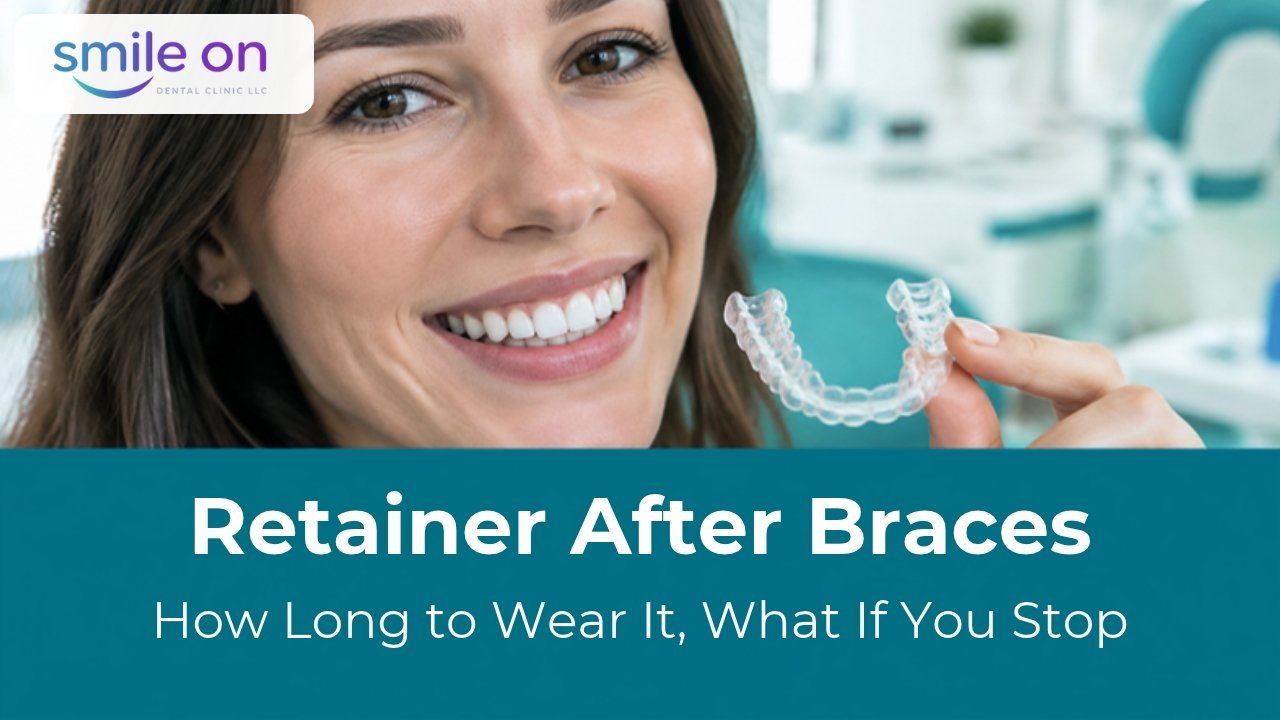
Getting your braces or aligners off feels like the finish line, but orthodontists see it as the start of the most important phase: keeping your teeth where they now are. Most people need to wear a retainer full time for the first few months after braces, then at night for the long term. Teeth can start drifting within weeks if a retainer is left out, and that movement is the main reason people end up needing a second round of orthodontic treatment.
This guide explains how long you need to wear a retainer after braces, why teeth move back, what happens if you stop, and how to look after your retainer so it lasts. It is written by the team at Smile On Dental Clinic in Al Satwa, Dubai, for anyone who has just finished braces or Invisalign, or is about to.
Just finished braces or need a new retainer?
Book a retainer check with our specialist orthodontist at Smile On Dental Clinic, Al Satwa. Upper and lower retainers AED 1,500.
How long do you need to wear a retainer after braces?
Most orthodontists recommend wearing your retainer for around 22 hours a day for the first three to six months after braces come off, then every night after that. For most adults, night-time wear is long term, because teeth keep moving slightly throughout life.
Every orthodontist sets their own schedule depending on how your teeth moved and how stable your bite is, but a typical plan looks like this:
| Stage | How often to wear it | Why |
|---|---|---|
| First 3 to 6 months | Full time, about 22 hours a day, out only to eat and brush | Gums and bone around the teeth are still settling and teeth relapse fastest now |
| 6 to 12 months | Every night, plus some daytime wear if your orthodontist asks | The bone is firming up but teeth can still shift |
| After the first year | Every night | Teeth naturally drift with age, so night wear protects the result |
| Long term | Most nights, for as long as you want to keep the result | There is no point at which teeth stop moving completely |
If you have a fixed (bonded) retainer, a thin wire glued behind the front teeth, it works 24 hours a day by default. Many orthodontists use a fixed retainer on the lower front teeth and a removable one on the upper teeth, or both together for extra security.
Why do teeth move back after braces?
Teeth move back because the fibres and bone that hold them in place have a memory of where the teeth used to be. When braces move a tooth, the bone around it reshapes and the gum fibres stretch. It takes many months for the bone to firm up in the new position, and the stretched fibres keep pulling the tooth back towards its original spot.
Other things also push teeth out of line over time:
- Natural ageing. Teeth tend to drift forward and lower front teeth crowd slightly as we get older, whether or not you had braces.
- Tongue and lip pressure. Habits like tongue thrusting can push teeth out again.
- Grinding and clenching. Night-time grinding puts constant force on the teeth.
- Wisdom teeth and gum changes. These can contribute to small shifts, although the main cause of relapse is simply not wearing a retainer.
This is why your orthodontist will talk about a retainer as a long-term habit rather than a short course.
What happens if you stop wearing your retainer?
If you stop wearing your retainer, your teeth will gradually move back towards where they started. How quickly depends on your case, but changes can begin within days in the first few months, and within weeks to months later on.
Here is what usually happens, in order:
- The retainer feels tight. If you skip a few nights and the retainer feels tight when you put it back in, your teeth have already started moving. Wearing it again as instructed often guides them back.
- Small gaps or overlaps appear. Front teeth are usually the first to shift. A small gap may reopen or a lower front tooth may start to twist.
- The retainer no longer fits. Once teeth have moved far enough, the old retainer will not go in or will cause pain. Forcing it can damage the teeth or the retainer.
- The bite changes. Over longer periods, the way your upper and lower teeth meet can change, which can affect chewing and put extra wear on some teeth.
- You may need treatment again. Significant relapse usually needs a second round of braces or clear aligners to correct, which costs much more than replacing a retainer.
If you have stopped wearing your retainer and it still goes in, start wearing it again full time for a few days and book a check. If it no longer fits, do not force it. Book an appointment so your orthodontist can assess the movement and either adjust the plan or make a new retainer.
Which type of retainer will you get?
The three common types are clear removable retainers (sometimes called Essix retainers), Hawley retainers with a wire and acrylic plate, and fixed retainers bonded behind the teeth. Your orthodontist chooses based on how your teeth moved, your bite and how likely you are to wear a removable one.
- Clear removable retainers are thin, nearly invisible and comfortable, and they are the most popular choice after braces and Invisalign. They need replacing when they crack or wear thin.
- Hawley retainers are very durable and can be adjusted, though they are more visible.
- Fixed retainers are not visible from the front and you cannot forget to wear them, but they make flossing harder and need regular checks to make sure the wire has not come loose.
For a full breakdown of what each type costs and how long each lasts, see our guide to teeth retainer cost in Dubai.
How to clean and look after your retainer
Clean a removable retainer every day, keep it in its case whenever it is out of your mouth, and keep it away from heat. A well-kept retainer lasts much longer and stays more hygienic.
Daily cleaning. Rinse it with cool water when you take it out, then brush it gently with a soft toothbrush and mild, unscented soap. Toothpaste is slightly abrasive and can scratch clear retainers, making them cloudy.
Avoid heat. Hot water, dishwashers and a hot car in Dubai summer can warp a clear retainer so it no longer fits. Never leave it on a dashboard or near a window.
Use the case. Most lost retainers are wrapped in a tissue at a restaurant and thrown away. Put it straight into its case instead.
Do not eat or drink with it in. Water is fine. Anything else, including coffee, tea and juice, can stain the retainer and trap sugar against your teeth.
For fixed retainers. Use a floss threader, a water flosser or interdental brushes to clean under the wire every day, and get it checked at your regular dental visits.
When should you replace your retainer?
Replace a retainer when it is cracked, warped, no longer fits snugly, or has become cloudy and hard to clean. Clear retainers often need replacing every one to three years with daily wear. Hawley and fixed retainers can last longer if they are looked after and checked regularly.
Contact your orthodontist straight away if:
- Your retainer is lost or broken. The longer you go without one, the more your teeth can move.
- A fixed retainer wire feels loose or a bond has come off. A partly loose wire can move teeth in the wrong direction.
- The retainer suddenly feels tight or painful.
At Smile On Dental Clinic, a new set of upper and lower retainers costs AED 1,500. We take a fresh scan or impression so the new retainer fits your teeth as they are now.
Retainers after Invisalign: is it any different?
No. Invisalign and other clear aligners move teeth in the same way braces do, so you need a retainer afterwards on the same schedule. Many patients find the switch easy because a clear retainer looks and feels similar to their aligners. If you are considering Invisalign, the retainer phase is part of the plan from day one. You can read more on our Invisalign in Dubai page.
Who looks after retainers at Smile On?
Retainer planning and checks at Smile On Dental Clinic are handled by Dr. Jeffrey Manuel, our Medical Director and Specialist Orthodontist. Whether you finished treatment with us or elsewhere, we can check your current retainer, make a replacement, or deal with relapse if your teeth have started to move. Find out more about our teeth retainers or our orthodontist in Dubai.
Retainer feeling tight or lost it?
Book a retainer check at Smile On Dental Clinic in Al Satwa, Dubai. New upper and lower retainers AED 1,500. Open daily, 9am to 9pm.
Frequently Asked Questions
How long should I wear my retainer after braces?
Most orthodontists recommend full-time wear, about 22 hours a day, for the first three to six months, then every night after that. For most people, night-time wear is long term because teeth keep moving slightly throughout life.
What happens if I stop wearing my retainer for a week?
Your teeth may shift slightly and the retainer may feel tight when you put it back in. If it still fits, wear it full time for a few days and book a check. If it does not fit, do not force it and see your orthodontist.
Do I have to wear a retainer forever?
For most people, yes, at least a few nights a week. Teeth continue to drift as we age, so long-term night wear is the most reliable way to keep the result.
Can teeth move back years after braces?
Yes. Teeth can shift at any age, especially the lower front teeth. That is why orthodontists recommend long-term night-time retainer wear even years after treatment.
How do I clean my retainer?
Rinse it with cool water and brush it gently with a soft toothbrush and mild soap every day. Avoid hot water, toothpaste and dishwashers, which can scratch or warp clear retainers.
How much does a new retainer cost in Dubai?
At Smile On Dental Clinic in Al Satwa, a new set of upper and lower retainers costs AED 1,500, made from a fresh scan or impression for an accurate fit.
What should I do if I lose my retainer?
Book an appointment as soon as possible so a new one can be made before your teeth start to move. If you have an old retainer that still fits, wear it in the meantime.