Teeth Filling in Dubai: Cost, Types and How Long They Last (2026)
What a teeth filling costs in Dubai, composite vs glass ionomer vs amalgam vs inlays, what affects the price, insurance cover, how long fillings last, and when a filling is not enough.
Endodontist in Dubai: When a Root Canal Needs a Specialist (2026)
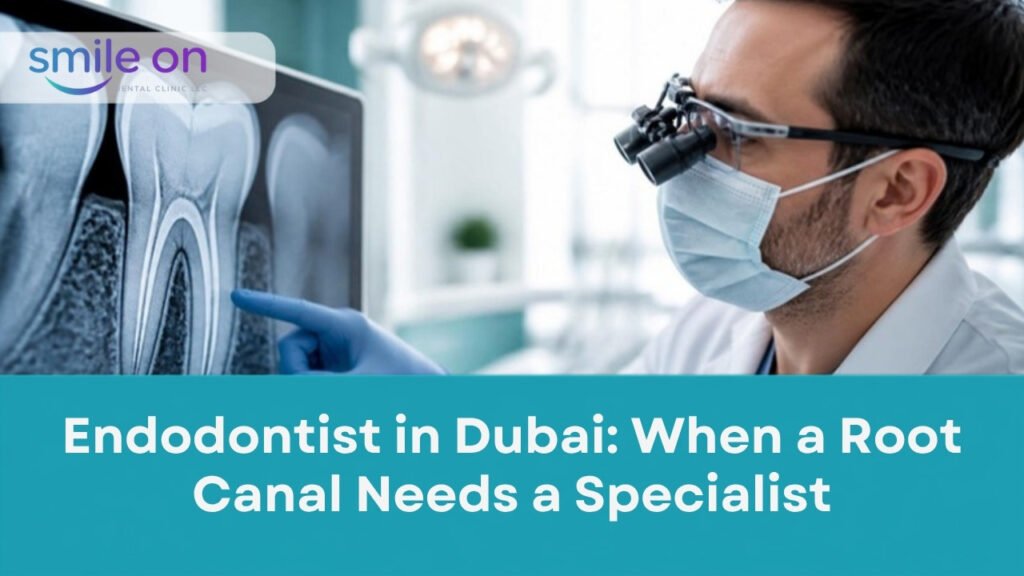
When to see an endodontist in Dubai instead of a general dentist: failed root canals, molars, cracked teeth, and teeth you were told to extract. Specialist costs in AED, success rates, and what to expect.
Dental Implants Cost in Sharjah vs Dubai: Is the Drive Worth It? (2026)
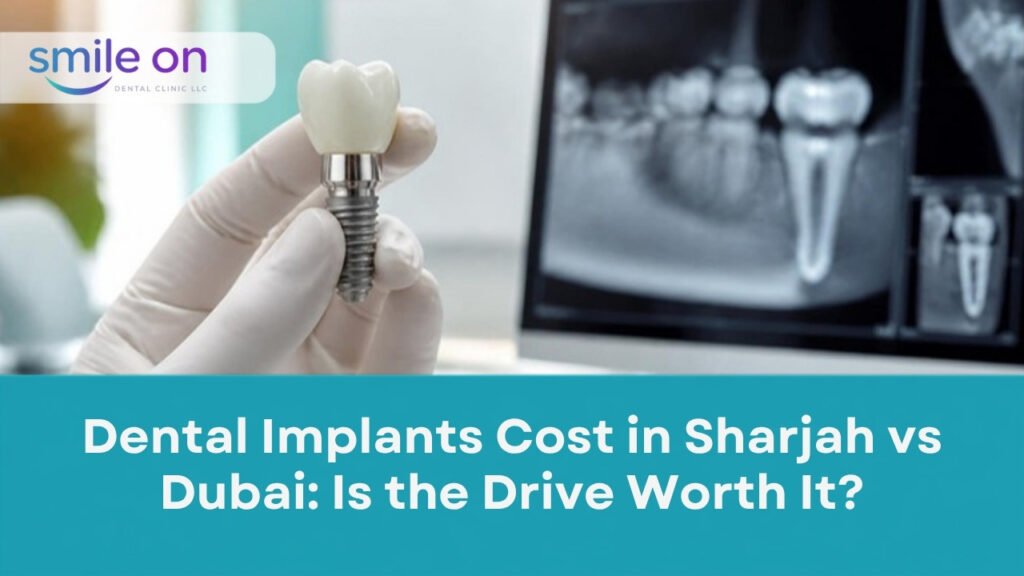
Dental implants in Sharjah cost about AED 3,000 to AED 10,000 per tooth, overlapping almost completely with Dubai prices. How to compare quotes, how many visits to expect, and when the drive to Dubai is worth it.
Best Orthodontics in Jumeirah: A Guide for Expat Families (2026)
A guide to orthodontics in Jumeirah for expat families: when your child should first see an orthodontist, Phase 1 and Phase 2 treatment, AED costs, braces vs Invisalign for teens, and planning around a move.
Porcelain Veneers in Dubai: Cost, Process and What to Ask (2026)
Porcelain veneers in Dubai cost AED 1,200 to AED 3,500 per tooth at Smile On Dental Clinic in Al Satwa. Prices by material, the two-visit process, lifespan, risks and the questions to ask before you book.
Invisalign in Abu Dhabi vs Dubai: What’s the Difference?
6 min read Share: If you are based in Abu Dhabi and researching Invisalign treatment, at some point you will ask whether it is worth making the trip to Dubai. It is a reasonable question. Both cities have multiple certified Invisalign providers, but there are real differences in the provider landscape, cost ranges, specialist availability, and practical treatment experience. This guide is written for patients in Abu Dhabi who want an honest comparison, not a sales pitch for either city. What matters is where you get the best outcome for your specific case, with a provider who is the right fit, at a cost that is fair. If you are looking for Invisalign in Abu Dhabi and wondering whether Dubai offers better options, read on. Invisalign treatment at Smile On Dental Clinic in Al Satwa, Dubai, is led by Dr. Jeffrey Manuel, Specialist Orthodontist and Medical Director, a graduate of A.B. Shetty Memorial Institute of Dental Sciences who has practised orthodontics in the UAE since 2008. The Provider Landscape: Dubai vs Abu Dhabi Dubai has a significantly larger number of Invisalign-certified providers than Abu Dhabi. Align Technology’s published provider data consistently shows Dubai with more Diamond and Platinum certified providers than any other city in the Middle East. Diamond status is awarded to practices completing 100 or more cases per year; Platinum requires 50 or more. Higher case volume generally correlates with greater experience across a broader range of complexity. That said, volume alone does not mean better clinical care. A Platinum provider who specialises in orthodontics and genuinely understands tooth movement will produce better outcomes than a Diamond provider who uses Invisalign as one treatment among dozens without deep specialist expertise. Abu Dhabi has a growing number of certified providers, particularly in areas like Al Reem Island, Khalidiyah, and near Cleveland Clinic Abu Dhabi. The pool is smaller than Dubai’s but includes some well-credentialled practices. The specialist distinction, whether the treating doctor is a specialist orthodontist with postgraduate training or a general dentist who is also Invisalign-certified, is the more important variable between cities. Who This Fits: Real Patient Scenarios From Abu Dhabi The patient with a complex bite case. Someone with a genuine overbite or crossbite alongside crowding benefits most from a specialist orthodontist’s ClinCheck planning, regardless of which city that specialist practises in. If a local Abu Dhabi consultation has not clearly explained the bite mechanics of the plan, a second opinion from a Dubai specialist is often worth the drive for a case this involved. The patient with straightforward mild crowding. A small gap or minor rotation on the front teeth is a case most certified providers, in either city, can handle competently. For this group, proximity and an Abu Dhabi provider they already trust is a perfectly reasonable choice, and the travel to Dubai is not clinically necessary. The patient who works in Dubai but lives in Abu Dhabi. Many professionals who commute already pass through Dubai regularly for work, which removes the travel objection entirely. For this group, timing Invisalign appointments around an existing commute is often more convenient than finding time for a separate trip from Abu Dhabi specifically for dental care. Cost Comparison: Abu Dhabi vs Dubai Invisalign pricing in both cities sits in the same general range, but Dubai’s more competitive market tends to produce a wider spread with more options at the mid-market level. Case Type Abu Dhabi Range (AED) Dubai Range (AED) Invisalign Lite (minor correction) 8,000 to 14,000 7,000 to 12,000 Invisalign Moderate 12,000 to 18,000 10,000 to 16,000 Invisalign Comprehensive 15,000 to 22,000 12,000 to 20,000 These are indicative 2026 ranges. Final cost depends on case assessment, the provider’s tier, what is included in the fee, and clinic location within each city. Pricing in Abu Dhabi has historically run slightly higher for equivalent treatment, partly because the competitive pressure from Dubai’s larger provider pool keeps prices lower across the market. What Is Clinically the Same in Both Cities Invisalign is a branded product manufactured by a single company, Align Technology. The aligner material (SmartTrack), the ClinCheck treatment planning software, and the fabrication process are identical regardless of where the treatment happens. A ClinCheck approved by a specialist orthodontist in Dubai produces the same quality of aligners as one approved in Abu Dhabi. Clinical outcome quality is driven almost entirely by the treating doctor: their orthodontic expertise, how carefully they plan the ClinCheck, how actively they manage tooth tracking through the process, and how they handle refinements when needed. The city itself has no bearing on that variable. Practical Considerations for Abu Dhabi Patients Travel time to Dubai. Depending on where you are based in Abu Dhabi, the trip to Al Satwa, Dubai takes between 75 and 120 minutes each way. For a treatment that requires an appointment every six to eight weeks, this adds up to four to eight trips over the course of a typical 12 to 18 month case. For many patients this is manageable, especially if the Dubai provider has a significantly higher level of expertise or if a specialist’s input genuinely justifies the travel. The key decision point. Is the Dubai provider meaningfully better for your specific case? If you are managing a complex bite issue or a case requiring specialist orthodontic input, the answer can genuinely be yes. If your case is straightforward mild crowding that any competent certified provider can handle, proximity and convenience are reasonable deciding factors. Financing and Payment Plans Whether you choose a Dubai or Abu Dhabi provider, most established clinics offer structured payment plans rather than requiring the full Invisalign fee upfront. A typical structure spreads payment across three or four milestones tied to your treatment progress, an initial payment at consultation, a second once the ClinCheck is approved, and the remainder across progress appointments. This is worth confirming with any provider you shortlist, since it is rarely advertised in detail and payment structures do vary between clinics in both cities. When Dubai Makes Sense for
Best Invisalign Dentist in Dubai: 5 Things to Check
8 min read Share: Dubai has hundreds of Invisalign-certified providers. Searching for the best Invisalign in Dubai returns a mix of clinics, aggregator lists, and promotional pages that do not make your decision any easier. The better question is not which clinic has the best marketing. It is how to evaluate a provider before committing to 12 to 18 months of treatment and a fee that typically runs AED 8,000 to AED 18,000 or more. These five checks will cut through the noise. They apply whether you are comparing your first shortlist or reconsidering a quote you have already received. If you have been searching for the best Invisalign dentist in Dubai or the best Invisalign clinic in Dubai, this is the framework to use, followed by real scenarios of who tends to fit which kind of provider, and what to actually ask before you commit. Check 1: Specialist Orthodontist or General Dentist? This is the most important distinction, and the one most patients do not ask about. Any licensed dentist in Dubai can become a certified Invisalign provider by completing Align Technology’s training programme. That training covers the system: how to submit cases, use the ClinCheck software, and deliver aligners. It does not replace the three or more years of postgraduate specialist training that a specialist orthodontist completes after dental school. A specialist orthodontist’s entire professional focus is on tooth movement and bite correction. They understand how teeth respond to force, how to manage cases when tracking goes off plan, and how to recognise when a case is more complex than it first appears. For mild cases involving minor crowding or small gaps, a competent GP provider is a reasonable choice. For anything involving bite correction, overbite, underbite, crossbite, open bite, or for complex adult cases with existing dental work, a specialist orthodontist is the more reliable option. How to verify. Ask directly whether the treating doctor is a DHA-licensed specialist orthodontist. The DHA public website allows verification. The license will specify “Specialist, Orthodontics” if relevant. At Dr. Jeffrey Manuel’s practice, this is confirmed both on the clinic’s doctor page and on his DHA registration, and worth checking for any provider you are considering, not just this one. Who This Fits: Real Patient Scenarios in Dubai The adult with mild crowding who wants the fastest, most affordable route. Someone with minor spacing or slight crowding on the front teeth, no bite issues, and no history of previous orthodontic work is often a straightforward Invisalign Lite case. A competent GP-certified provider handles this comfortably, and there is no strong clinical reason to insist on a specialist orthodontist for a case this simple, though a specialist will still do it well. The adult with a previous orthodontic relapse. Patients who wore braces as a teenager and stopped wearing retainers often see their teeth drift back years later. These cases look mild on the surface but frequently involve subtle rotation the untrained eye misses. A specialist orthodontist is better placed to read the relapse pattern accurately and plan a ClinCheck that actually corrects it rather than partially masking it. The patient managing a bite issue alongside crowding. Anyone with an overbite, underbite, crossbite, or open bite, even a mild one, benefits from a specialist’s assessment. Bite correction with clear aligners requires more nuanced force application than straightening alone, and a provider without deep orthodontic training is more likely to under-plan the case, leading to a result that looks fine cosmetically but does not resolve the underlying bite mechanics. Check 2: What Certification Level Means and What It Does Not Align Technology awards certification tiers based on case volume. Tier Cases Per Year Gold 25+ Platinum 50+ Diamond 100+ Diamond Plus / Black Diamond 200 to 400+ Higher certification means more cases completed, and more experience with a wider range of complexity is a reasonable inference from that. That said, a Diamond provider who is a general dentist working across multiple treatment types may have less orthodontic depth than a Platinum provider who is a specialist orthodontist and focuses primarily on alignment cases. Use certification as a baseline filter, not the deciding factor. A provider who is both a high-tier certified Invisalign provider and a specialist orthodontist is where both signals line up. Check 3: Does the Clinic Use an iTero Scanner? The iTero Element is the 3D digital intraoral scanner used in Invisalign treatment planning. It creates a precise digital model of your teeth in a few minutes, with no impression trays, no impression material, no discomfort. More importantly, the iTero scanner includes Outcome Simulator technology that shows you an animated prediction of how your teeth will look after treatment. You see the result before any aligners are ordered. This is the starting point for an informed patient decision. Clinics that still use physical impressions rather than digital scanning are working with less precise data, which can affect ClinCheck accuracy. If a clinic you are considering does not use iTero scanning, ask why and whether they use an alternative digital system. At Smile On Dental Clinic, iTero digital scanning is included at the initial consultation. Check 4: Who Reviews the ClinCheck, and How? The ClinCheck is the 3D simulation that maps every planned tooth movement in your case from start to finish. It is produced by Align Technology’s clinical team based on the scan data, but it requires review and modification by the treating doctor before aligners are manufactured. This is where cases succeed or fail. A ClinCheck that is not reviewed critically by an experienced orthodontist may contain planned movements the teeth will not actually make, or that will need multiple refinement rounds to correct. Ask at your consultation: will you show me the ClinCheck before the aligners are ordered, and can you explain what movements are planned and why. A provider who walks you through the ClinCheck at a dedicated review appointment is treating you as an informed patient. A provider who sends aligners without a ClinCheck review session
Teeth Cleaning Dubai: Price, Process and How Often
9 min read Share: Professional teeth cleaning in Dubai typically costs AED 250 to AED 600 for a routine scale and polish, with deep cleaning for gum disease running AED 400 to AED 1,200 per quadrant. Most adults need it every six months, though your actual interval depends on how quickly plaque builds up for you specifically and how well your daily brushing and flossing routine keeps pace between visits. This guide breaks down what you’re actually paying for, the difference between routine and deep cleaning, and how to know which one you need before you book your next appointment. Teeth Cleaning Cost in Dubai by Type Cleaning Type What It Involves Typical Cost (AED) Routine scale and polish Plaque and surface stain removal, above the gumline 250 – 600 Air-flow cleaning Air, water, and fine powder jet, gentler, good for sensitive teeth 350 – 600 Deep cleaning (root planing) Cleaning below the gumline for gum disease, per quadrant 400 – 1,200 A full mouth deep clean, all four quadrants, costs meaningfully more than a single-quadrant treatment, most patients with gum disease need multiple quadrants treated, sometimes across two visits. Why the Price Range Is So Wide Routine vs. deep cleaning. This is the single biggest factor. Routine cleaning addresses plaque and tartar above the gumline. Deep cleaning, also called root planing or scaling and root planing, treats below the gumline, where gum disease actually develops, and takes considerably more time and precision. Clinic location. Clinics in premium districts like DIFC, Downtown, or JBR typically price above clinics in areas like Al Satwa or Deira, for what’s often clinically the same procedure. Technology used. Air-flow cleaning, using a controlled jet of air, water, and fine powder, is gentler and more comfortable for sensitive teeth or patients with orthodontic brackets, and sometimes carries a small premium over traditional scaling. Severity of buildup. A cleaning after 12 months without a visit takes longer and involves more plaque and tartar removal than a routine 6-month check, which can affect time and, at some clinics, cost. Routine Cleaning vs. Deep Cleaning: Which Do You Need? Routine cleaning is for most patients with generally healthy gums, done every six months as preventive maintenance rather than as treatment for an existing problem. It addresses surface plaque, tartar, and stains before they cause problems. Deep cleaning is recommended specifically when gum disease, gingivitis or early periodontitis, is present, signs include gums that bleed when you brush, persistent bad breath, gum redness or swelling, or visible tartar buildup below the gumline that you can sometimes feel with your tongue. A routine clean won’t adequately address these, since the problem area is below where a standard scale and polish reaches. Your dentist will typically identify which you need during the initial exam and probing, not something you should self-diagnose before booking. What Happens During the Appointment A routine cleaning takes 30 to 60 minutes and includes a brief exam, plaque and tartar removal using an ultrasonic scaler, polishing to smooth the tooth surface and remove stains, and sometimes flossing. It’s generally not painful, you may feel vibration and pressure, and any sensitivity is usually minor. Deep cleaning is performed under local anesthetic, since it involves cleaning below the gumline, and is well tolerated even though the procedure itself is more involved than a routine clean. What Happens If You Skip Regular Cleanings Plaque that isn’t removed regularly hardens into tartar within days, and tartar cannot be removed by brushing or flossing at home, it requires professional instruments. Left long enough, this progresses from mild gingivitis, which is fully reversible with treatment, into periodontitis, which involves bone loss around the teeth and is not reversible, only manageable. Patients who skip cleanings for several years often need deep cleaning rather than a routine clean at their next visit, at a higher cost and with more appointments required, simply because the gap allowed a preventable problem to become a treatment-requiring one. If it’s been more than a year since your last cleaning, expect your dentist to recommend an assessment first rather than assuming a routine clean will be sufficient. Combining Cleaning With Other Treatments Many patients schedule a cleaning alongside other dental work, since a clean, plaque-free surface gives a more accurate picture of the teeth underneath. If you’re also considering teeth whitening, a professional cleaning beforehand removes surface stains that whitening treatments don’t address, giving you a more accurate baseline for the whitening result. Patients starting orthodontic treatment are also generally advised to have a cleaning and gum health check first, since braces and aligners make plaque control harder, starting treatment with healthy gums reduces complications later. Is Air-Flow Cleaning Worth the Extra Cost? Air-flow cleaning has become more common at Dubai clinics over the past few years, and it’s worth understanding whether it’s a genuine upgrade or just a pricier alternative. The technique uses a controlled jet of air, water, and fine powder particles to remove plaque, surface stains, and biofilm, rather than the mechanical scraping of a traditional ultrasonic scaler. It tends to be noticeably more comfortable for patients with sensitive teeth or exposed root surfaces, and it’s particularly effective around orthodontic brackets, implants, and other dental work where traditional instruments risk scratching the surface. For a patient with straightforward, healthy teeth and no sensitivity issues, traditional scaling and polishing does the job just as effectively at a lower price point. Air-flow becomes the more worthwhile choice specifically if you have sensitive teeth, visible dental work you want to protect, or you’ve found traditional cleanings uncomfortable in the past. How Often You Actually Need It Every six months is the standard recommendation for most adults with generally healthy gums and no particular risk factors. If you have a history of gum disease, smoke, or have certain health conditions that affect gum healing, such as diabetes, your dentist may recommend cleanings every three to four months instead. This isn’t a one-size-fits-all interval, it’s worth confirming your specific recommended frequency
How Much Does a Teeth Retainer Cost in Dubai?
7 min read Share: A teeth retainer in Dubai typically costs between AED 500 and AED 1,500 per arch, depending on the type you get. Clear removable retainers sit at the lower end of that range, Hawley retainers land in the middle, and fixed (bonded) retainers usually cost the most because they involve chairside placement rather than a lab-made appliance you take home. This guide breaks down what drives that price, what each retainer type actually involves, and what to check before you commit to one, so you’re not comparing quotes without knowing what’s behind them. It’s most useful if you’ve just finished braces or Invisalign and your orthodontist has brought up retainers, or if you’re replacing one that’s lost or broken. Before we get into the numbers, here’s the part that matters more than price: skipping a retainer, or wearing the wrong one inconsistently, is how relapse happens. Worth reading through before you decide based on cost alone. Teeth Retainer Cost in Dubai by Type Retainer Type What It Is Cost in AED (per arch) Clear/Essix retainer Custom clear plastic tray, removable 500 – 800 Hawley retainer Wire and acrylic, removable 700 – 1,100 Fixed (bonded) retainer Thin wire bonded behind teeth, permanent 900 – 1,500 Replacement (lost/broken) Re-fabrication of an existing type 400 – 900 These figures reflect typical Dubai clinic pricing as of 2026. Some clinics bundle the first retainer into the overall braces or Invisalign package, so it’s worth asking your orthodontist whether that applies to you before assuming it’s a separate line item. What Actually Drives the Price Retainer type. This is the single biggest factor. Clear removable retainers are lab-fabricated from a digital or physical impression and don’t require an in-chair bonding appointment, which keeps them cheaper. Fixed retainers need a dentist to bond a wire directly to the back of your teeth, chairside, which adds clinical time and pushes the cost up. Number of arches. Most patients need both upper and lower retainers, not just one. Quoted prices are almost always per arch, so double the single-arch figure to budget realistically for a full set, unless a clinic explicitly quotes a package rate for both. Material and fabrication method. Retainers made from a digital scan, rather than a traditional putty impression, sometimes carry a small premium, though the fit is typically more precise. Ask whether your clinic uses digital scanning as part of the quote. Clinic and location. Clinics closer to central Dubai and higher-footfall areas like Downtown, Marina, or Jumeirah tend to price slightly above clinics in areas like Al Satwa or Deira, though the difference for a retainer specifically is usually smaller than it is for bigger orthodontic procedures. Whether it’s included in your original treatment. Many orthodontists bundle the first set of retainers into the total cost of braces or Invisalign treatment. If yours didn’t, or if you’re past your original treatment window, expect to pay separately. Does Insurance Cover Retainer Costs in Dubai? Usually not, and this catches people off guard. Dental cover in most UAE health insurance plans is an optional add-on rather than something included automatically, and even where dental benefits exist, orthodontic-related costs, including retainers, are commonly excluded from basic and mid-tier plans entirely. A small number of premium plans, typically Bupa Premium or MetLife Executive tiers, include a lifetime orthodontic sub-benefit somewhere in the range of AED 3,000 to AED 6,000, which can sometimes be applied to retainers if your original braces or Invisalign treatment fell under the same benefit. This is worth checking directly with your insurer rather than assuming, since coverage details and waiting periods vary significantly between providers like Daman, AXA, Bupa, Sukoon, and Cigna. If your retainer was part of a documented orthodontic treatment plan, ask your clinic to check whether it can be billed under that plan’s remaining balance before you pay out of pocket. If you’re self-paying, budgeting for the full AED 500 to AED 1,500 per arch range without expecting reimbursement is the safer assumption. What’s Usually Included vs. Charged Separately A retainer quote should include the impression or digital scan, fabrication of the appliance, and the fitting appointment. What’s commonly billed separately: replacement retainers if you lose or damage the original, adjustment visits months later if your bite has shifted slightly, and any additional consultation if you’re switching retainer types partway through treatment. Some clinics also charge separately for a retainer case, cleaning tablets, or a follow-up check at the three-month mark, so it’s reasonable to ask upfront whether the quote is truly all-inclusive or a starting figure. If a quoted price seems unusually low, ask specifically what it covers. A retainer that doesn’t include a proper impression or fitting appointment is not comparable to one that does, even if the sticker price looks similar. Clear, Hawley, or Fixed: Which One Costs What and Why Clear retainers are the most commonly recommended option today, largely because they’re the least visible and the easiest to keep clean since you remove them to eat and brush. Their lower cost reflects a simpler fabrication process, not lower quality. Hawley retainers use a wire that wraps around the front teeth, held in acrylic that sits against the roof of the mouth or under the tongue. They’re more durable than clear plastic and easier to adjust if your orthodontist needs to fine-tune tooth position slightly, which is part of why they sit in the middle of the price range. Fixed retainers are bonded permanently behind your front teeth, usually the lower ones, and are the option most likely to be recommended if your orthodontist is concerned about long-term compliance with a removable retainer. The higher cost reflects the in-chair bonding procedure itself, not just the appliance. Real-World Scenarios: Which Retainer Actually Fits Your Case The recent Invisalign patient who travels often for work. A removable clear retainer usually makes the most sense here. It’s discreet in meetings, easy to remove for flights and meals, and doesn’t need an in-clinic visit if