Best Orthodontics in Jumeirah: A Guide for Expat Families (2026)

A guide to orthodontics in Jumeirah for expat families: when your child should first see an orthodontist, Phase 1 and Phase 2 treatment, AED costs, braces vs Invisalign for teens, and planning around a move.
Same Day Dental Implants in Jumeirah: Are You a Candidate?
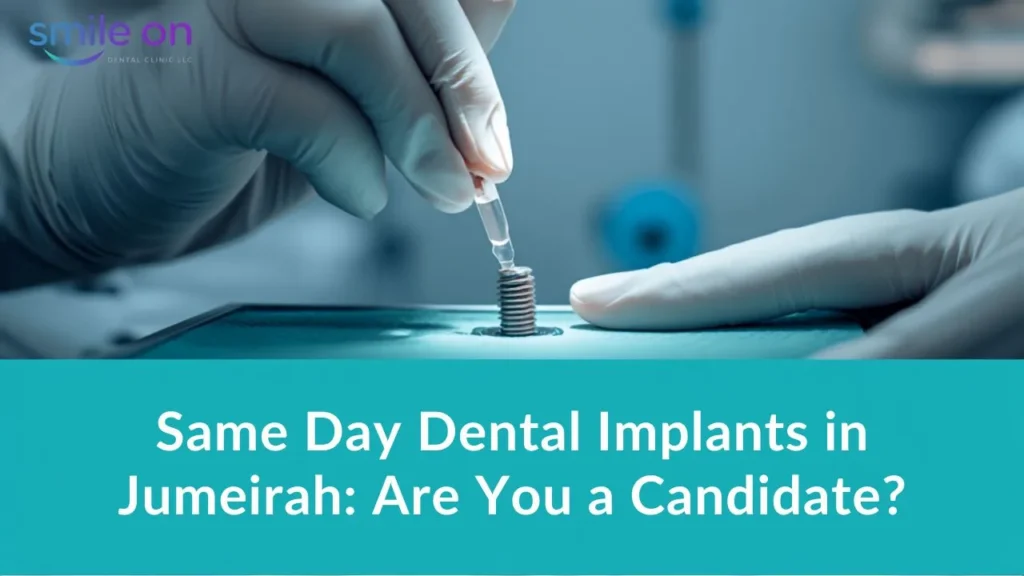
8 min read Share: Same day dental implants let you leave the clinic with a functioning temporary tooth on the same appointment your implant is placed. No waiting three to six months between surgery and restoration. No gap in your smile during healing. For patients who qualify, it is a genuine step forward from conventional dental implant treatment. The word candidate matters here. Not everyone is suitable for immediate loading, and a clinic that skips that conversation is worth avoiding. If you are researching same day dental implants in Jumeirah, this guide explains exactly who qualifies, what gets assessed at your consultation, what the procedure involves step by step, and what recovery actually feels like in the weeks that follow. At Smile On Dental Clinic in Al Satwa, Dubai, implant treatment is handled by a specialist surgical and restorative team. Dr. Amit Gupta, a DHA-licensed specialist in oral and maxillofacial surgery, places the implant. Dr. Rahul Patel, a DHA-licensed specialist prosthodontist, designs and fits the crown. The clinic is accessible from the Jumeirah area in under 10 minutes. What Are Same Day Dental Implants? Same day dental implants, also called immediate loading implants or teeth in a day, combine two stages that happen months apart in conventional implant treatment: placing the titanium implant into the jawbone and attaching a temporary crown on top. In a standard implant procedure, you receive the implant, then wait three to six months for osseointegration before a crown is placed. Same day treatment loads the implant with a temporary crown immediately, giving you a functional, aesthetic replacement while bone continues to integrate around it. The permanent crown is typically fitted three to six months later, once integration is confirmed. This approach is backed by over a decade of published clinical data showing success rates of 94 to 97 percent at five years for single-tooth same day implants in properly selected patients, comparable to conventional two-stage implants. Who Is a Good Candidate? Same day implants require stricter patient selection than conventional implants. Every case is assessed before the procedure is planned. Adequate bone density and volume. The implant needs sufficient bone to anchor in on day one, since it is loaded immediately. Bone quantity and quality are assessed using a CBCT 3D scan before any procedure. If bone volume is insufficient due to long-term tooth loss or bone resorption, a bone graft may be recommended first, and same day loading may not be appropriate. Healthy gums. Active gum disease creates infection risk that makes immediate loading inadvisable. Patients with a history of gum disease need a clean bill of gum health confirmed clinically before proceeding. No active infection at the implant site. If the tooth being replaced had an active abscess, same day placement requires caution. Dr. Amit Gupta assesses whether immediate placement is safe or whether a healing period is needed first. No systemic conditions affecting bone healing. Uncontrolled diabetes, active cancer treatment, bisphosphonate therapy, and certain autoimmune conditions affect how bone heals. These are not automatic disqualifiers but require detailed clinical review before same day loading is recommended. Non-smoker status. Smoking reduces blood flow to gum and bone tissue, which impairs osseointegration. Patients who smoke carry a materially higher risk of implant failure. The standard recommendation is to stop smoking completely for at least two weeks before and eight weeks after placement. What if you do not qualify? Conventional two-stage implants remain an excellent solution for patients who do not meet immediate loading criteria. Outcomes are clinically equivalent. The main difference is timeline. Dr. Gupta and Dr. Patel will discuss both options and recommend the one that gives the best long-term result for your case. Who This Fits: Real Patient Scenarios in Jumeirah The professional who cannot be without a front tooth for months. Patients in client-facing roles who lose a front tooth to trauma or a failed old filling often cannot accept a visible gap while waiting for a conventional implant to integrate. A same day implant, when the bone and gum health support it, means leaving with a temporary crown in place rather than a removable flipper. The patient who has already lost the tooth years ago. Long-standing tooth loss often means some bone resorption at the site, since bone needs the stimulation of a tooth root to maintain its volume. This is one of the more common reasons a patient is not immediately a same day candidate and needs a bone graft first, something that only becomes clear from the CBCT scan, not from how the gap looks in the mirror. The patient replacing a single back tooth versus a front tooth. Same day loading criteria are somewhat more forgiving for back teeth, since the cosmetic stakes and bite forces during healing differ from a front tooth. Front tooth cases require more conservative bite management during the healing phase to protect the temporary crown, something Dr. Patel discusses in detail before the surgical day. The Same Day Implant Procedure: Step by Step Step 1, pre-surgical planning. A 3D cone beam CT scan maps your bone volume, bone density, nerve position, and sinus proximity with precision a standard X-ray cannot match. This data drives the surgical plan: implant diameter, length, angle, and position are all determined from the scan, not estimated on the day. Where guided surgery is appropriate, a surgical guide translates the digital plan directly into your mouth. Step 2, day of surgery. Under local anaesthesia, Dr. Gupta places the implant, a small titanium screw, into the prepared site in the jawbone. If a tooth is still present, extraction and same day implant placement can often happen in the same appointment, provided bone levels permit. Step 3, temporary crown fitted same day. Once the implant is placed and primary stability confirmed, Dr. Patel attaches a temporary crown via an abutment. You leave with a functional tooth that looks and works normally. Step 4, healing and osseointegration. The temporary crown stays in place for three to six months while the
Root Canal Treatment in Jumeirah: Patient Guide
8 min read Share: If you’re searching for root canal treatment near Jumeirah, you’re likely dealing with a genuinely painful tooth right now, not casually researching for future reference. The most useful thing to know upfront: an infected tooth doesn’t resolve on its own, and delaying treatment by even a few weeks can turn a straightforward procedure into a significantly more complex one. This guide covers what root canal treatment involves, how quickly you can typically be seen from Jumeirah, what to expect at the appointment, and what it costs, written for someone who needs an actual answer today, not a general explainer. Signs You May Need Root Canal Treatment Persistent sensitivity to hot or cold that lingers well beyond the moment of contact, spontaneous throbbing pain that’s often worse at night, pain when biting down on a specific tooth, or visible swelling on the gum near one tooth are the signals that typically bring patients in for an assessment. None of these resolve on their own. If you’re experiencing any of these, treat it as something to address this week, not eventually. Getting Seen Quickly From Jumeirah Al Satwa is one of the closer central Dubai clinic locations to Jumeirah, typically a 10 to 15 minute drive depending on traffic, without needing to cross into Downtown or Business Bay congestion during peak hours. For an urgent tooth pain situation, same-day or next-day assessment appointments are the priority, most root canal cases start with an X-ray and clinical assessment on the same visit as the initial call, so the tooth is diagnosed before the pain gets worse. Call +971 55 896 1826 directly for the fastest same-day assessment slot. What the Procedure Actually Involves Root canal treatment, also called endodontic treatment, removes infected or inflamed pulp, the soft tissue inside the tooth containing nerves and blood vessels, cleans and disinfects the canal, then seals it to prevent reinfection. Despite its reputation, a modern root canal performed under local anesthetic is not more uncomfortable than having a cavity filled, the pain people associate with root canals is almost always the infection itself, before treatment, not the treatment. Most cases are completed in one to two visits, depending on the tooth’s complexity and how advanced the infection is. Front teeth, incisors and canines, have a single canal and are typically quicker to treat than molars, which have multiple canals and take considerably longer to clean and seal properly. Root Canal vs. Extraction: Why Saving the Tooth Usually Wins When a tooth is badly infected, the alternative to root canal treatment is extraction, followed by a bridge or implant to replace it. It’s worth understanding why root canal treatment is almost always the first recommendation. Your natural tooth, once treated and typically capped with a crown, continues functioning at close to full strength for chewing and bite alignment, and preserves the surrounding jaw bone in a way that’s lost once a tooth is extracted. Extraction followed by an implant is also generally a longer and more expensive path overall than root canal treatment plus a crown, once you account for the healing time needed before an implant can be placed and the cost of the implant itself. Extraction remains the right call in specific situations, severe fracture below the gumline, or extensive bone loss around the root, but for most infected teeth caught at a reasonable stage, saving the natural tooth is both the more conservative and often more cost-effective choice over time. Choosing an Endodontist vs a General Dentist General dentists in Dubai can and do perform straightforward root canal treatments. For a tooth with unusual anatomy, a previous failed root canal needing retreatment, or a case where a general dentist’s initial attempt hasn’t fully resolved the infection, a Specialist Endodontist, someone with dedicated postgraduate training specifically in root canal and pulp-related treatment, is the more appropriate choice. If your case has been flagged as complex, or if a previous treatment on the same tooth didn’t fully resolve your symptoms, ask specifically whether the dentist treating you holds Specialist Endodontist registration with the DHA. What to Expect Afterward Mild soreness for a few days is normal and manageable with over-the-counter pain relief. A treated tooth is more brittle than a healthy one, since it no longer has a living blood supply, which is why a crown is usually recommended afterward, particularly for molars that handle significant biting force during everyday chewing. Skipping the crown when one is recommended increases the risk of the tooth cracking under normal use later. dental crowns and bridges covers what that follow-up step involves in more detail. What Root Canal Treatment Costs Root canal treatment in Dubai typically costs between AED 1,500 and AED 2,500 per tooth, depending on complexity and how many canals the specific tooth has. Front teeth with a single canal are generally at the lower end of that range, while molars with multiple canals cost more due to the additional time and precision required. A crown afterward, if recommended, typically adds AED 1,000 to AED 2,500 depending on the material chosen. If a quoted price seems unusually low, confirm whether it includes the full course of treatment or just the first visit, some quotes cover only the initial cleaning stage, with the final filling and any crown priced separately. Insurance and Root Canal Treatment Most UAE dental insurance plans that include coverage beyond the most basic tier offer at least partial coverage for root canal treatment, though the percentage covered varies significantly by insurer and plan. It’s worth confirming your specific plan’s coverage before treatment where possible, though in a genuinely urgent pain situation, starting treatment shouldn’t wait on a lengthy pre-authorization process if the pain is severe. What Happens During Each Visit: Step by Step Understanding the actual sequence helps demystify what’s often an anxiety-inducing procedure by name alone. At the first visit, your dentist takes an X-ray to assess the root anatomy and confirm the diagnosis, administers local anesthetic, and