Invisalign is the most popular orthodontic treatment in Dubai for adults and teenagers who want to straighten their teeth without metal brackets or wires. If you’re considering it, you likely already know the basic concept. What’s less clear is what the treatment actually looks like from start to finish: what happens at each appointment, how long each stage takes, what your daily routine looks like for months in between, and what it actually feels like to live with aligners through a Dubai summer, travel, and client meetings.
This guide walks through Invisalign treatment in Dubai step by step, from the first consultation to the retention phase. All information reflects how treatment is delivered at Smile On Dental Clinic in Al Satwa, Dubai, under the supervision of Dr. Jeffrey Manuel, Specialist Orthodontist and Medical Director.
Dr. Jeffrey Manuel is a DHA-licensed specialist orthodontist and a certified Invisalign provider. He has practised in the UAE since 2008 and personally reviews and plans every Invisalign case at Smile On before aligners are manufactured.
Ready to get a proper assessment?
Book a consultation at Smile On Dental Clinic in Al Satwa. Dr. Jeffrey Manuel, Specialist Orthodontist, will assess your teeth and give you a clear treatment recommendation before anything begins.
How Invisalign Treatment Works
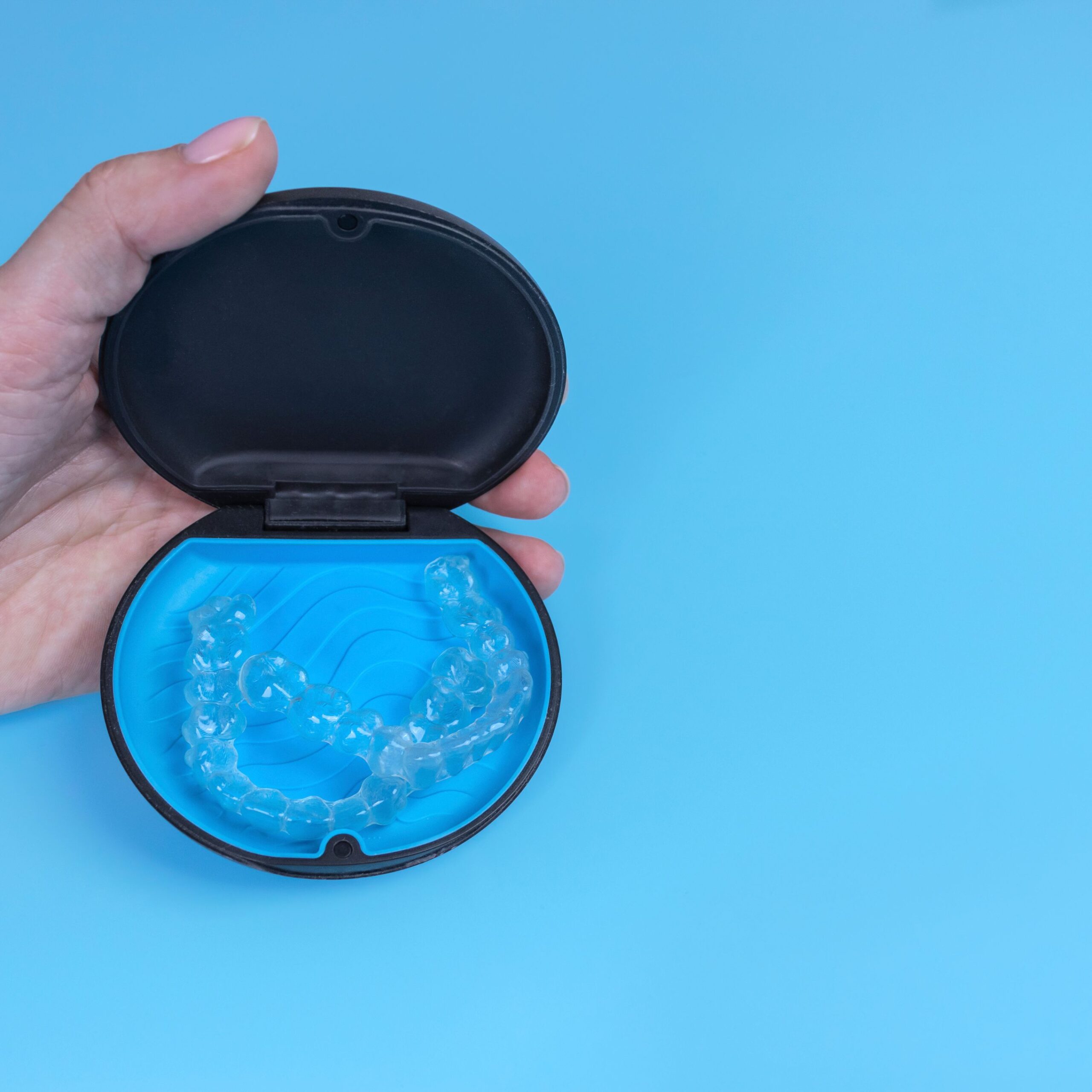
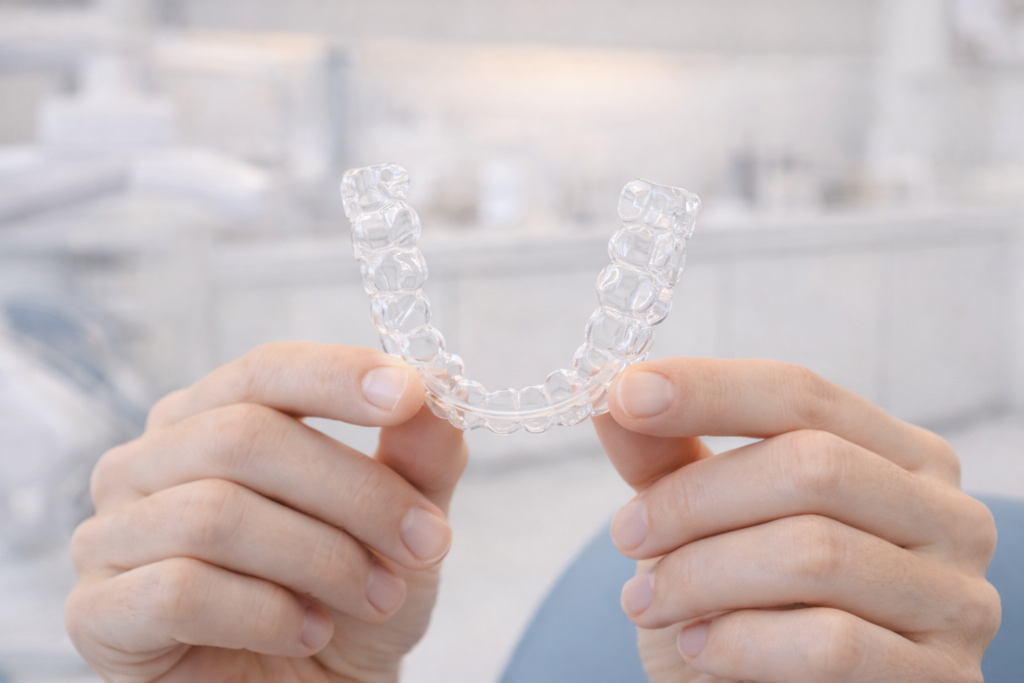
Invisalign moves your teeth using a series of custom-made, removable clear plastic aligners. Each set is worn for one to two weeks, applying gentle and controlled pressure to shift teeth a small amount at a time. Simple cases might involve 20 to 30 sets. Complex cases can require 50 or more. The aligners are made from SmartTrack material. No wires, no brackets, no monthly tightening appointments.
Step 1: Initial Consultation and 3D Scan
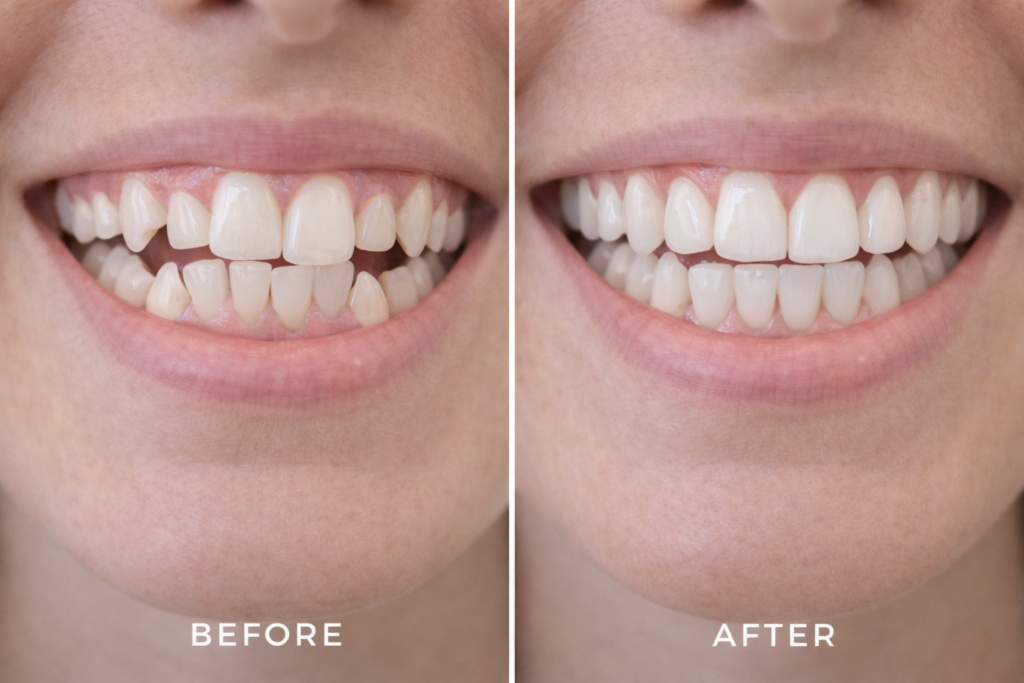
Your treatment starts with a clinical assessment covering a physical examination of your teeth, bite, and jaw; a review of existing dental work; and a 3D digital scan using iTero technology. The scan builds a precise digital model of your teeth and generates a Smile Simulation, an animation showing how your teeth are expected to look after treatment, before any aligners are ordered. For a full pricing breakdown by case type, see our Invisalign cost guide for Dubai and UAE.
Step 2: The ClinCheck Treatment Plan
After your scan, Dr. Jeffrey Manuel submits your case to Align Technology, who produce a ClinCheck: a detailed 3D simulation mapping every planned tooth movement from start to finish. You review the ClinCheck with Dr. Manuel at a follow-up appointment and can ask questions about specific movements. Once approved, Align Technology fabricates your aligner series, a process that typically takes two to three weeks.
Step 3: Receiving Your Aligners
When your aligners arrive, Dr. Manuel checks the fit of your first sets, places attachments if your plan requires them, and walks you through the daily routine. Attachments are small, tooth-coloured composite bumps bonded to specific teeth to help aligners achieve movements that smooth plastic alone cannot manage. Not every case needs them.
Who This Fits: Real Patient Scenarios From Dubai
The professional who cannot have a visibly different smile at work. Client-facing roles, on-camera work, and frequent presentations make discretion a genuine priority, not a vanity concern. Invisalign is close to invisible at conversation distance, and most colleagues never notice unless told. This is the single most common reason working adults in Dubai choose aligners over fixed braces.
The adult with a relapsed teenage orthodontic result. Patients who wore braces years ago and stopped wearing their retainer often see mild crowding return over time. These cases look simple but frequently involve subtle rotation that a careful ClinCheck review catches and a rushed one misses, which is where a specialist orthodontist’s eye matters even on what looks like a minor case.
The patient juggling frequent travel. Dubai’s business travel culture means many patients are on planes monthly. Aligners handle this well since there is no appointment dependency between visits the way there is with fixed braces, though switching to a new set a day or two off schedule due to travel does not meaningfully affect the outcome as long as you get back on track quickly.
Step 4: Wearing Your Aligners, the Daily Routine
The 20 to 22 hour rule. Aligners must be worn for 20 to 22 hours each day. Falling below this regularly causes teeth to stop tracking correctly, extending your treatment or requiring additional aligner series.
What you remove them for. Remove aligners before eating or drinking anything other than plain water. Hot drinks distort the plastic. Food and sugary drinks trapped against the aligner surface accelerate decay.
Cleaning your aligners. Rinse with cool water when you remove them. Clean with a soft toothbrush and clear soap, not toothpaste, which clouds the plastic over time.
Switching sets. Most patients move to a new set every week. Follow the plan. Switching too early means the current aligner has not completed its planned movement.
Managing discomfort. Each new set creates noticeable pressure for the first two to three days. Over-the-counter pain relief manages it for most patients.
Step 5: Progress Check Appointments
You will see Dr. Manuel every six to eight weeks throughout treatment. These 20 to 30 minute appointments verify teeth are tracking correctly, check attachment integrity, and answer your questions. If a tooth is not tracking as planned, Dr. Manuel adjusts the approach early, which is far simpler than addressing it at the end of treatment.
Step 6: Refinements
Refinements are additional aligner series produced when your original series is complete but teeth have not fully reached the planned position. They are common and not a sign something went wrong. If refinements are needed, a new iTero scan is taken, a new ClinCheck produced, and a short additional series manufactured, adding four to twelve weeks to your timeline. Whether refinements are included in your original fee is worth confirming in writing before you start.
Step 7: Retention
Treatment ends when your teeth reach the planned position. Retention begins immediately. Teeth have a biological tendency to drift toward their original positions, and retainers prevent this long term. After Invisalign at Smile On, options typically include clear plastic retainers, worn full-time initially and then nightly, and fixed bonded retainers. Our guide to teeth retainers in Dubai covers the main types and long-term wear.
What the Full Timeline Looks Like
| Stage | Typical Timeframe |
|---|---|
| Initial consultation and iTero scan | Week 1 |
| ClinCheck review and approval | Weeks 2 to 3 |
| Aligner fabrication | Weeks 3 to 5 |
| Active aligner wear (mild case) | 6 to 9 months |
| Active aligner wear (moderate case) | 12 to 18 months |
| Active aligner wear (complex case) | 20 to 24+ months |
| Progress check appointments | Every 6 to 8 weeks throughout |
| Refinements (if needed) | Additional 4 to 12 weeks |
| Retention phase | Begins immediately after final aligner |
Are You a Candidate for Invisalign Treatment in Dubai?
Invisalign treats a broad range of orthodontic issues including crowding, spacing, overbite, underbite, crossbite, and open bite. Cases where traditional braces are more reliable include severe skeletal jaw discrepancies and significant individual tooth rotations. A clinical assessment is the only reliable way to know which approach suits your situation. If your child is between six and ten years old, Invisalign First is designed specifically for growing patients with mixed dentition.
Financing and Payment Plans
Invisalign treatment is a meaningful investment, and most Dubai clinics, including Smile On, offer structured payment plans rather than requiring the full fee upfront. Typical structures split the cost across three or four milestones: an initial payment at consultation, a second once the ClinCheck is approved and aligners are ordered, and the remainder spread across progress appointments. Some patients use third-party medical financing for interest-free instalments over several months. Ask about payment structure at your consultation, since it is rarely advertised upfront and varies between providers.
What to Confirm Before You Start
Is the treating doctor a certified Invisalign provider? Certification levels (Gold, Platinum, Diamond) reflect case volume and indicate experience with the system.
Is the doctor a specialist orthodontist or a general dentist? A specialist orthodontist has completed at least three additional years of postgraduate training in tooth movement and bite correction. For complex cases, a specialist is the more reliable choice.
What is included in the fee? A complete fee should cover the aligner series, iTero scanning, all progress appointments, attachments if needed, and at minimum one round of refinements. Retainers are typically quoted separately. Get an itemised breakdown before committing.
Is the clinic DHA-licensed? All dental clinics in Dubai are required to hold a DHA license. Smile On Dental Clinic and Dr. Jeffrey Manuel are both DHA-licensed.
Invisalign Treatment at Smile On Dental Clinic, Al Satwa
Smile On Dental Clinic is a DHA-licensed multi-specialty dental practice in Al Satwa, accessible from Jumeirah, Karama, and Bur Dubai. Invisalign treatment is supervised by Dr. Jeffrey Manuel, Specialist Orthodontist and Medical Director, a graduate of A.B. Shetty Memorial Institute of Dental Sciences who has practised orthodontics in the UAE since 2008. The multi-specialty setup means adult patients with existing dental work or gum sensitivity have access to a periodontist and prosthodontist in the same practice. To compare Invisalign with other orthodontic options, see our guide to orthodontic braces in Dubai.
Start your Invisalign journey at Smile On Dental Clinic
Smile On Dental Clinic, Al Satwa, Dubai. Appointments with Dr. Jeffrey Manuel, Specialist Orthodontist, are available 6 days a week. Book your iTero scan and consultation today.
Frequently Asked Questions
How long does Invisalign treatment take in Dubai?
Most moderate cases complete in 12 to 18 months of active aligner wear. Mild cases can finish in 6 to 9 months. Complex cases with significant bite correction can take 20 to 24 months or more.
How much does Invisalign cost in Dubai?
Invisalign in Dubai ranges from approximately AED 7,000 for a short Lite course to AED 18,000 or more for a comprehensive complex case. For a full breakdown, read our Invisalign cost guide.
Can I eat normally with Invisalign?
Yes. Aligners are removed before every meal so there are no food restrictions. The key habits are removing them consistently and rinsing your mouth before reinserting them. Avoid hot or sugary drinks with aligners in place.
What happens if I do not wear my aligners for the full 22 hours?
Consistent under-wear causes teeth to stop tracking correctly against the treatment plan. In mild cases this slows treatment. In more significant cases, aligners stop fitting properly and may require a new ClinCheck and additional aligner series to correct.
What are Invisalign attachments?
Attachments are small tooth-coloured composite bumps bonded to specific teeth to help aligners grip for complex movements like rotations and vertical adjustments. Not every case requires them. Dr. Manuel confirms whether your plan needs attachments at the ClinCheck review appointment.
Do I need a retainer after Invisalign?
Yes, retention is permanent. After your final aligner, retainers prevent teeth from drifting back. Most patients use a fixed retainer on lower front teeth and a clear retainer worn nightly.
Is Invisalign better than braces?
For most adults, Invisalign is more comfortable and harder to notice day to day, with no food restrictions. For cases involving severe bite issues or complex tooth movements, traditional braces may be more predictable. The right option depends on your specific clinical case.
Is Smile On Dental Clinic a certified Invisalign provider?
Yes. Smile On Dental Clinic in Al Satwa is a certified Invisalign provider. Treatment is supervised by Dr. Jeffrey Manuel, Specialist Orthodontist, who is DHA-licensed with formal postgraduate training in orthodontics.