Root Canal Treatment in Jumeirah — Patient Guide
8 min read Share: If you’re searching for root canal treatment near Jumeirah, you’re likely dealing with a genuinely painful tooth right now, not casually researching for future reference. The most useful thing to know upfront: an infected tooth doesn’t resolve on its own, and delaying treatment by even a few weeks can turn a straightforward procedure into a significantly more complex one. This guide covers what root canal treatment involves, how quickly you can typically be seen from Jumeirah, what to expect at the appointment, and what it costs, written for someone who needs an actual answer today, not a general explainer. Signs You May Need Root Canal Treatment Persistent sensitivity to hot or cold that lingers well beyond the moment of contact, spontaneous throbbing pain that’s often worse at night, pain when biting down on a specific tooth, or visible swelling on the gum near one tooth are the signals that typically bring patients in for an assessment. None of these resolve on their own. If you’re experiencing any of these, treat it as something to address this week, not eventually. Getting Seen Quickly From Jumeirah Al Satwa is one of the closer central Dubai clinic locations to Jumeirah, typically a 10 to 15 minute drive depending on traffic, without needing to cross into Downtown or Business Bay congestion during peak hours. For an urgent tooth pain situation, same-day or next-day assessment appointments are the priority, most root canal cases start with an X-ray and clinical assessment on the same visit as the initial call, so the tooth is diagnosed before the pain gets worse. Call 04 347 2102 directly for the fastest same-day assessment slot. What the Procedure Actually Involves Root canal treatment, also called endodontic treatment, removes infected or inflamed pulp, the soft tissue inside the tooth containing nerves and blood vessels, cleans and disinfects the canal, then seals it to prevent reinfection. Despite its reputation, a modern root canal performed under local anesthetic is not more uncomfortable than having a cavity filled, the pain people associate with root canals is almost always the infection itself, before treatment, not the treatment. Most cases are completed in one to two visits, depending on the tooth’s complexity and how advanced the infection is. Front teeth, incisors and canines, have a single canal and are typically quicker to treat than molars, which have multiple canals and take considerably longer to clean and seal properly. Root Canal vs. Extraction: Why Saving the Tooth Usually Wins When a tooth is badly infected, the alternative to root canal treatment is extraction, followed by a bridge or implant to replace it. It’s worth understanding why root canal treatment is almost always the first recommendation. Your natural tooth, once treated and typically capped with a crown, continues functioning at close to full strength for chewing and bite alignment, and preserves the surrounding jaw bone in a way that’s lost once a tooth is extracted. Extraction followed by an implant is also generally a longer and more expensive path overall than root canal treatment plus a crown, once you account for the healing time needed before an implant can be placed and the cost of the implant itself. Extraction remains the right call in specific situations, severe fracture below the gumline, or extensive bone loss around the root, but for most infected teeth caught at a reasonable stage, saving the natural tooth is both the more conservative and often more cost-effective choice over time. Choosing an Endodontist vs a General Dentist General dentists in Dubai can and do perform straightforward root canal treatments. For a tooth with unusual anatomy, a previous failed root canal needing retreatment, or a case where a general dentist’s initial attempt hasn’t fully resolved the infection, a Specialist Endodontist, someone with dedicated postgraduate training specifically in root canal and pulp-related treatment, is the more appropriate choice. If your case has been flagged as complex, or if a previous treatment on the same tooth didn’t fully resolve your symptoms, ask specifically whether the dentist treating you holds Specialist Endodontist registration with the DHA. What to Expect Afterward Mild soreness for a few days is normal and manageable with over-the-counter pain relief. A treated tooth is more brittle than a healthy one, since it no longer has a living blood supply, which is why a crown is usually recommended afterward, particularly for molars that handle significant biting force during everyday chewing. Skipping the crown when one is recommended increases the risk of the tooth cracking under normal use later. dental crowns and bridges covers what that follow-up step involves in more detail. What Root Canal Treatment Costs Root canal treatment in Dubai typically costs between AED 1,500 and AED 2,500 per tooth, depending on complexity and how many canals the specific tooth has. Front teeth with a single canal are generally at the lower end of that range, while molars with multiple canals cost more due to the additional time and precision required. A crown afterward, if recommended, typically adds AED 1,000 to AED 2,500 depending on the material chosen. If a quoted price seems unusually low, confirm whether it includes the full course of treatment or just the first visit, some quotes cover only the initial cleaning stage, with the final filling and any crown priced separately. Insurance and Root Canal Treatment Most UAE dental insurance plans that include coverage beyond the most basic tier offer at least partial coverage for root canal treatment, though the percentage covered varies significantly by insurer and plan. It’s worth confirming your specific plan’s coverage before treatment where possible, though in a genuinely urgent pain situation, starting treatment shouldn’t wait on a lengthy pre-authorization process if the pain is severe. What Happens During Each Visit: Step by Step Understanding the actual sequence helps demystify what’s often an anxiety-inducing procedure by name alone. At the first visit, your dentist takes an X-ray to assess the root anatomy and confirm the diagnosis, administers local anesthetic, and creates
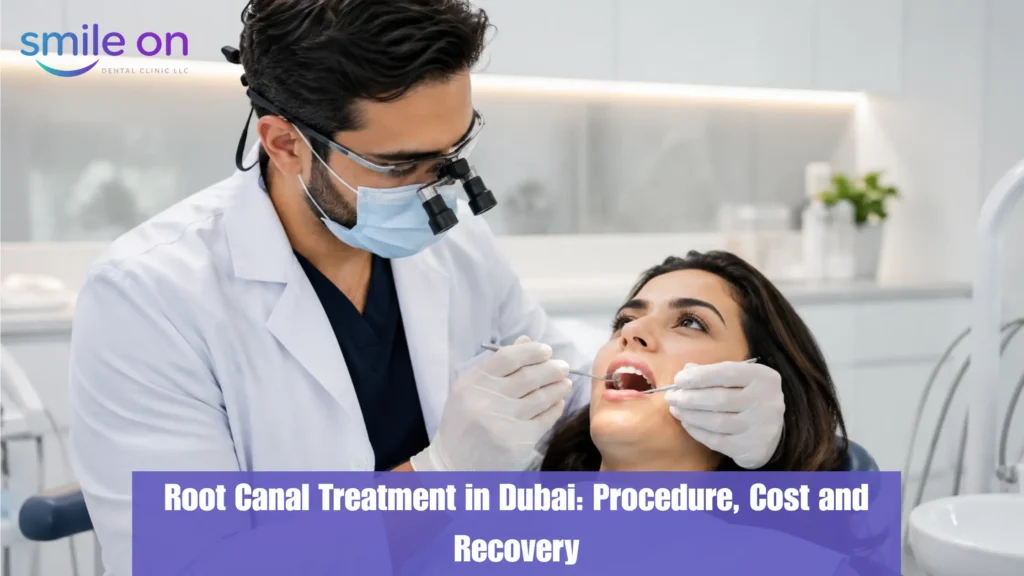
Root Canal Treatment in Dubai: Procedure, Cost, and What to Expect
12 min read Share: Root canal treatment saves a tooth that would otherwise need to be extracted. It involves removing infected or damaged tissue from inside the tooth, disinfecting the internal canal system, and sealing it to prevent reinfection. In Dubai, root canal treatment typically costs between AED 1,000 and AED 4,000 per tooth, depending on which tooth is being treated, the complexity of the canal anatomy, and whether a dental crown is included. If your dentist has told you that you need a root canal, or if you are experiencing symptoms that suggest you might, this guide covers exactly what the procedure involves, what causes the need for one, what the recovery looks like, and how to evaluate whether your quote is reasonable. What Is Root Canal Treatment and When Is It Needed? A root canal is a procedure that treats infection or damage inside the tooth’s pulp chamber. The pulp is the soft tissue at the centre of every tooth, containing nerves, blood vessels, and connective tissue. When this pulp becomes infected or irreversibly inflamed, the tooth does not heal on its own. Without treatment, the infection spreads to the surrounding bone, forms an abscess, and the tooth is eventually lost. Root canal treatment becomes necessary in several clinical situations. Deep decay that has reached the pulp. A cavity that goes untreated long enough will eventually penetrate through the enamel and dentin into the pulp chamber. Once bacteria reach the pulp, infection is essentially inevitable. A cracked or fractured tooth. A crack that extends into the pulp creates a direct pathway for bacteria. Even if the crack is not visible to the naked eye, it can expose the nerve and trigger infection. Trauma to the tooth. A blow to the face, a sports injury, or biting down on something unexpectedly hard can damage the pulp even if the tooth appears intact externally. The pulp may die slowly over weeks or months following the trauma. Repeated dental procedures on the same tooth. Each time a tooth is drilled for a filling or adjusted for a crown, the pulp is stressed. After multiple procedures, the pulp may become irreversibly inflamed (a condition called irreversible pulpitis) even without bacterial infection. A failed previous restoration. An old filling or crown with microleakage (a gap between the restoration and tooth structure) allows bacteria to seep in gradually and infect the pulp. The key clinical indicators that a root canal is needed include spontaneous pain (pain that occurs without any trigger), prolonged sensitivity to hot or cold that lingers for 30 seconds or more after the stimulus is removed, pain when biting or pressing on the tooth, swelling in the gum near the affected tooth, a discoloured (darkened) tooth, and a visible pimple-like swelling on the gum (a sinus tract or fistula draining pus from an abscess). What Happens During Root Canal Treatment: Step by Step The procedure is performed by a general dentist or, for complex cases, an endodontist (a dentist who has completed postgraduate specialty training in root canal therapy). Here is what happens during each phase. Diagnosis and Treatment Planning Your dentist will take a periapical X-ray (a detailed image of the individual tooth and surrounding bone) to assess the extent of infection, the number and shape of root canals, and whether there is bone loss around the root tip. In complex cases, a cone beam CT scan (CBCT) provides a three-dimensional view that reveals canal anatomy that standard X-rays cannot show. A series of clinical tests (cold test, electric pulp test, percussion test, palpation test) determine whether the pulp is alive, dead, or irreversibly inflamed. These tests guide the diagnosis and confirm which tooth is actually causing the symptoms. Referred pain, where one tooth causes pain that feels like it is coming from a different tooth, is common in the back of the mouth. Anaesthesia and Access Local anaesthesia is administered to numb the tooth and surrounding area completely. You should feel no pain during the procedure. For patients with dental anxiety, sedation dentistry options including oral sedation and nitrous oxide are available at some Dubai clinics. A rubber dam (a thin latex or silicone sheet) is placed over the tooth to isolate it from the rest of the mouth. This prevents saliva contamination, stops irrigating solutions from entering your throat, and creates a sterile working field. The rubber dam is a non-negotiable quality indicator. If a clinic performs root canals without one, that is a red flag. The dentist then drills a small access opening through the top of the tooth (for front teeth) or the biting surface (for molars) to reach the pulp chamber. Cleaning and Shaping Using specialised endodontic files, which are thin, flexible instruments made from nickel-titanium alloy, the infected or dead pulp tissue is removed from the pulp chamber and root canals. The canals are then shaped (widened in a precise taper) using rotary file systems driven by an electric endodontic motor. Throughout the cleaning process, the canals are irrigated with sodium hypochlorite (a powerful disinfectant that dissolves organic tissue and kills bacteria) and EDTA (a chelating agent that removes the smear layer and opens dentinal tubules for better disinfection). An electronic apex locator is used to measure the exact length of each canal to ensure the files reach the tip of the root without extending beyond it. This device has largely replaced the need for multiple X-rays during the procedure. Obturation (Filling the Canals) Once the canals are cleaned, shaped, and dried, they are filled with a biocompatible rubber-like material called gutta-percha, combined with a sealer cement. The gutta-percha is either laterally condensed (packed in from the sides) or vertically condensed using warm obturation techniques (heated gutta-percha that flows into canal irregularities for a more thorough seal). The goal of obturation is a complete, three-dimensional seal of the entire canal system from the access opening to the root tip. An incomplete seal allows bacteria to recolonise the canal space and cause reinfection. Restoration