Dental Radiology Services in Dubai: Precise Imaging for Accurate Diagnosis and Treatment Planning

Advanced Digital Dental Imaging at Smile On Dental Clinic, Al Satwa, Dubai

A dental diagnosis is only as good as the information available to support it. What a dentist can see with the naked eye during a clinical examination represents only a portion of what is happening in and around the teeth, jaw bone, and supporting structures. Dental radiology provides the imaging layer that makes accurate diagnosis possible, precise treatment planning achievable, and surgical procedures safer.

At Smile On Dental Clinic in Al Satwa, Dubai, dental radiology services are available in-house, meaning patients do not need to travel to an external imaging centre for the scans and X-rays that support their dental treatment. Digital X-rays, panoramic scans, and cone beam CT imaging are all available at the clinic and are interpreted by the treating specialist for each patient’s specific case.

This page covers the types of dental radiology available at Smile On Dental Clinic, what each imaging modality is used for, and what patients can expect from a dental imaging appointment.

This field is for validation purposes and should be left unchanged.
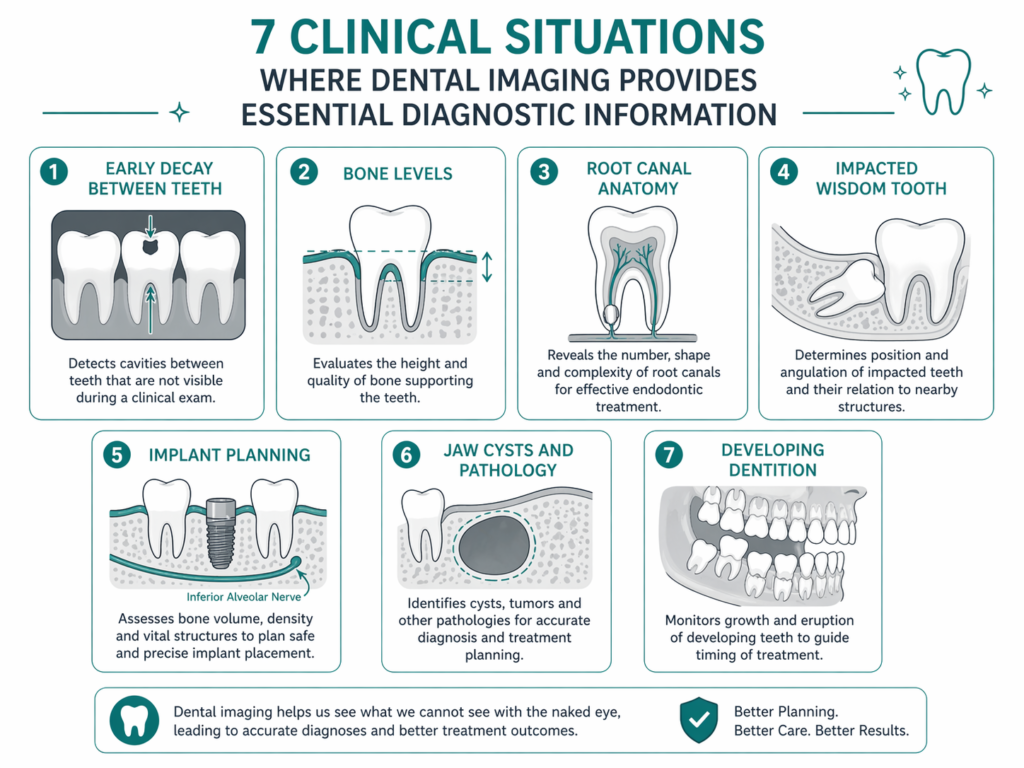
7 clinical situations in dental imaging

Why Dental Imaging Is Essential for Modern Dental Care

Dental imaging reveals information that no clinical examination alone can provide. Without X-rays and advanced imaging, a significant proportion of dental conditions would go undetected until they cause symptoms, by which point the problem has almost always progressed further and become more difficult and expensive to treat.

Here is what dental radiology reveals that is invisible to the naked eye:

  • Early decay between teeth: Cavities forming on the contact surfaces between adjacent teeth are completely invisible without an X-ray, yet they are among the most common locations for decay to develop
  • Bone levels around teeth: Periodontal bone loss caused by gum disease occurs beneath the gum surface and can only be accurately measured on a dental X-ray. Knowing the extent of bone loss is essential for planning periodontal treatment and assessing whether a tooth can be saved
  • Root anatomy for endodontic treatment: The number, length, curvature, and position of root canals in a tooth are determined from X-ray imaging before root canal treatment begins. This information directly determines how the procedure is planned
  • Impacted teeth: Wisdom teeth and other impacted teeth buried in the jaw bone are assessed entirely through imaging, as they have no visible clinical presence until they cause symptoms
  • Implant planning: The volume and density of jaw bone available for implant placement is measured from CBCT imaging, and the proximity of the inferior alveolar nerve and sinus floor to the planned implant positions can only be assessed three-dimensionally
  • Cysts and pathological changes: Bone cysts, tumours, and other pathological changes in the jaw bone have no clinical symptoms until they are advanced. Dental X-rays taken at routine checkups identify these changes early when they are far simpler to manage
  • Assessment of developing dentition in children: The position and development of permanent teeth forming beneath the primary teeth, including impacted canines and other developmental anomalies, are assessed through imaging in pediatric patients

Dental Radiology Services Available at Smile On Dental Clinic

Smile On Dental Clinic offers a full range of in-house dental imaging services at the Al Satwa clinic in Dubai, covering the imaging requirements of every specialty available at the clinic.

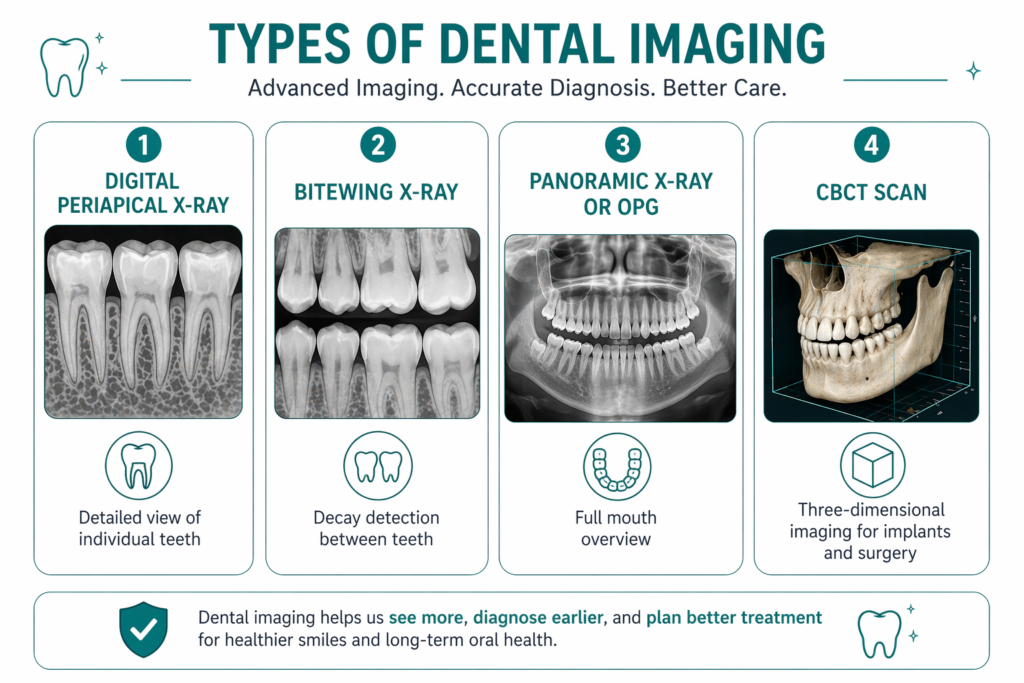
Digital Periapical X-Rays A periapical X-ray is a small, targeted image that shows the full length of one to three teeth including the root tips and the surrounding bone. It is the most commonly taken dental X-ray and is used for diagnosing decay, assessing root length and anatomy before endodontic treatment, checking bone levels around specific teeth, and evaluating the area around a dental implant at follow-up appointments.

Digital periapical X-rays at Smile On Dental Clinic use a sensor rather than traditional X-ray film, which produces an instant, high-resolution image on screen that can be enlarged, adjusted for contrast, and stored digitally in the patient’s record. The radiation dose from a digital periapical X-ray is significantly lower than from conventional film-based X-rays.

Bitewing X-Rays Bitewing X-rays show the crowns of the upper and lower back teeth in the same image and are the most effective X-ray type for detecting early cavities between adjacent teeth. They are a standard part of routine dental checkups for adults and children and are taken at intervals determined by the patient’s individual decay risk.

Dental Panoramic X-Ray (OPG) A panoramic X-ray, also called an orthopantomogram or OPG, is a wide-field image that captures all of the teeth, both jaw bones, the jaw joints, and the surrounding structures in a single scan. The patient stands at the machine and the X-ray source rotates around the head, producing a flattened two-dimensional representation of the entire dental and jaw anatomy.

Panoramic X-rays are used for overall assessment of the dentition and jaw, planning wisdom tooth extractions, evaluating jaw joint structure, assessing developing dentition in children, and as a baseline screening image before comprehensive treatment planning.

Cone Beam CT Scan (CBCT) A cone beam computed tomography scan, commonly called a CBCT or 3D dental scan, produces a three-dimensional volumetric image of the jaw, teeth, and surrounding structures. Unlike a medical CT scan, a CBCT is specifically designed for dental structures and uses a significantly lower radiation dose than medical CT while providing the three-dimensional detail needed for complex dental procedures.

At Smile On Dental Clinic, CBCT scanning is used for:

  • Implant planning: Measuring exact bone volume and density, identifying the position of the inferior alveolar nerve and sinus floor, and planning the position of implants digitally before surgery
  • 3D guided implant surgery: Producing the data from which a surgical guide is fabricated for guided implant placement
  • Complex endodontic cases: Assessing unusual root anatomy, identifying missed canals, and evaluating the extent of periapical pathology in difficult root canal cases
  • Impacted tooth assessment: Determining the three-dimensional position of impacted wisdom teeth, canines, and other buried teeth relative to adjacent roots and anatomical structures
  • TMJ assessment: Evaluating the bony components of the temporomandibular joint in patients with jaw joint disorders
  • Orthodontic planning: Assessing skeletal relationships, tooth positions, and airway dimensions as part of complex orthodontic treatment planning
Types of dental imaging infographic

Radiation Safety in Dental Radiology

Radiation exposure is a concern many patients raise, and it is a reasonable question to ask. The context that is helpful to understand is that the doses involved in dental radiology are among the lowest of any medical imaging procedure.

A single digital periapical X-ray delivers a radiation dose comparable to a few minutes of natural background radiation from the environment, far less than what a person is exposed to during a short flight. A full-mouth series of periapical X-rays is equivalent to a few hours of background radiation. A dental CBCT scan delivers more radiation than a single periapical X-ray but considerably less than a medical CT scan of the same area.

At Smile On Dental Clinic, dental X-rays are taken only when there is a specific clinical indication that makes the information they provide necessary for the patient’s diagnosis or treatment. Routine X-rays are not taken at every visit without reason. The frequency and type of imaging recommended for each patient is based on their individual clinical situation, their medical history, and the information genuinely needed to support their dental care.

Lead aprons and thyroid collars are used where indicated, particularly for pregnant patients where extra precaution is appropriate. Patients who have concerns about radiation are encouraged to discuss them directly with the treating clinician before any imaging is taken.

How Dental Radiology Supports Every Specialty at Smile On Dental Clinic

Because Smile On Dental Clinic has specialist clinicians across multiple dental disciplines, the in-house radiology capability directly supports the full scope of clinical work at the clinic. Each specialist uses imaging appropriate to their specialty as an integral part of their diagnostic and treatment planning process:

  • Dr. Arun Devarajan uses digital periapical X-rays and CBCT for endodontic diagnosis and root canal treatment planning
  • Dr. Vineetha Varughese uses bitewing and periapical X-rays for periodontal bone level assessment and treatment monitoring
  • Dr. Rahul Patel uses panoramic and periapical X-rays for prosthodontic planning and crown and implant assessment
  • Dr. Amit Gupta uses panoramic X-rays and CBCT for implant surgery planning, guided surgery, wisdom tooth assessment, and TMJ evaluation
  • Dr. Jeffrey Manuel uses panoramic X-rays and cephalometric imaging for orthodontic diagnosis and treatment planning
  • Dr. Hashmit Kaur uses periapical and panoramic X-rays for pediatric dental assessment and developing dentition monitoring

Having all imaging available in-house means patients do not wait for external imaging appointments to be scheduled before their treatment can be planned, and the treating clinician has direct access to the images for review and discussion with the patient at the same appointment.

Other Dental Services You May Be Interested In

Dental Implants Dubai: CBCT scanning is an essential component of safe implant planning at Smile On Dental Clinic. This page covers the full implant treatment range and how 3D imaging underpins every implant case from the initial assessment.

3D Guided Implant Surgery Dubai: This page explains in detail how CBCT scan data is used to plan implant positions digitally and fabricate a surgical guide for precisely guided implant placement at Smile On Dental Clinic.

Root Canal Treatment Dubai: Digital periapical X-rays and CBCT scanning are used at Smile On Dental Clinic to assess root anatomy before endodontic treatment and to confirm successful treatment outcomes. This page covers the full root canal treatment process.

What Our Patients Have to Say

Our Latest Blogs

  • All Posts
  • Dental
  • Dental Implants
  • Invisalign
  • PROSTHODONTICS
Load More

End of Content.

Book your dental appointment at Smile On Dental Clinic, Al Satwa, Dubai, and benefit from in-house digital dental imaging that supports accurate diagnosis and precise treatment planning from the first visit

Dental Radiology Dubai FAQs: What Patients Ask Most

Yes. Dental X-rays deliver very low levels of radiation, significantly lower than most other medical imaging procedures. A single digital periapical X-ray delivers a dose comparable to a few minutes of natural background radiation from the environment. Modern digital X-ray equipment at Smile On Dental Clinic uses considerably less radiation than older film-based systems. X-rays are only recommended when the clinical information they provide is necessary for the patient’s diagnosis or treatment, and lead aprons are used where indicated, including for pregnant patients.

A conventional dental X-ray, whether periapical, bitewing, or panoramic, produces a two-dimensional image of the teeth and jaw bone. A CBCT scan produces a three-dimensional volumetric image that can be viewed from any angle and measured precisely. CBCT is used when two-dimensional imaging does not provide sufficient information, which is most commonly the case for implant planning, guided surgery, complex root canal anatomy, impacted tooth assessment, and TMJ evaluation. Standard two-dimensional X-rays are used for the majority of routine dental diagnosis and are appropriate for most clinical situations.

The frequency of dental X-rays depends on your individual clinical situation, your decay risk, and your treatment history. Patients with a high decay risk, active gum disease, or complex dental treatment needs may require X-rays more frequently than patients who are dentally stable and well-maintained. Routine bitewing X-rays for adult patients with good dental health are typically recommended every one to two years. Your treating clinician at Smile On Dental Clinic will recommend the appropriate imaging frequency for your specific situation rather than applying a blanket schedule.

Yes. CBCT scanning is available in-house at Smile On Dental Clinic in Al Satwa, Dubai. This means patients requiring three-dimensional imaging for implant planning, guided surgery, complex root canal assessment, or other indications do not need to attend an external imaging centre. The scan is taken, reviewed, and used for treatment planning at the clinic by the treating specialist.

No external referral is required for dental radiology at Smile On Dental Clinic. Imaging is arranged directly by the treating clinician as part of the clinical assessment and treatment planning process. Patients who are already attending the clinic for any dental treatment will have the appropriate imaging taken at the clinic as part of their care. Patients who have had recent dental imaging at another clinic can bring their existing X-rays or scans for review by the treating clinician, which may avoid the need for repeat imaging.

Dental X-rays during pregnancy are generally considered safe when there is a specific clinical need for the imaging and appropriate shielding is used. The radiation dose from dental X-rays is very low, and with a lead apron and thyroid collar the exposure to the developing baby is negligible. Routine X-rays that are not clinically urgent are typically postponed until after delivery as a precaution. If you are pregnant and require dental treatment that involves imaging, discuss this with Dr. Amit Gupta or the treating clinician at Smile On Dental Clinic who will advise on the most appropriate approach for your specific situation.