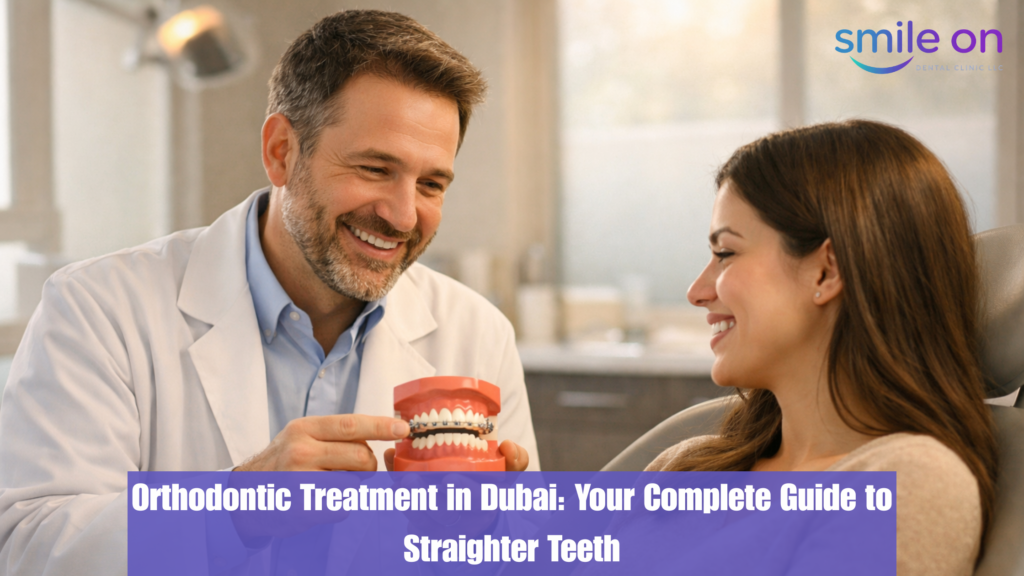
Orthodontic Treatment in Dubai: Your Complete Guide to Straighter Teeth
7 min read Share: You’ve been thinking about it for a while. Maybe it’s the slight crowding on your lower teeth, an overbite you’ve learned to live with, or gaps you’ve always felt self-conscious about. Whatever the reason, if you’re considering orthodontic treatment, you’re not alone. Thousands of people in Dubai, both children and adults, start this process every year, and the options available today are far better than what most people imagine. Orthodontic treatment is the branch of dentistry focused on correcting the alignment of teeth and jaws. It uses appliances like braces or clear aligners to move teeth gradually into their correct positions, improving both function and appearance. In Dubai, where appearance and professional presentation matter to many residents and expats, demand for orthodontic care has grown significantly. This guide covers everything you need to know: the types of treatment available, who needs it, how long it takes, what it costs, and how to choose the right orthodontist in Dubai. What Does Orthodontic Treatment Actually Fix? Orthodontic treatment addresses a range of alignment issues, not just crooked teeth. The most common conditions treated include crowding (teeth that overlap due to insufficient space), spacing (gaps between teeth), overbite (upper teeth covering too much of the lower teeth), underbite (lower teeth sitting in front of upper teeth), crossbite, and open bite. Beyond aesthetics, misaligned teeth can cause real functional problems. Crowded teeth are harder to clean, which increases the risk of decay and gum disease. An uncorrected bite issue can lead to jaw pain, uneven wear on tooth enamel, and even headaches in some cases. So when people pursue orthodontic treatment, they’re often investing in their long-term dental health, not just a more confident smile. The right treatment for you depends on the type and severity of the misalignment, your age, and your lifestyle preferences. That’s why a proper clinical assessment from a qualified orthodontist is always the starting point. What Are the Types of Orthodontic Treatment Available in Dubai? Dubai clinics now offer several well-established types of orthodontic appliances, and the choice between them depends on your specific case as much as your personal preferences. Traditional Metal Braces Metal braces remain one of the most reliable and cost-effective options for complex cases. They use metal brackets bonded to the teeth, connected by an archwire that applies gentle, consistent pressure over time. Modern metal braces are smaller and more comfortable than older versions, and they work well for patients of all ages. Damon Braces Damon braces use a self-ligating bracket system, meaning they don’t require the elastic ties used in traditional braces. This can reduce friction during tooth movement and may mean fewer adjustment visits. Many patients find them more comfortable, and they can work faster in certain cases. Lingual Braces Lingual braces are fixed to the back surface of your teeth, making them essentially invisible from the front. They’re a good choice for adults who want the effectiveness of fixed braces without the visible brackets. They do require a short adjustment period for speech and tongue comfort. Invisalign (Clear Aligners) Invisalign uses a series of custom-made, removable clear aligners to shift teeth gradually. Each set of aligners is worn for about one to two weeks before moving to the next. Because they’re removable, you can eat and brush normally without any restrictions. Invisalign is popular with adults and older teenagers in Dubai, particularly those in professional or social environments where visible braces feel like an obstacle. The right choice isn’t always obvious from the outside. An orthodontist will assess your bite, jaw structure, and bone density before recommending a specific appliance. How Long Does Orthodontic Treatment Take? This is one of the first questions people ask, and the honest answer is: it varies, but there are useful benchmarks. For mild cases, such as minor crowding or small gaps, treatment with clear aligners can be completed in as little as six to twelve months. Moderate cases typically take twelve to eighteen months. More complex cases involving significant bite correction or jaw alignment can take anywhere from eighteen months to three years. Age plays a role too. Teenagers tend to see faster tooth movement than adults because their bone density is lower and their jaws are still developing. That said, adults achieve excellent results with orthodontic treatment; it simply requires patience and consistency. Compliance matters more than most people expect. With removable aligners, wearing them for the recommended 20 to 22 hours a day is essential for staying on track. Missing appointments or not wearing your aligners as prescribed are the most common reasons treatment takes longer than expected. What Is the Cost of Orthodontic Treatment in Dubai? Orthodontic treatment costs in Dubai vary depending on the type of appliance, the complexity of the case, and the clinic you choose. As a general guide: Traditional metal braces typically range from AED 5,000 to AED 10,000 for a full course of treatment. Damon or self-ligating braces tend to be slightly higher, in the AED 7,000 to AED 12,000 range. Lingual braces, due to their custom fabrication, usually start from AED 12,000 and can go higher for complex cases. Invisalign treatment in Dubai commonly ranges from AED 8,000 to AED 18,000, depending on the number of aligners required. These figures are estimates and your actual cost will be confirmed after a clinical assessment. Many clinics, including Smile On Dental Clinic, offer flexible payment plans, which makes the process more manageable for families or individuals budgeting carefully. Some UAE insurance plans cover a portion of orthodontic costs for children, so it’s worth checking your policy. Who Should Consider Orthodontic Treatment, and When Is the Right Age? There is no single right age for orthodontic treatment, but timing can affect both the ease of treatment and the long-term outcome. For children, the ideal window for a first orthodontic assessment is around age seven. At this stage, an orthodontist can spot developing issues early, even while most baby teeth are still present. Early intervention doesn’t