
TMJ Jaw Pain: Symptoms, Causes and When to See a Specialist

5 min read Share: Jaw pain, clicking when you open your mouth, headaches around the temples, or a jaw that feels tired after chewing are all common signs of a problem with the temporomandibular joint, better known as TMJ. In most people these symptoms are caused by muscle tension, clenching or grinding, and they often settle with simple self-care. When pain keeps coming back, the jaw locks, or opening becomes limited, it is time to see a specialist. This guide explains what the TMJ is, the most common symptoms and causes of jaw pain, what you can safely try at home, and the signs that mean you should get it checked. It is written by the team at Smile On Dental Clinic in Al Satwa, Dubai, for anyone living with jaw pain who wants to understand what is going on. What is the TMJ? The temporomandibular joint is the hinge that connects your lower jaw to your skull, just in front of each ear. You have two, one on each side, and they work together every time you talk, chew, yawn or swallow. A small disc of cartilage sits inside each joint and cushions the movement, while several muscles control how the jaw opens, closes and moves side to side. Problems with the joint, the disc or the surrounding muscles are grouped together as temporomandibular disorders, often shortened to TMD or simply “TMJ problems”. They range from mild, short-lived muscle soreness to long-term joint conditions. Common symptoms of a TMJ problem The most common symptom is pain or tenderness in the jaw, around the ear or in the temples, often worse when chewing or first thing in the morning. Other signs include: Clicking on its own, without pain or restricted movement, is common and usually does not need treatment. It becomes worth checking when it comes with pain, locking or difficulty opening. What causes TMJ jaw pain? Most TMJ pain comes from overworked jaw muscles, usually from clenching or grinding, rather than from damage inside the joint. The main causes are: Cause What happens Common clues Clenching and grinding (bruxism) Constant pressure overworks the jaw muscles and strains the joint Morning jaw ache, worn or chipped teeth, partner hears grinding at night Stress Tension often shows up as clenching during the day without realising Symptoms worse during busy or stressful periods Disc displacement The cushioning disc slips out of position Clicking, catching or locking of the jaw Arthritis Wear or inflammation inside the joint Grating sound, stiffness, pain that builds over time Injury A blow to the jaw, a fall or a whiplash injury Pain starting after a specific event Habits Chewing gum, biting nails, resting your chin on your hand, holding the phone with your shoulder Pain linked to specific activities Bite problems Teeth that do not meet evenly can contribute to muscle strain in some people Uneven wear, a bite that feels “off” Often more than one factor is involved. Stress leads to clenching, clenching tires the muscles, and tired muscles make the joint more sensitive. What you can try at home For mild or recent jaw pain, simple self-care often helps within a few weeks. These steps are safe for most people: Rest your jaw. Choose softer foods for a while, cut food into smaller pieces, and avoid chewing gum, very chewy meat and hard foods like nuts. Notice clenching during the day. Your teeth should only touch when you swallow or chew. A simple reminder is “lips together, teeth apart”. Many people are surprised how often they clench at a desk or while driving. Use warm or cold compresses. A warm compress relaxes tight muscles, while a cold pack can ease sharp pain. Ten to fifteen minutes at a time is enough. Gently massage the jaw muscles. Use your fingertips in small circles on the sides of the face and the temples. Avoid wide opening. Support your chin when yawning, and avoid biting into very large items. Look after posture. Long hours looking down at a phone or laptop push the head forward and add tension to the neck and jaw. Manage stress. Exercise, sleep and relaxation techniques reduce clenching, especially at night. Over-the-counter pain relief can help in the short term, but if you find you need it regularly, the cause needs looking at rather than masking. When should you see a specialist? See a dentist or TMJ specialist if your jaw pain lasts more than a couple of weeks, keeps returning, or comes with any of the following: Getting it checked early matters. Muscle-related pain is much easier to settle before it becomes a long-term pattern, and joint problems are better managed when they are diagnosed accurately. What happens at a TMJ assessment? A TMJ assessment starts with a conversation about your symptoms and habits, followed by an examination of the jaw joints, muscles and bite. The specialist will: From there you get a clear explanation of what is causing your symptoms and a treatment plan. How is TMJ pain treated? Most TMJ problems are treated without surgery. Treatment usually starts with the simplest options and only moves on if symptoms do not improve: TMJ treatment at Smile On is priced on consultation, because it depends on what the assessment finds. You can read more about how we diagnose and treat jaw joint problems on our TMJ treatment in Dubai page. TMJ pain and teeth grinding Grinding often happens during sleep, so many people do not know they do it. Signs include waking with a sore jaw or headache, teeth that look flatter or have small chips, and sensitive teeth. Over time, grinding wears enamel and can crack fillings or teeth, which is why a night guard protects both the joint and the teeth. If grinding has already damaged teeth, options such as dental crowns can restore them once the grinding is under control. Who treats TMJ problems at Smile On? TMJ assessment and treatment at Smile On Dental Clinic is led by
Wisdom Tooth Extraction Cost in Dubai: What to Expect Before, During, and After
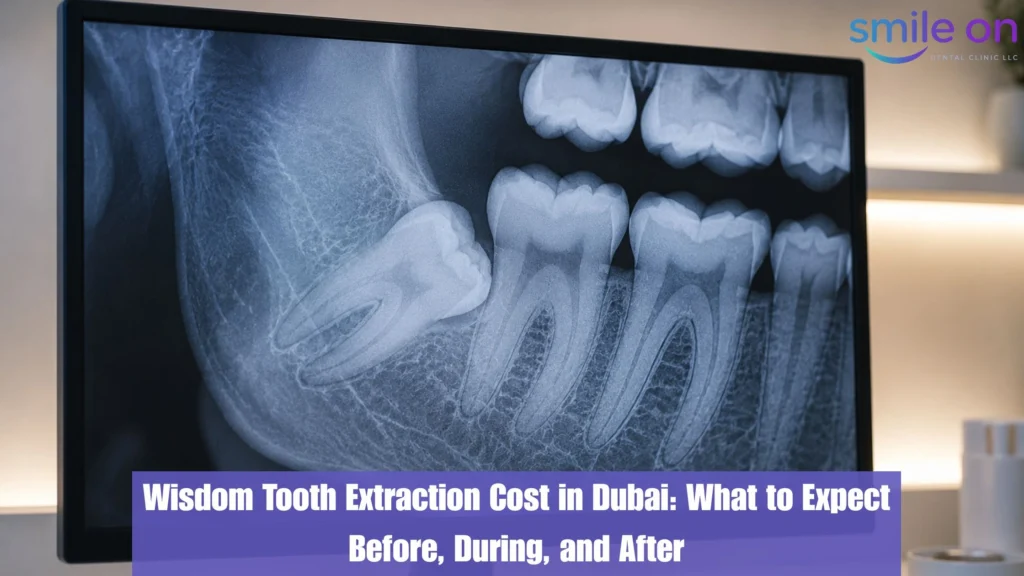
5 min read Share: Wisdom tooth pain has a way of making dental decisions urgent. Most people searching for extraction costs in Dubai aren’t browsing casually they’re in discomfort, they’ve been told the tooth needs to come out, and they want to know what they’re getting into and what it’s going to cost before they book anywhere. This guide gives you straight answers. What the procedure involves, what determines the price in Dubai, the difference between a simple extraction and a surgical one, and what the recovery actually looks like without the clinical language that makes it harder to understand than it needs to be. Why Wisdom Teeth Cause Problems Wisdom teeth are the third molars the last teeth to erupt, typically between the ages of 17 and 25. Because they arrive last, there often isn’t enough space for them to emerge properly. When they can’t come through fully, they become “impacted” either trapped under the gum, partially erupted, or growing at an angle that pushes against the adjacent molar. Impacted wisdom teeth cause problems in several predictable ways: recurring infection in the gum tissue around the partially erupted tooth, decay on the adjacent second molar, cyst formation around an unerupted tooth, or persistent jaw pain that’s difficult to locate without an X-ray. Not every wisdom tooth needs to come out. Fully erupted, properly aligned wisdom teeth that can be cleaned effectively are fine to leave. The decision to extract should be based on a proper clinical assessment and X-ray not just because the tooth exists. Simple vs Surgical Extraction: What’s the Difference? This distinction matters because it’s the biggest single factor in what you’ll pay. Simple extraction applies to a wisdom tooth that has fully erupted above the gumline, is accessible, and can be removed with forceps in a straightforward procedure. It typically takes 20–40 minutes, requires only local anaesthetic, and has a relatively quick recovery. Surgical extraction is required when the tooth is impacted partially or fully submerged in the gum or jawbone, growing at an angle, or positioned in a way that makes simple removal impossible. The oral surgeon makes a small incision in the gum, may need to section the tooth into pieces for removal, and closes the site with dissolvable sutures. This takes longer, involves more post-operative care, and costs more. The type of extraction you need is determined by your X-ray, which is why a dental assessment before quoting is essential. Any clinic quoting you a price for wisdom tooth removal without seeing your X-ray is guessing. Wisdom Tooth Extraction Cost in Dubai: What to Expect Prices in Dubai in 2026 typically fall within these ranges: Extraction Type Approximate Cost Per Tooth Simple extraction (erupted tooth) AED 400 – AED 900 Surgical extraction (partially impacted) AED 900 – AED 2,000 Surgical extraction (fully impacted/bony) AED 1,500 – AED 3,000 All four wisdom teeth (surgical, combined) AED 4,000 – AED 9,000 What is typically included: What is often charged separately: Always ask for a written cost breakdown that covers all of the above before proceeding. A clinic that can’t give you a clear itemised quote before the procedure isn’t well-organised enough to be trusted with the procedure itself. What to Expect on the Day Most wisdom tooth extractions at a competent Dubai clinic are far less dramatic than patients expect. Here’s the actual sequence. Local anaesthetic is administered around the affected area. You will feel pressure during the procedure but not pain. If you feel sharp pain at any point, you tell the dentist immediately. You should always be adequately numb before the procedure begins. For a simple extraction: The dentist loosens the tooth using an elevator instrument, then removes it with forceps. The socket is cleaned and you bite on gauze for 20–30 minutes to control initial bleeding. For a surgical extraction: An incision is made in the gum to expose the tooth and any surrounding bone. The tooth may be divided into sections to allow safer removal. The site is thoroughly cleaned, and dissolvable sutures close the incision. The whole procedure typically takes 45 minutes to an hour for a complex impacted tooth. Sedation options are available for patients who experience significant dental anxiety. IV sedation allows you to remain conscious but fully relaxed and amnesiac you won’t remember the procedure. This is arranged in advance and requires someone to drive you home. Recovery: What Actually Happens After Extraction Recovery from wisdom tooth extraction in Dubai is broadly predictable. The first 48–72 hours are the most uncomfortable; after that, most patients return to normal activity. The first 24 hours: Some bleeding is normal and controlled with gauze pressure. Swelling begins and peaks around day 2–3. Rest, keep your head elevated, and avoid strenuous activity. Do not rinse forcefully, use a straw, or smoke:all of these disturb the blood clot forming in the socket, which is how “dry socket” (a painful complication) develops. Days 2–5: Swelling is at its peak around day 2–3 then gradually reduces. Soft foods, gentle saltwater rinses from day 2 onwards, and prescribed pain relief and antibiotics if given. Most people with desk jobs return to work within 2–3 days; physical jobs may require 4–5 days. After one week: Dissolvable sutures begin to dissolve. Most patients feel largely normal. A follow-up appointment checks that healing is progressing without infection. Dry socket occurs when the blood clot is dislodged before the socket heals, leaving nerve and bone exposed. It causes intense, identifiable pain 3–5 days after extraction that is distinctly worse than normal post-procedure soreness. It is treatable contact your clinic immediately if you think this is happening rather than waiting. What Patients in Sharjah and Abu Dhabi Should Know Wisdom tooth extraction prices in Sharjah are generally similar to Dubai, sometimes modestly lower. Patients in Abu Dhabi sometimes travel to Dubai for specialist oral surgery, particularly for complex impacted cases requiring a maxillofacial surgeon. The same advice applies regardless of emirate: the type of impaction determines the complexity, the