All-on-4 and All-on-6 both replace a full row of teeth using a fixed bridge supported by a small number of implants. You don’t remove them. You care for them like natural teeth. The difference is how many implants anchor the bridge, where they sit in the jaw, and which clinical situations each one is designed for.
If you’re researching full arch implants in Dubai, this is the comparison you need before your consultation.
Ready to find out which is right for your teeth?
Book a consultation at Smile On Dental Clinic in Al Satwa. We assess your teeth properly and give you a written recommendation with rationale before you decide anything.
What All-on-4 and All-on-6 Actually Mean
Both treatments replace every tooth in one arch (upper jaw, lower jaw, or both) using a fixed bridge that is permanently screwed onto implant posts placed in the jaw. The bridge is not a denture. It does not come out. It functions and looks like natural teeth.
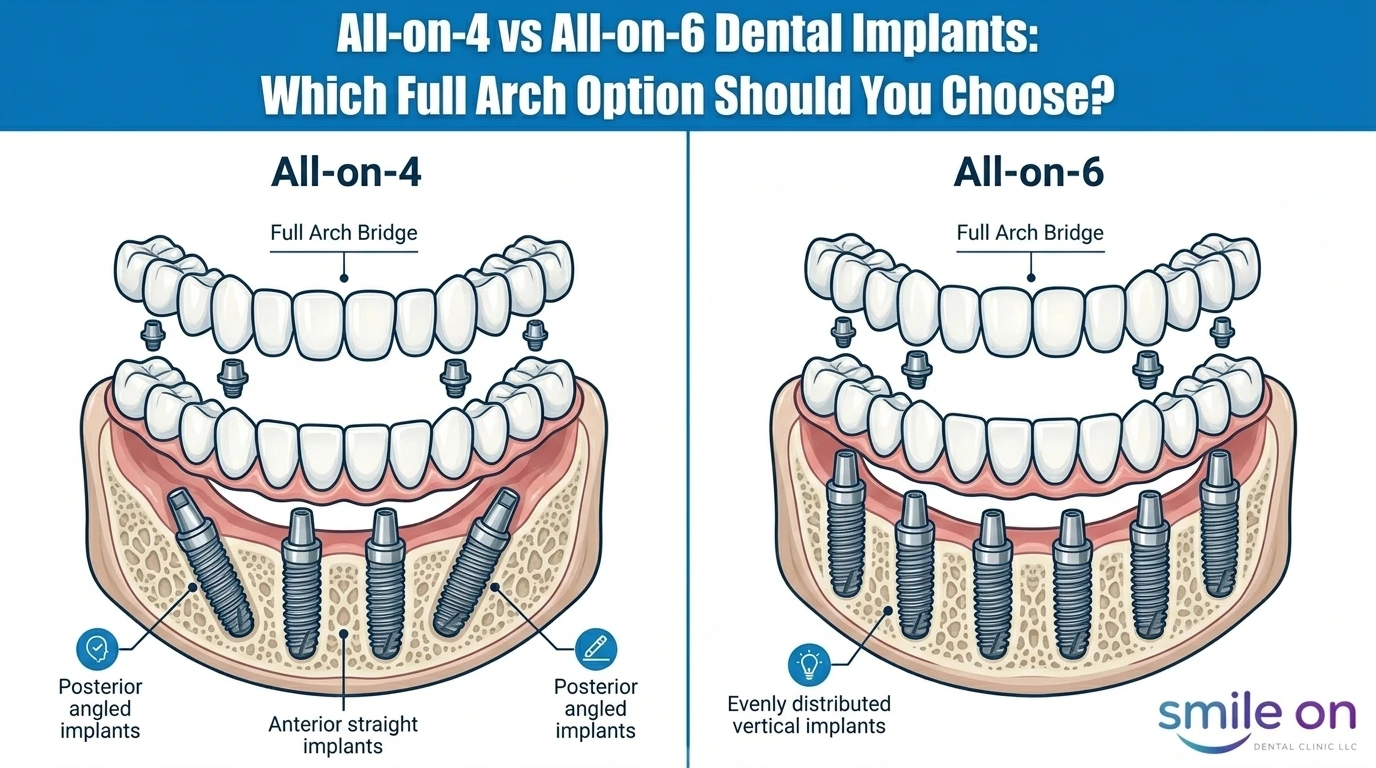
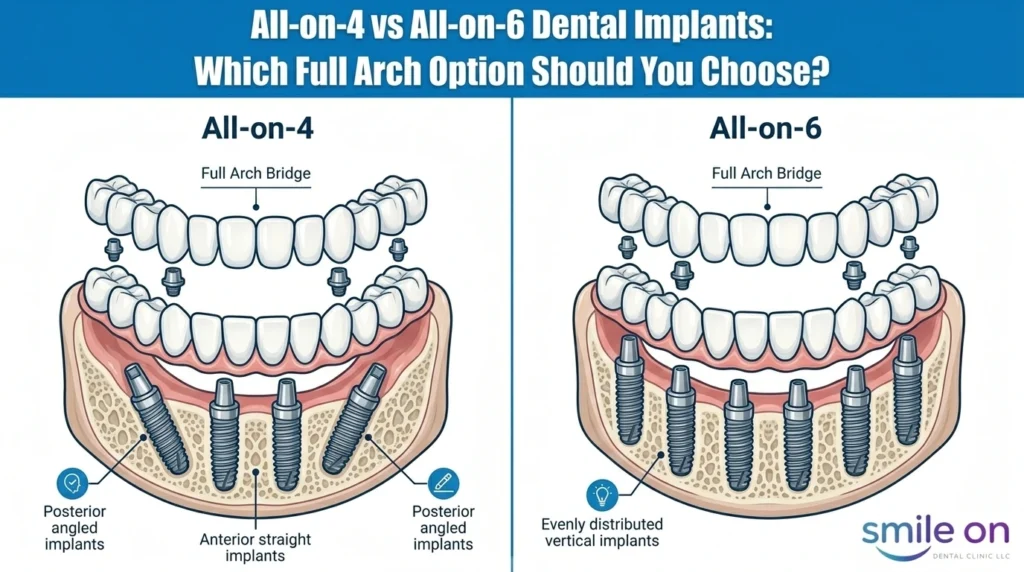
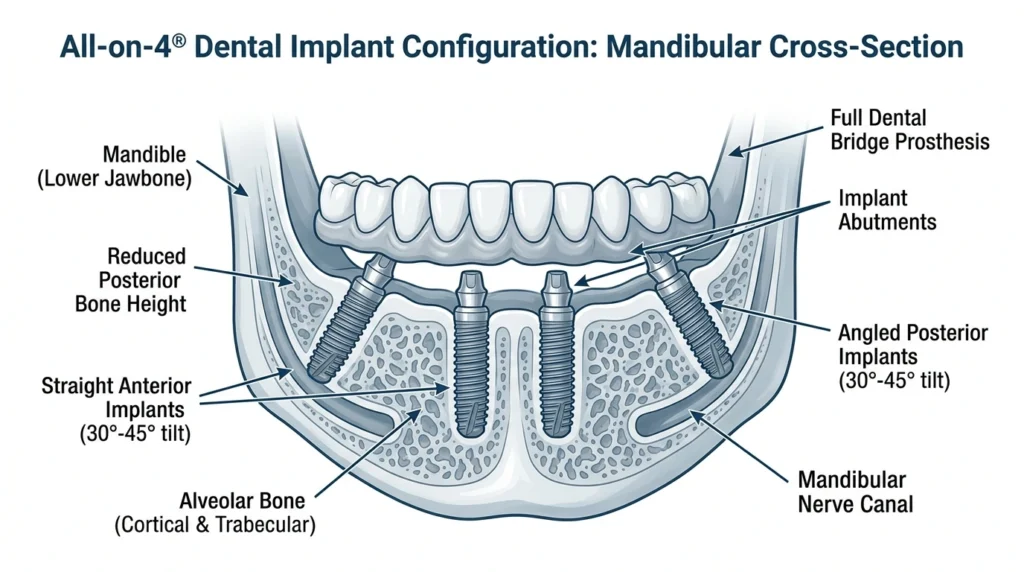
All-on-4: Four titanium implant posts are placed in the jaw. The two front implants sit straight. The two rear implants are angled at approximately 30-45 degrees. The angling achieves two things: it allows the rear implants to anchor into a longer section of available bone, and it avoids the areas at the back of the jaw where bone is often thinner, or where sinus anatomy in the upper jaw limits vertical implant depth.
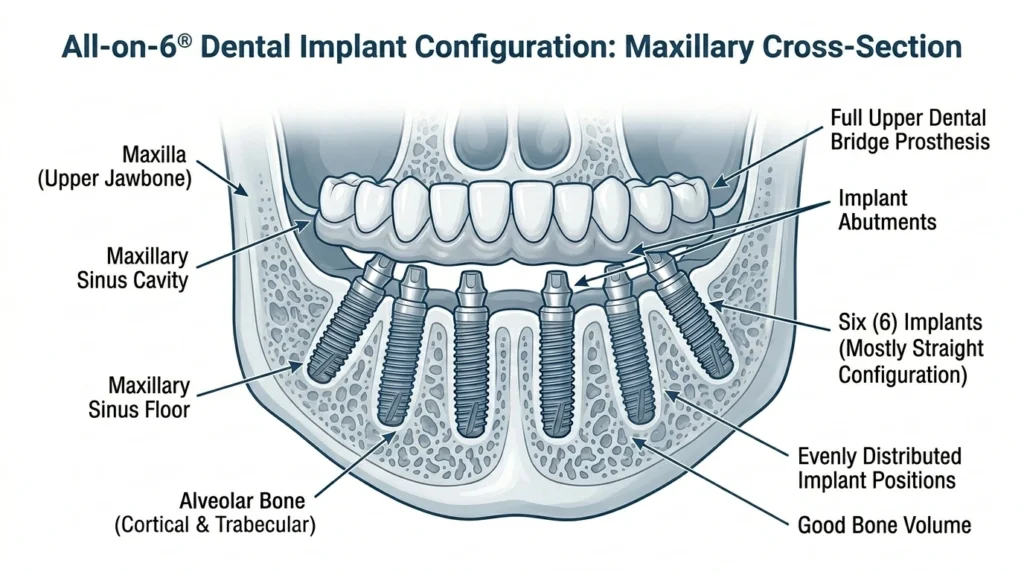
All-on-6: Six titanium implants are placed, typically distributed more evenly across the arch. The additional implants provide more support points for the bridge and spread the chewing load across a wider area of the jaw.
In both cases, the bridge placed on top is fixed permanently at the implant connections.
Core Differences at a Glance
| Factor | All-on-4 | All-on-6 |
|---|---|---|
| Number of implants per arch | 4 | 6 |
| Rear implant angulation | 30-45 degrees | Typically straight or minimal angle |
| Bone density requirement | Works with moderate bone loss | Requires more available bone volume |
| Chewing load distribution | Across 4 points | Across 6 points |
| Suitability for patients with bone loss | Better suited | May require bone grafting if volume is low |
| Approximate cost per arch (Dubai, 2025) | AED 25,000 – 55,000 | AED 30,000 – 65,000 |
| Upper jaw with sinus proximity | Yes — angled implants avoid the sinus floor | May require sinus lift in lower-volume cases |
All-on-4: The Logic Behind the Angled Implants
All-on-4 was developed to make full arch implant treatment possible for patients who had been told they didn’t have sufficient bone for conventional implants. The angling technique lets the rear implants engage a longer stretch of available bone, bypassing the areas of maximum resorption.
This matters clinically because patients who have worn dentures for years, or who have lost teeth due to advanced gum disease, often have significant bone loss in the regions where teeth used to be. The All-on-4 concept, developed by Dr. Paulo Malo, uses the bone that remains, positioned at an angle, rather than first grafting in new bone.
For many patients, this eliminates the need for bone grafting that would otherwise be required before any implants could be placed. That reduces total treatment time, the number of surgical procedures, and the overall cost compared to a grafting-plus-conventional-implant plan.
All-on-6: When More Support Points Make a Difference
Adding two more implants distributes the load of chewing across six anchor points rather than four. For patients with adequate bone volume, this provides:
Better long-term load distribution. Each implant carries less individual force when six are sharing the load. Over years of chewing, this can be beneficial for the bone around each implant and for the mechanical integrity of the bridge-to-implant connections.
A wider structural base for the bridge. With six support points, the prosthetic engineering of the bridge has more structural options, which can simplify the design and reduce mechanical stress at each connection point.
Reduced risk of full arch failure. In the unlikely event that one implant fails to integrate, a six-implant bridge has more redundancy than a four-implant bridge. This is a relevant consideration for patients with risk factors such as a history of smoking or uncontrolled diabetes.
Where All-on-6 is particularly appropriate:
Upper jaw cases in patients with good bone volume. The maxilla (upper jaw) has different bone quality characteristics to the lower jaw and often benefits clinically from the additional anchor points.
Patients with strong bite forces, such as those who grind or clench their teeth. More implants distributing that force is a measurable advantage over time.
Cases where the surgeon assesses that four anchor points won’t provide optimal long-term stability given that patient’s specific bone density and jaw anatomy.
Bone Density Is the Real Deciding Factor
The choice between All-on-4 and All-on-6 is driven by clinical assessment, not personal preference. It is determined primarily by your bone volume and density as revealed by a CBCT (cone beam CT) scan.
A CBCT scan gives the implant surgeon a three-dimensional view of the entire jaw. It shows exactly how much bone is available at each proposed implant site, where bone density is adequate for secure implant placement, and where anatomical structures (the inferior alveolar nerve in the lower jaw, the sinus floor in the upper jaw) limit implant positioning and depth.
After reviewing the CBCT, the clinical picture generally falls into one of three situations:
Bone is moderate to significantly reduced across the arch. All-on-4 is typically recommended. The angling technique makes the most of available bone without requiring grafting.
Bone volume is good across the arch. All-on-6 may be recommended to provide optimal load distribution and the strongest long-term structural foundation.
Bone loss is very severe. Neither All-on-4 nor All-on-6 may be immediately viable. Bone grafting or sinus lift surgery may need to come first, extending the treatment timeline.
No responsible implant clinic should quote you for either treatment without first reviewing a CBCT scan. If you receive a quote before a scan has been done, ask for it to be completed before the treatment plan is finalised.
Cost Comparison in Dubai
| Treatment | Approximate Cost per Arch (AED) |
|---|---|
| All-on-4 | AED 25,000 – AED 55,000 |
| All-on-6 | AED 30,000 – AED 65,000 |
| Bone grafting if required | AED 1,500 – AED 8,000 (extent-dependent) |
| CBCT scan | AED 300 – AED 600 (sometimes included in consultation) |
For patients treating both arches, these figures apply per arch. The difference between All-on-4 and All-on-6 per arch reflects the additional implants and the more complex surgical planning and prosthetic work involved.
When getting quotes, ask for an itemised written breakdown that specifies: the number of implants, implant brand, whether CBCT is included, whether bone grafting is included or charged separately, the bridge material (PMMA temporary versus zirconia permanent), and what follow-up appointments are covered in the package price.
The Role of 3D Guided Implant Surgery at Smile On Dental Clinic
At Smile On Dental Clinic in Al Satwa, Dubai, All-on-4 and All-on-6 procedures are performed by Dr. Rahul Patel, the clinic’s oral and maxillofacial surgery specialist.
3D guided implant surgery uses the CBCT scan data to plan each implant’s exact position digitally before any surgery begins. A surgical guide is produced from this plan and used during the procedure to place each implant at precisely the planned position, depth, and angle.
For All-on-4 cases, 3D guided planning is particularly valuable. The angled rear implants need to be calculated precisely relative to available bone, the inferior alveolar nerve, and the sinus anatomy. A surgical guide removes the guesswork from what is already a technically demanding placement.
For All-on-6, the same planning approach applies, confirming that each of the six positions has adequate bone support and optimal distribution for load bearing.
Book a Dental Consultation
Al Satwa, Dubai
Frequently Asked Questions
Which is better, All-on-4 or All-on-6?
Neither is universally better. All-on-4 is more appropriate for patients with moderate bone loss because angled rear implants use available bone efficiently. All-on-6 provides better load distribution and suits cases with adequate bone volume across the arch. Your CBCT scan determines which is clinically appropriate for your jaw.
How long do All-on-4 and All-on-6 implants last?
Implant posts, when properly placed and maintained, can last 20 years or more. The bridge on top typically needs replacement after 10-15 years depending on the material. Zirconia bridges generally outlast acrylic or PMMA bridges. Proper oral hygiene and regular monitoring appointments are essential for long-term success.
Is the All-on-4 procedure painful?
The procedure is performed under local anaesthesia, so there is no pain during surgery. Post-operative discomfort during the first 3-5 days is managed with prescribed pain relief and is comparable to other oral surgical procedures. Swelling and some bruising are normal during the first week. Most patients find the discomfort manageable.
Can I eat normally after All-on-4 or All-on-6?
A temporary bridge is placed shortly after surgery, allowing soft food consumption relatively quickly. Full dietary normalcy, including hard and crunchy foods, is restored gradually over 3-6 months as the implants integrate with the jawbone. The permanent bridge is placed after full osseointegration is confirmed.
Do I need bone grafting before All-on-4?
All-on-4 was specifically designed to reduce the need for bone grafting by using angled rear implants to access available bone more efficiently. Many patients who would require grafting before conventional implants can proceed directly with All-on-4. Whether grafting is needed is determined by your CBCT scan at the consultation.
How do I clean All-on-4 or All-on-6 implants?
You brush the bridge and implant areas with a soft toothbrush twice daily. A water flosser is recommended to clean beneath the bridge where it meets the gum tissue. Regular professional hygienist appointments, typically every 6 months, are essential for cleaning under and around the bridge where a toothbrush cannot reach effectively.