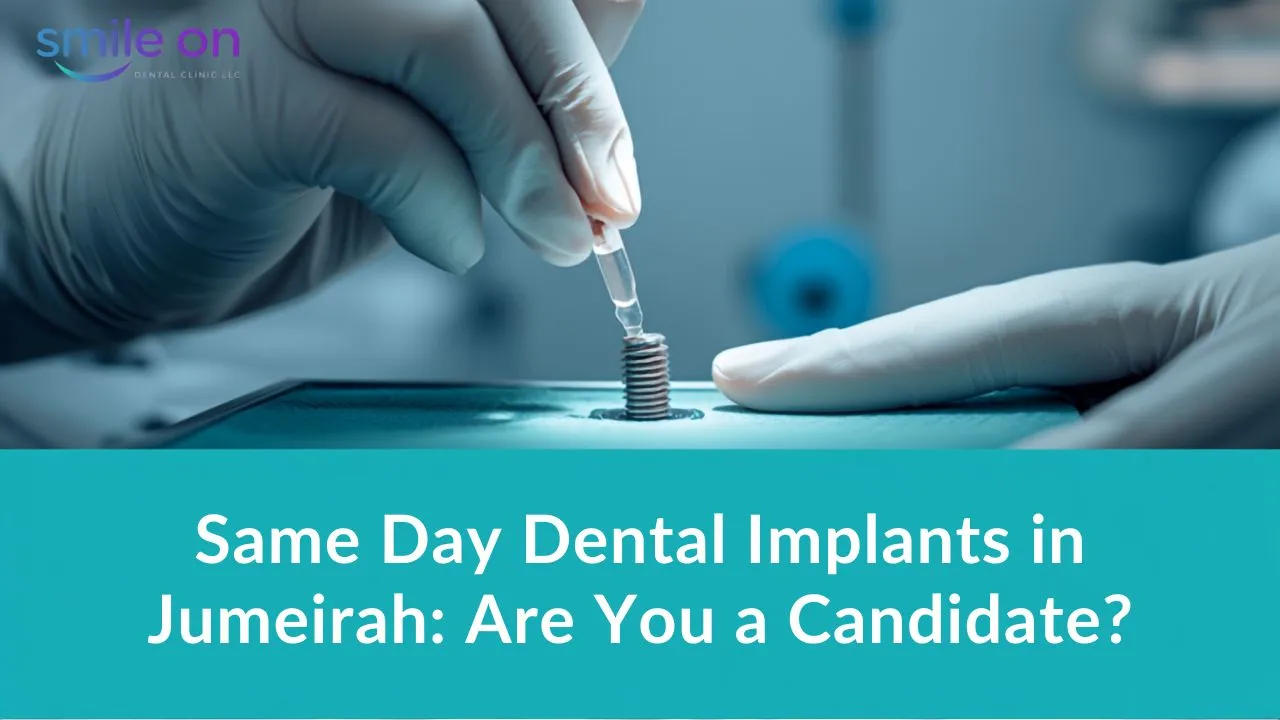
Same Day Dental Implants in Jumeirah — Are You a Candidate?
8 min read Share: Same day dental implants let you leave the clinic with a functioning temporary tooth on the same appointment your implant is placed. No waiting three to six months between surgery and restoration. No gap in your smile during healing. For patients who qualify, it is a genuine step forward from conventional implant treatment. The word candidate matters here. Not everyone is suitable for immediate loading, and a clinic that skips that conversation is worth avoiding. If you are researching same day dental implants in Jumeirah, this guide explains exactly who qualifies, what gets assessed at your consultation, what the procedure involves step by step, and what recovery actually feels like in the weeks that follow. At Smile On Dental Clinic in Al Satwa, Dubai, implant treatment is handled by a specialist surgical and restorative team. Dr. Amit Gupta, a DHA-licensed specialist in oral and maxillofacial surgery, places the implant. Dr. Rahul Patel, a DHA-licensed specialist prosthodontist, designs and fits the crown. The clinic is accessible from the Jumeirah area in under 10 minutes. What Are Same Day Dental Implants? Same day dental implants, also called immediate loading implants or teeth in a day, combine two stages that happen months apart in conventional implant treatment: placing the titanium implant into the jawbone and attaching a temporary crown on top. In a standard implant procedure, you receive the implant, then wait three to six months for osseointegration before a crown is placed. Same day treatment loads the implant with a temporary crown immediately, giving you a functional, aesthetic replacement while bone continues to integrate around it. The permanent crown is typically fitted three to six months later, once integration is confirmed. This approach is backed by over a decade of published clinical data showing success rates of 94 to 97 percent at five years for single-tooth same day implants in properly selected patients, comparable to conventional two-stage implants. Who Is a Good Candidate? Same day implants require stricter patient selection than conventional implants. Every case is assessed before the procedure is planned. Adequate bone density and volume. The implant needs sufficient bone to anchor in on day one, since it is loaded immediately. Bone quantity and quality are assessed using a CBCT 3D scan before any procedure. If bone volume is insufficient due to long-term tooth loss or bone resorption, a bone graft may be recommended first, and same day loading may not be appropriate. Healthy gums. Active gum disease creates infection risk that makes immediate loading inadvisable. Patients with a history of gum disease need a clean bill of gum health confirmed clinically before proceeding. No active infection at the implant site. If the tooth being replaced had an active abscess, same day placement requires caution. Dr. Amit Gupta assesses whether immediate placement is safe or whether a healing period is needed first. No systemic conditions affecting bone healing. Uncontrolled diabetes, active cancer treatment, bisphosphonate therapy, and certain autoimmune conditions affect how bone heals. These are not automatic disqualifiers but require detailed clinical review before same day loading is recommended. Non-smoker status. Smoking reduces blood flow to gum and bone tissue, which impairs osseointegration. Patients who smoke carry a materially higher risk of implant failure. The standard recommendation is to stop smoking completely for at least two weeks before and eight weeks after placement. What if you do not qualify? Conventional two-stage implants remain an excellent solution for patients who do not meet immediate loading criteria. Outcomes are clinically equivalent. The main difference is timeline. Dr. Gupta and Dr. Patel will discuss both options and recommend the one that gives the best long-term result for your case. Who This Fits: Real Patient Scenarios in Jumeirah The professional who cannot be without a front tooth for months. Patients in client-facing roles who lose a front tooth to trauma or a failed old filling often cannot accept a visible gap while waiting for a conventional implant to integrate. A same day implant, when the bone and gum health support it, means leaving with a temporary crown in place rather than a removable flipper. The patient who has already lost the tooth years ago. Long-standing tooth loss often means some bone resorption at the site, since bone needs the stimulation of a tooth root to maintain its volume. This is one of the more common reasons a patient is not immediately a same day candidate and needs a bone graft first, something that only becomes clear from the CBCT scan, not from how the gap looks in the mirror. The patient replacing a single back tooth versus a front tooth. Same day loading criteria are somewhat more forgiving for back teeth, since the cosmetic stakes and bite forces during healing differ from a front tooth. Front tooth cases require more conservative bite management during the healing phase to protect the temporary crown, something Dr. Patel discusses in detail before the surgical day. The Same Day Implant Procedure: Step by Step Step 1, pre-surgical planning. A 3D cone beam CT scan maps your bone volume, bone density, nerve position, and sinus proximity with precision a standard X-ray cannot match. This data drives the surgical plan: implant diameter, length, angle, and position are all determined from the scan, not estimated on the day. Where guided surgery is appropriate, a surgical guide translates the digital plan directly into your mouth. Step 2, day of surgery. Under local anaesthesia, Dr. Gupta places the implant, a small titanium screw, into the prepared site in the jawbone. If a tooth is still present, extraction and same day implant placement can often happen in the same appointment, provided bone levels permit. Step 3, temporary crown fitted same day. Once the implant is placed and primary stability confirmed, Dr. Patel attaches a temporary crown via an abutment. You leave with a functional tooth that looks and works normally. Step 4, healing and osseointegration. The temporary crown stays in place for three to six months while the implant
Invisalign Cost in Dubai and UAE: What to Budget in 2026
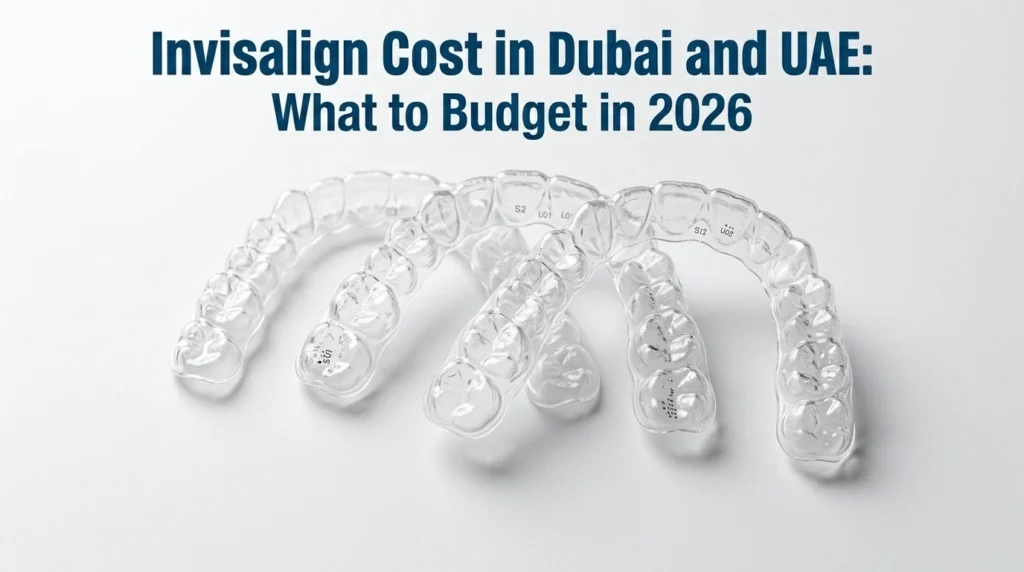
8 min read Share: Invisalign pricing in Dubai ranges from AED 7,000 for a short Lite course to AED 18,000 or more for a full complex case. The range reflects genuinely different product tiers with different scope, not clinics pricing the same thing inconsistently. This guide breaks down what each tier covers, what makes a case cost more, and what a complete quote from a Dubai provider should include. If you’ve already decided on Invisalign and you’re comparing providers, the section on what to ask for in a written quote will be the most immediately useful. Invisalign Cost in Dubai: Price Summary for 2026 Treatment Type Case Complexity Approximate Cost (AED) Invisalign Lite Minor crowding or spacing (up to 20 trays) 7,000 – 10,000 Invisalign Full / Moderate Moderate cases (up to 40+ trays, 1 refinement) 10,000 – 15,000 Invisalign Comprehensive Complex cases (unlimited refinements included) 13,000 – 18,000 Invisalign First (children, ages 6-10) Early interceptive jaw development 6,000 – 12,000 Vivera Retainers (post-treatment) Retention phase 1,500 – 3,000 These are 2026 indicative ranges for Dubai. The final cost depends on the tier assigned to your case after a 3D iTero scan and ClinCheck assessment. Abu Dhabi and Sharjah prices are broadly comparable. The tier determines everything: the number of aligner sets included, how many refinement rounds are covered, and therefore the total treatment scope the price covers. The Different Invisalign Product Tiers Align Technology (the company behind Invisalign) sells treatment at different tiers based on case complexity. The tier your case falls into determines how many aligners are produced and what happens if teeth don’t move exactly as planned. Invisalign Lite:Designed for minor corrections using a small number of aligner trays, typically up to 20. Used for mild crowding, small gaps between teeth, or cases where previous orthodontic treatment has slightly relapsed. Not appropriate for bite correction or moderate-to-complex tooth movement. If a Lite case turns out to need more movement than initially assessed, the provider may need to upgrade the case to a higher tier at additional cost. Invisalign Full (also called Moderate at some clinics):Covers a broader range of tooth movements for moderate cases. A higher number of aligner sets is included, typically with one round of refinements included. This is the most common tier for adult patients with moderate crowding in Dubai. Invisalign Comprehensive:The highest tier. Unlimited refinement aligners are included within the treatment window (typically 5 years from the start date). Used for complex cases requiring significant tooth movement, bite adjustments, or cases that need multiple refinement rounds to achieve the full planned result. If your case genuinely needs this scope, choosing a lower tier to save money upfront often costs more when additional refinements need to be purchased separately. Invisalign First:Specifically for children aged 6-10 with jaw development issues. Uses phase 1 orthodontic principles to guide jaw growth and begin correcting alignment before all permanent teeth have erupted. This is clinical early interceptive treatment, not cosmetic alignment work for children. What Is Typically Included in an Invisalign Package When you receive a quote for Invisalign in Dubai, ask for written confirmation of what is included. The items below vary between clinics and the differences can add AED 2,000-4,000 if they’re charged separately and you don’t find out until mid-treatment. Usually included in a complete Invisalign package: All aligner trays for the planned treatment course. The initial 3D iTero digital scan (or impression alternative, though iTero is now standard at most Dubai providers). The ClinCheck digital treatment plan showing the expected result before any trays are produced. Attachment placement and removal (small composite bumps bonded to specific teeth to help aligners achieve certain movements). Progress appointments throughout treatment. IPR (interproximal reduction, the gentle reshaping between teeth where needed). One round of refinements in Full tier cases. Commonly charged separately: X-rays before treatment begins if not done recently. Vivera retainers post-treatment (AED 1,500-3,000, sometimes included, often not). Additional refinement rounds beyond what the tier includes. Any gum treatment required before Invisalign can start. Emergency appointments for dislodged or broken attachments. The retainer is worth asking about specifically. Some clinics include an initial retainer in the Invisalign package. Others quote the treatment price and add the retainer separately at the end. Since retainers are essential after any orthodontic treatment, the total cost should always include them in your comparison. What Makes Your Case More Expensive Case complexity. This is the single largest driver. A case requiring significant crowding resolution, bite adjustment, or movement across many teeth will be assigned to Comprehensive tier. A case involving mild spacing in the upper front four teeth may qualify for Lite. The case assignment happens after your 3D scan and cannot be fully predicted without one. Number of refinement rounds needed. Some cases require multiple refinement sets to achieve the planned result. Comprehensive cases include unlimited refinements within the treatment window. Full or Moderate cases include one refinement round. If a second refinement is needed and isn’t included, the additional cost is typically AED 2,000-4,000 per refinement. Provider experience level. Invisalign categorises its providers by annual case submission volume. Diamond, Platinum, and Gold tiers reflect increasing levels of experience. Higher-tier providers typically command a premium, and for complex cases, that experience difference affects outcome quality in measurable ways. For Lite cases, provider tier matters less. For Comprehensive cases, it matters considerably. Clinic location and overheads. A Dubai clinic in DIFC, Downtown, or Palm Jumeirah carries significantly higher operational costs than a clinic in Al Satwa, Bur Dubai, or Al Barsha. The same case, the same tier, and the same quality of orthodontist can cost AED 2,000-4,000 more at a high-overhead location. This is a real cost difference worth factoring in when comparing quotes. Dubai vs Abu Dhabi vs Sharjah: Does Location in the UAE Affect Price? Invisalign aligner sets are priced within a standard range by Align Technology across the UAE, so the variation in final cost comes from clinic overheads, provider tier, and what each clinic includes in the
All-on-4 vs All-on-6 Dental Implants: Which Full Arch Option Should You Choose?
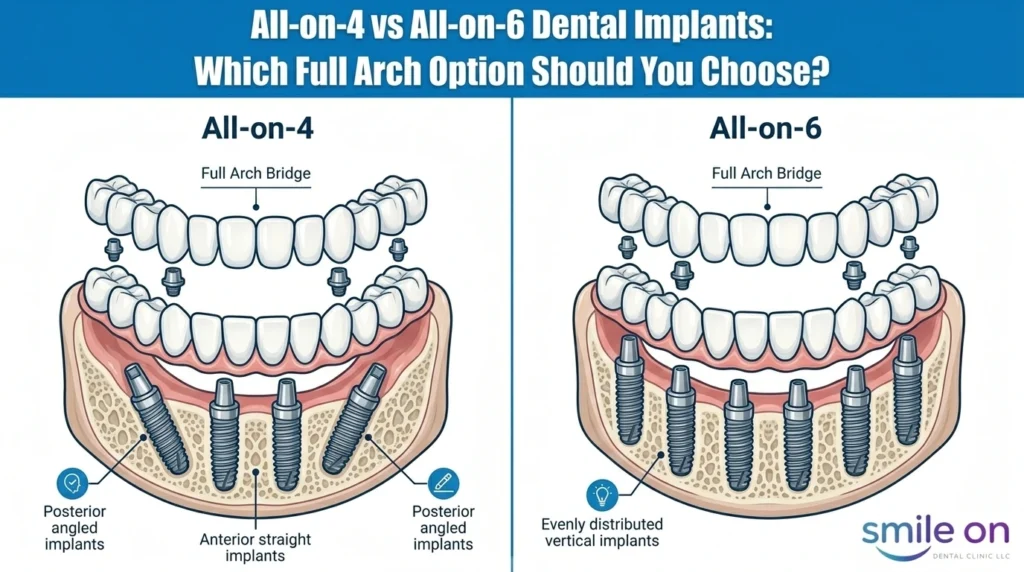
6 min read Share: All-on-4 and All-on-6 both replace a full row of teeth using a fixed bridge supported by a small number of implants. You don’t remove them. You care for them like natural teeth. The difference is how many implants anchor the bridge, where they sit in the jaw, and which clinical situations each one is designed for. If you’re researching full arch implants in Dubai, this is the comparison you need before your consultation. What All-on-4 and All-on-6 Actually Mean Both treatments replace every tooth in one arch (upper jaw, lower jaw, or both) using a fixed bridge that is permanently screwed onto implant posts placed in the jaw. The bridge is not a denture. It does not come out. It functions and looks like natural teeth. All-on-4: Four titanium implant posts are placed in the jaw. The two front implants sit straight. The two rear implants are angled at approximately 30-45 degrees. The angling achieves two things: it allows the rear implants to anchor into a longer section of available bone, and it avoids the areas at the back of the jaw where bone is often thinner, or where sinus anatomy in the upper jaw limits vertical implant depth. All-on-6: Six titanium implants are placed, typically distributed more evenly across the arch. The additional implants provide more support points for the bridge and spread the chewing load across a wider area of the jaw. In both cases, the bridge placed on top is fixed permanently at the implant connections. Core Differences at a Glance Factor All-on-4 All-on-6 Number of implants per arch 4 6 Rear implant angulation 30-45 degrees Typically straight or minimal angle Bone density requirement Works with moderate bone loss Requires more available bone volume Chewing load distribution Across 4 points Across 6 points Suitability for patients with bone loss Better suited May require bone grafting if volume is low Approximate cost per arch (Dubai, 2025) AED 25,000 – 55,000 AED 30,000 – 65,000 Upper jaw with sinus proximity Yes — angled implants avoid the sinus floor May require sinus lift in lower-volume cases All-on-4: The Logic Behind the Angled Implants All-on-4 was developed to make full arch implant treatment possible for patients who had been told they didn’t have sufficient bone for conventional implants. The angling technique lets the rear implants engage a longer stretch of available bone, bypassing the areas of maximum resorption. This matters clinically because patients who have worn dentures for years, or who have lost teeth due to advanced gum disease, often have significant bone loss in the regions where teeth used to be. The All-on-4 concept, developed by Dr. Paulo Malo, uses the bone that remains, positioned at an angle, rather than first grafting in new bone. For many patients, this eliminates the need for bone grafting that would otherwise be required before any implants could be placed. That reduces total treatment time, the number of surgical procedures, and the overall cost compared to a grafting-plus-conventional-implant plan. All-on-6: When More Support Points Make a Difference Adding two more implants distributes the load of chewing across six anchor points rather than four. For patients with adequate bone volume, this provides: Better long-term load distribution. Each implant carries less individual force when six are sharing the load. Over years of chewing, this can be beneficial for the bone around each implant and for the mechanical integrity of the bridge-to-implant connections. A wider structural base for the bridge. With six support points, the prosthetic engineering of the bridge has more structural options, which can simplify the design and reduce mechanical stress at each connection point. Reduced risk of full arch failure. In the unlikely event that one implant fails to integrate, a six-implant bridge has more redundancy than a four-implant bridge. This is a relevant consideration for patients with risk factors such as a history of smoking or uncontrolled diabetes. Where All-on-6 is particularly appropriate: Upper jaw cases in patients with good bone volume. The maxilla (upper jaw) has different bone quality characteristics to the lower jaw and often benefits clinically from the additional anchor points. Patients with strong bite forces, such as those who grind or clench their teeth. More implants distributing that force is a measurable advantage over time. Cases where the surgeon assesses that four anchor points won’t provide optimal long-term stability given that patient’s specific bone density and jaw anatomy. Bone Density Is the Real Deciding Factor The choice between All-on-4 and All-on-6 is driven by clinical assessment, not personal preference. It is determined primarily by your bone volume and density as revealed by a CBCT (cone beam CT) scan. A CBCT scan gives the implant surgeon a three-dimensional view of the entire jaw. It shows exactly how much bone is available at each proposed implant site, where bone density is adequate for secure implant placement, and where anatomical structures (the inferior alveolar nerve in the lower jaw, the sinus floor in the upper jaw) limit implant positioning and depth. After reviewing the CBCT, the clinical picture generally falls into one of three situations: Bone is moderate to significantly reduced across the arch. All-on-4 is typically recommended. The angling technique makes the most of available bone without requiring grafting. Bone volume is good across the arch. All-on-6 may be recommended to provide optimal load distribution and the strongest long-term structural foundation. Bone loss is very severe. Neither All-on-4 nor All-on-6 may be immediately viable. Bone grafting or sinus lift surgery may need to come first, extending the treatment timeline. No responsible implant clinic should quote you for either treatment without first reviewing a CBCT scan. If you receive a quote before a scan has been done, ask for it to be completed before the treatment plan is finalised. Cost Comparison in Dubai Treatment Approximate Cost per Arch (AED) All-on-4 AED 25,000 – AED 55,000 All-on-6 AED 30,000 – AED 65,000 Bone grafting if required AED 1,500 – AED 8,000 (extent-dependent) CBCT scan AED 300 – AED
Dental Implant Cost in Dubai: What You Actually Pay in 2026 (and Why Prices Vary)
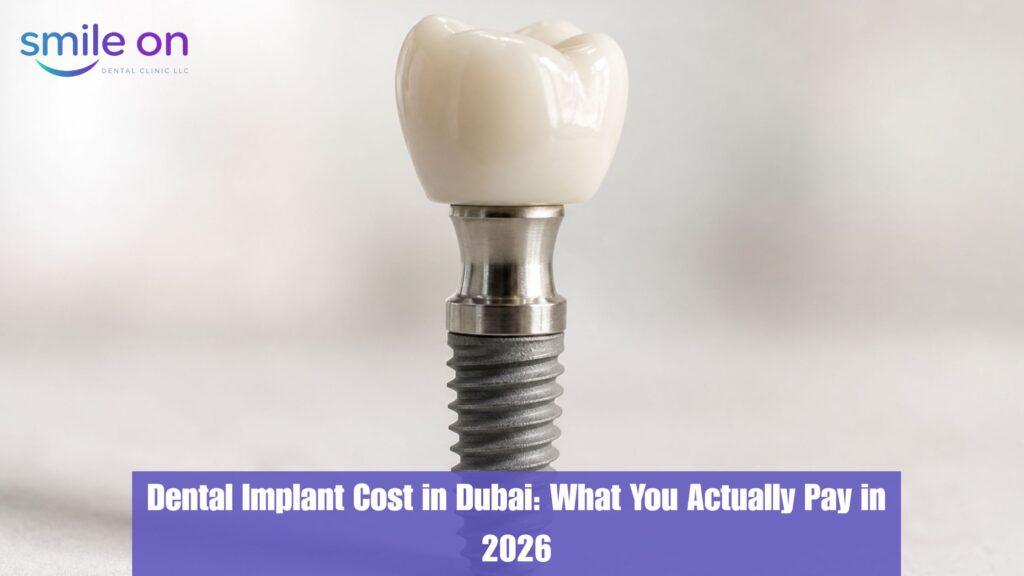
8 min read Share: If you have been searching for dental implant prices in Dubai, you have probably seen numbers ranging from AED 1,500 to AED 15,000, sometimes for what appears to be the same treatment. That gap is not a typo, and it is not clinics trying to trick you. It reflects genuinely different components, materials, technologies, and the scope of work. This guide breaks down exactly what affects the cost, what a realistic price range looks like in Dubai in 2026, what questions to ask before you sign anything, and what warning signs to watch for when a quote seems unusually low. Searching for the best dental implants in Dubai? By the end of this guide, you will know exactly what to look for and what questions to ask any clinic before you commit. What Does a Dental Implant Actually Include? Before comparing prices, it helps to understand what you are actually buying. A dental implant is not a single item; it is a three-part system. The implant post is a small titanium screw surgically placed into your jawbone. This is what fuses with the bone over time (a process called osseointegration) and acts as the root of your new tooth. The abutment is a connector piece that sits on top of the implant post, above the gumline. It holds the crown in place. The crown is the visible part the artificial tooth that is matched to the colour and shape of your natural teeth. Important: When clinics quote a price, they may be quoting for just the post, or for the full system including crown and abutment. This is one of the most common sources of confusion when patients compare costs across clinics. Always confirm in writing what the quoted price includes. What Determines the Cost of Dental Implants in Dubai Several factors pull the final price up or down. Here is what actually matters. 1. The Implant Brand Not all implant posts are the same. Premium brands like Straumann, Nobel Biocare, and Osstem have decades of clinical research behind them, documented success rates, and global service networks. These cost more than lesser-known or generic implant systems. If a clinic does not tell you which brand they are using, ask. The brand matters for long-term reliability, not just the immediate result. 2. Whether You Need Bone Grafting Dental implants require sufficient bone density to anchor properly. If you have been missing a tooth for some time, or if you have existing bone loss from gum disease, you may need a bone graft before the implant can be placed. This is a separate procedure with its own cost typically between AED 1,500 and AED 4,000 depending on the extent of grafting required. Some clinics include a basic assessment for bone volume in the consultation; others charge for the CT scan separately. 3. The Crown Material The visible crown on top can be made from different materials. Porcelain-fused-to-metal (PFM) crowns are more affordable. Full zirconia crowns are stronger, more stain-resistant, and look more natural they are also more expensive. If aesthetics matter to you (especially for front teeth), zirconia is worth the premium. 4. Number of Implants A single implant costs very differently from replacing a full arch of teeth. Multiple implants, or implant-supported bridges that use fewer implants to replace more teeth, are priced differently again. Make sure any quote is clear about how many implants are being placed, not just how many teeth are being replaced. 5. The Complexity of Your Case Patients who need sinus lifts, have unusual jaw anatomy, or have significant existing dental issues will have more complex surgical planning and longer treatment timelines. Complexity is priced accordingly. Types of Dental Implants and What They Cost in Dubai in 2026 Here is a realistic breakdown of what patients in Dubai are paying in 2026. These are indicative ranges your actual cost will depend on the factors above. Implant Type Typical Range (AED) Notes Standard Single Implant AED 4,500 – 9,000 Full system: post, abutment, crown Same-Day Dental Implant AED 6,000 – 12,000 Per implant. Suitability assessment required All-on-4 (full arch) AED 25,000 – 55,000 Per arch. Includes bridge on 4 implants All-on-6 (full arch) AED 30,000 – 65,000 Per arch. More support, more implants Bone Grafting (if needed) AED 1,500 – 4,000 Depends on extent of grafting required 3D CT Scan (CBCT) AED 300 – 600 Sometimes included in consultation Standard Single Dental Implant This is the most common implant procedure one titanium post, one abutment, one crown, replacing a single missing tooth. The process usually spans several months: the post is placed and left to fuse with the bone (3 to 6 months), then the crown is attached. Premium implant brands sit at the higher end of this range; budget systems and grey-market clinics sit at the lower end. Same-Day Dental Implants Same-day implants (also called immediate-load implants) allow a temporary crown to be placed on the same day as the post. This is not suitable for every patient you need adequate bone density and no active infection. Where it is appropriate, it eliminates the long waiting period between post placement and crown fitting. Patients in Al Satwa and Jumeirah searching for same-day dental implants should look for clinics with 3D guided implant surgery capability, which ensures precise placement with less surgical guesswork. All-on-4 Dental Implants All-on-4 (or All-on-6) is a full-arch solution that replaces an entire row of teeth using just four or six strategically placed implants that support a fixed bridge. This is a significant procedure requiring thorough planning, 3D CT imaging, and a team experienced in full-mouth rehabilitation. The cost is significantly higher, but it replaces what would otherwise require dozens of individual implants. What Is Typically Included — and What Gets Charged Separately Even in a reasonably priced clinic, there are often additional costs that patients do not anticipate. Here is what to clarify upfront. Usually included in the quoted price: Often charged separately: Pro Tip: Ask for
When Do Dental Implants Make Sense?
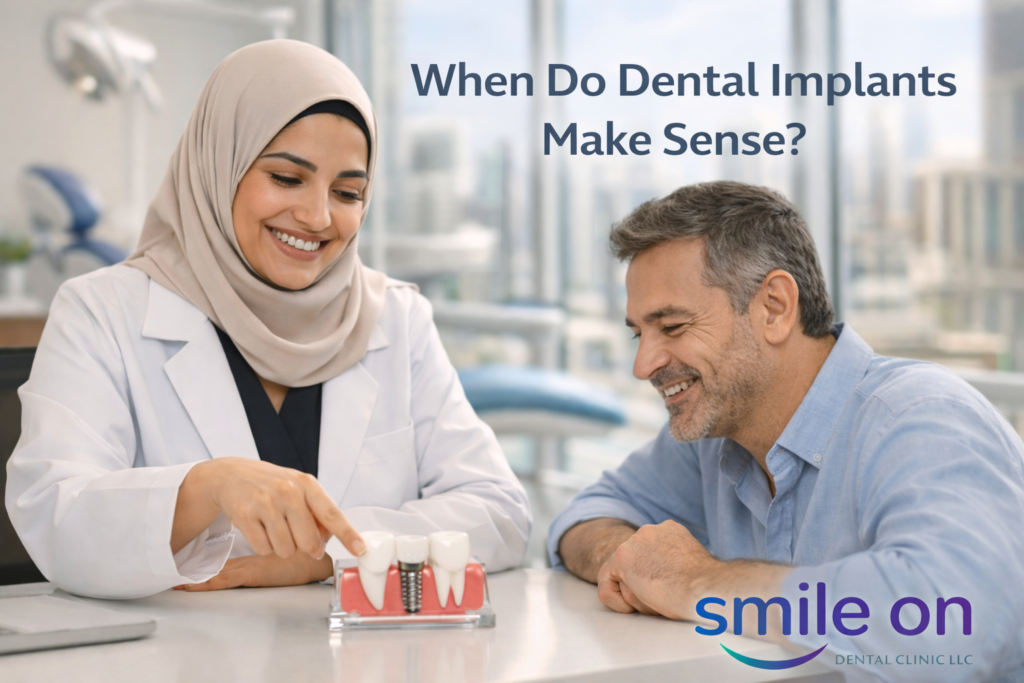
9 min read Share: Missing a tooth affects more than just your smile. It changes how you eat, how you speak, and often how you feel about yourself. If you’re researching tooth replacement options in Dubai, you’ve probably come across dental implants and wondered: are they really worth it? When do they actually make sense? This guide will help you understand when dental implants are the smart choice, when they might not be, and how to make the decision that’s right for your situation. What Are Dental Implants? Dental implants are titanium posts surgically placed into your jawbone that act as artificial tooth roots. Unlike bridges or dentures that sit on top of your gums, implants anchor directly into the bone. Once the implant fuses with your jawbone (a process called osseointegration), a custom crown is attached to complete your new tooth. The result looks, feels, and functions like a natural tooth. Most people won’t even notice you have an implant. When Do Dental Implants Make the Most Sense? 1. You’ve Lost One or More Permanent Teeth The most obvious scenario is when you’re missing teeth due to: If you have a gap in your smile that’s affecting your daily life, implants are often the gold standard solution. 2. You Want to Protect Your Jawbone Here’s something many people don’t realize: when you lose a tooth, the bone underneath starts to deteriorate. Without the stimulation that comes from chewing, your body begins to reabsorb that bone tissue. Over time, this leads to: Dental implants stimulate the jawbone just like natural teeth do. This prevents bone loss and maintains your facial structure. If preserving your bone health is important to you, implants are the only tooth replacement option that does this. 3. You Don’t Want to Damage Healthy Teeth Traditional dental bridges require grinding down the healthy teeth on either side of the gap. These supporting teeth are filed down to accommodate crowns, which permanently alters them. Implants stand alone. They don’t rely on neighboring teeth for support, which means your other teeth remain untouched. If you want to preserve as much natural tooth structure as possible, implants make sense. 4. You’re Looking for a Long-Term Solution If you want something that lasts, implants are hard to beat. With proper care, dental implants can last 20+ years, often a lifetime. The crown on top may need replacement after 10-15 years, but the implant itself typically stays put. Compare this to: When you factor in replacement costs over time, implants often become the most cost-effective option despite higher upfront costs. 5. You Want to Eat Normally Again Dental implants restore about 80-90% of your natural chewing power. This means you can eat steak, apples, nuts, and other foods that might be difficult with dentures. If you miss eating your favorite foods or find yourself avoiding social situations because of dietary restrictions, implants can bring that freedom back. 6. Your Dentures Don’t Fit Well Anymore Many people who’ve worn dentures for years experience problems: Implant-supported dentures or individual implants can provide the stability dentures lack. If you’re frustrated with traditional dentures, switching to implants often makes sense. 7. You’re Tired of Daily Denture Maintenance Removable dentures require: Implants are permanent. You brush and floss them just like natural teeth. If convenience matters to you, implants simplify your oral care routine significantly. 8. You Want the Most Natural-Looking Result Modern dental implants are virtually indistinguishable from natural teeth. The crowns are custom-made to match the shape, size, and color of your existing teeth. For front teeth or visible areas, implants typically provide the most aesthetically pleasing result. If appearance is a priority, implants usually deliver better outcomes than bridges or partial dentures. When Might Implants NOT Make Sense? Being realistic about when implants aren’t the best choice is just as important. 1. You Don’t Have Enough Jawbone Dental implants need adequate bone to anchor properly. If you’ve had significant bone loss, you might need bone grafting first, which adds time and cost to the process. In some cases where bone loss is severe, dentures or bridges might be more practical solutions. 2. You Have Certain Medical Conditions Some health issues can affect implant success: This doesn’t mean implants are impossible, but you’ll need careful evaluation by your dentist. In some cases, addressing these conditions first or choosing alternative treatments makes more sense. 3. Budget Is a Major Constraint Right Now Dental implants are an investment. In Dubai, a single implant typically ranges from AED 6,000 to AED 15,000, depending on the complexity and materials used. If the upfront cost is prohibitive and financing isn’t an option, bridges or dentures might be more accessible starting points. Keep in mind that while cheaper initially, these options need replacement more frequently. 4. You’re Not Ready for Surgery Dental implant placement is a surgical procedure. While typically straightforward with modern techniques, it does require: If the idea of surgery makes you very anxious or you can’t commit to the healing process, non-surgical options like bridges might suit you better. 5. You Need Immediate Results The complete implant process takes 3-6 months on average. While same-day implants exist for certain cases, the standard timeline includes: If you need a tooth replaced immediately for an upcoming event and can’t wait, a temporary bridge or denture might be more appropriate. 6. You’re Still Growing (Under 18-21) Dental implants are generally not recommended for teenagers because their jaws are still developing. Placing an implant while bone growth is ongoing can lead to complications. If you’re young and missing a tooth, your dentist might recommend waiting until your jaw is fully mature or using a temporary solution in the meantime. How Do Implants Compare to Other Options? Here’s a quick comparison to help you understand how implants stack up against bridges and dentures. Dental Implants vs. Bridges Implants Win When: Bridges Win When: Dental Implants vs. Dentures Implants Win When: Dentures Win When: Implant-Supported Dentures: The Middle Ground For people missing all teeth in