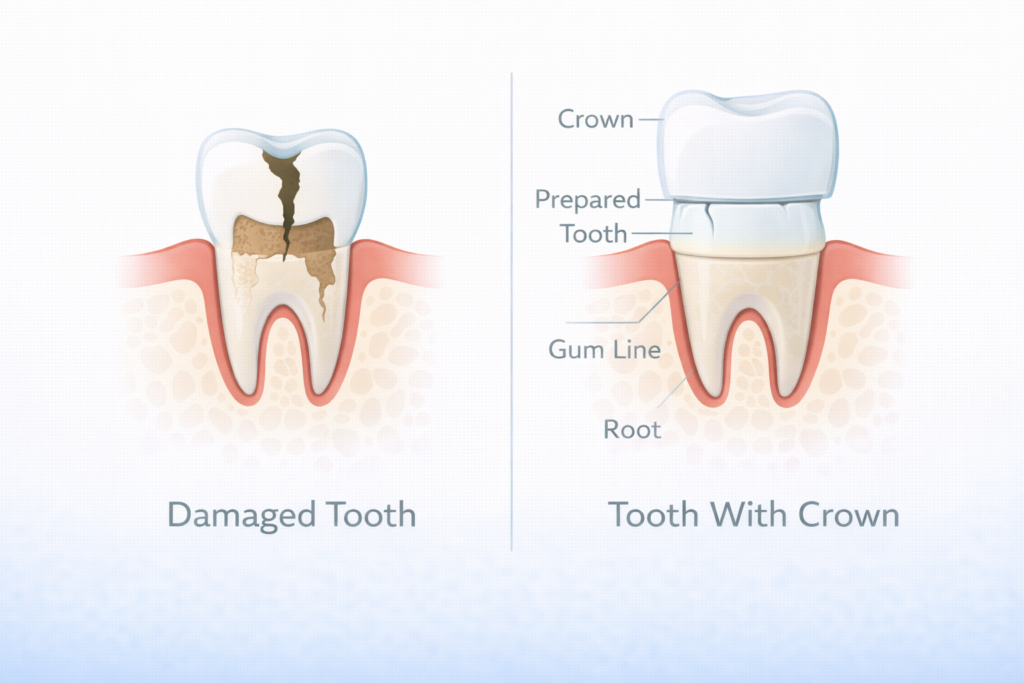
A tooth that is cracked, heavily decayed, or has had a root canal is no longer structurally sound enough to function without protection. A dental crown solves this. It fits over the entire visible portion of the tooth, restoring its shape, strength, and appearance so it works exactly as it did before the damage occurred. A dental bridge does something different but equally important: it replaces a missing tooth entirely by anchoring a prosthetic tooth to the natural teeth on either side of the gap.
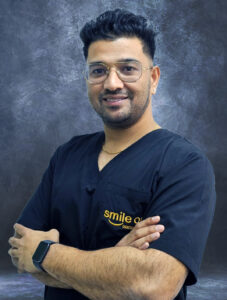
At Smile On Dental Clinic in Al Satwa, Dubai, dental crowns and bridges are designed and fitted by Dr. Rahul Patel, a specialist prosthodontist with dedicated training in restorative dentistry. This page covers the types of crowns available, how bridges work, what the treatment process involves, and what crowns and bridges cost in Dubai.
A dental crown is a custom-made cap that covers the entire visible surface of a tooth from the gum line upward. It is permanently cemented in place and functions exactly like a natural tooth in terms of biting, chewing, and appearance.
You need a dental crown when a tooth is too damaged or weakened for a filling to be a reliable long-term solution. The most common situations where a crown is the right treatment include:
A crown is not always the first choice. Where a tooth can be adequately restored with a filling or an inlay, that approach preserves more natural tooth structure. Dr. Rahul Patel assesses each case individually and recommends a crown only when it is genuinely the most appropriate restoration for the clinical situation.
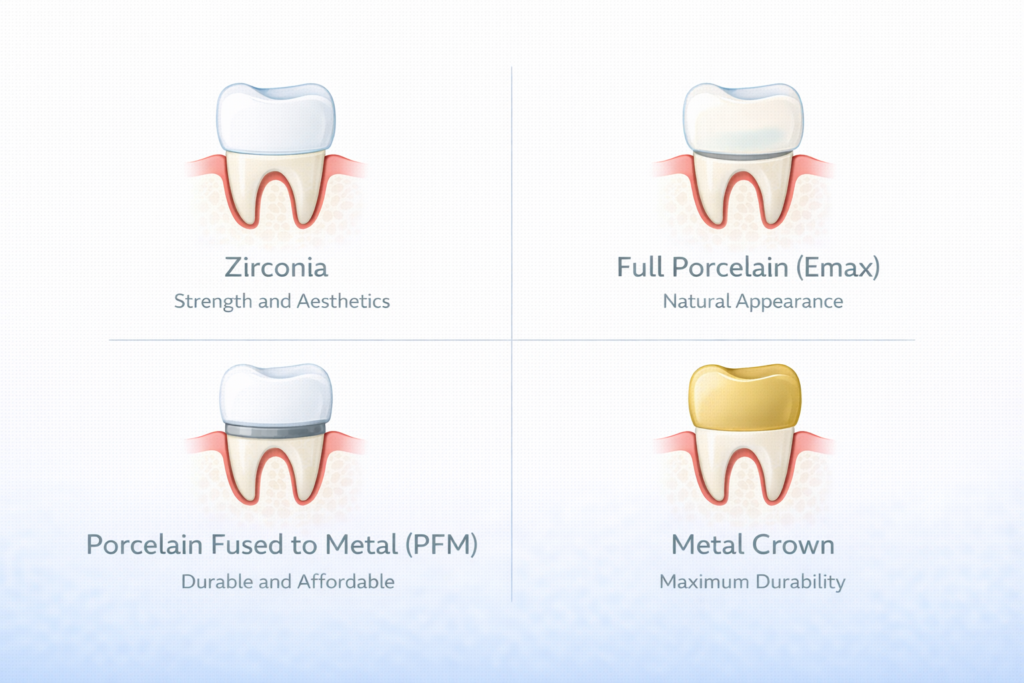
Not all crowns are the same. The material a crown is made from affects its appearance, durability, and suitability for different teeth and bite situations. At Smile On Dental Clinic, crowns are available in the following materials:
Zirconia Crowns: Zirconia is a high-strength ceramic material that combines the aesthetics of a tooth-colored crown with the durability needed for back teeth that bear significant biting force. Zirconia crowns do not contain any metal, which means there is no dark line visible at the gum margin over time. They are highly biocompatible, meaning they are well tolerated by the surrounding gum tissue. Zirconia is currently the most widely used crown material for both front and back teeth in modern restorative dentistry, and it is the material Dr. Rahul Patel most frequently recommends for posterior crowns where strength and aesthetics both matter.
Full Porcelain Crowns (Emax): Full porcelain crowns, most commonly made from lithium disilicate ceramic (Emax), offer exceptional aesthetics and are the preferred material for front teeth where the translucency and light-reflecting properties of the ceramic closely mimic natural tooth enamel. They are slightly less strong than zirconia under heavy biting load, which is why they are most often used on front teeth rather than molars. For patients whose primary concern is a natural and invisible-looking result on visible teeth, full porcelain is the premium choice.
Porcelain Fused to Metal (PFM): Porcelain fused to metal crowns have a metal substructure for strength with a porcelain outer layer for aesthetics. They have been used successfully in dentistry for decades and remain a reliable and cost-effective option. The main limitation is that over time, as the gum tissue recedes slightly with age, the metal margin at the base of the crown can become visible as a dark line near the gum line. For back teeth that are not highly visible, PFM remains a practical and durable option.
Metal Crowns: Full metal crowns, typically made from gold alloy or other dental alloys, are extremely durable and require minimal tooth preparation. They are rarely used for visible teeth for aesthetic reasons, but they remain an excellent choice for second molars that are completely out of sight and subject to very heavy biting forces. Their longevity in the right location is exceptional.
A dental bridge is a fixed prosthetic restoration that replaces one or more missing teeth. It works by anchoring a false tooth, called a pontic, to the natural teeth on either side of the gap. These anchor teeth, called abutments, are prepared and crowned as part of the bridge construction. The result is a single connected unit that spans the gap and restores the appearance and function of the missing tooth.
Bridges are a non-implant option for replacing missing teeth and are appropriate in specific clinical situations:
The main limitation of a bridge compared to an implant is that preparing the adjacent teeth for crowning removes healthy tooth structure from teeth that may not have needed treatment otherwise. It also does not stimulate the jaw bone in the way a dental implant does, which means some bone loss in the gap area can occur gradually over time. Dr. Rahul Patel discusses these trade-offs clearly with each patient so the decision between a bridge and an implant is made with full understanding of the long-term implications of each.
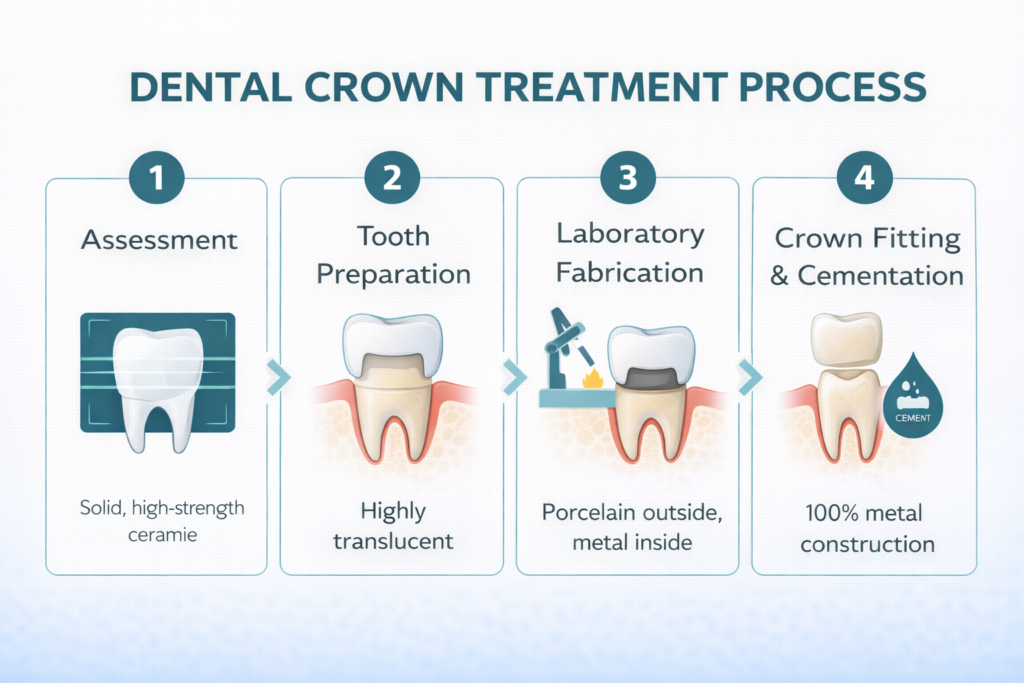
Understanding what happens across the two main appointments helps patients prepare for treatment with realistic expectations.
First Appointment: Assessment, Preparation, and Temporary Crown
The process begins with a clinical assessment and X-rays to confirm the tooth or teeth are suitable for crowning. Once treatment is agreed, the tooth is prepared under local anaesthesia by reducing its outer surfaces to create space for the crown. A digital scan or impression is taken of the prepared tooth and the surrounding teeth to send to the dental laboratory. A temporary crown is placed on the prepared tooth to protect it while the permanent crown is being fabricated. Laboratory turnaround typically takes seven to ten working days.
Second Appointment: Fitting the Permanent Crown
At the second appointment, the temporary crown is removed and the permanent crown is tried in before cementing. Dr. Rahul Patel checks the fit, the contact with the adjacent teeth, and the bite carefully before the crown is permanently cemented. Adjustments are made at the chairside if needed. Once fitted and cemented, the crown is complete and functional immediately.
For Bridges: The process follows the same two-appointment structure, with the additional step of preparing both abutment teeth at the first visit and fitting the three-unit (or larger) connected bridge at the second.
Specialist Prosthodontist, Not a General Dentist: Dental crowns and bridges at Smile On Dental Clinic are designed and fitted by Dr. Rahul Patel, a DHA-licensed specialist prosthodontist. The difference matters in complex crown cases: the preparation design, the impression technique, the bite assessment, and the final fit all require a level of precision that specialist training directly improves. A poorly fitted crown that needs replacement within a few years costs far more in the long run than a correctly made one from the outset.
High-Quality Crown Materials: The clinic works with experienced dental laboratories to produce crowns in zirconia, full porcelain, and porcelain fused to metal. The material recommendation for each patient is based on the clinical demands of the tooth and the patient’s aesthetic goals, not a one-size-fits-all approach.
Digital Scanning for Accurate Impressions: Where available, digital intraoral scanning produces a more accurate impression of the prepared tooth than traditional putty impressions, resulting in a better-fitting crown from the laboratory. Accurate impressions reduce the need for chairside adjustments at the fitting appointment.
Coordinated Care Across the Clinic: Many patients needing crowns also need root canal treatment on those teeth first, or periodontal treatment to stabilise the gums before the crown can be placed. At Smile On Dental Clinic in Al Satwa, Dr. Rahul Patel coordinates directly with Dr. Arun Devarajan (Endodontics) and Dr. Vineetha Varughese (Periodontics) so the full treatment sequence is managed in one place without referrals to external practices.
Central Location Accessible from Across Dubai: The clinic is located in Al Satwa, within easy reach of Jumeirah, Downtown Dubai, Sheikh Zayed Road, and DIFC. Same-day consultations are available where possible for patients with urgent crown needs such as a broken or lost crown.
The cost of dental crowns in Dubai depends on the material selected, the tooth being treated, and whether any preparatory treatment such as a root canal or gum treatment is needed before the crown can be placed.
Here is what typically affects the price:
As a general market reference for dental crowns in Dubai, fees range from AED 1,200 to AED 2,500 per crown depending on material and complexity. Dental bridge costs in Dubai vary based on the number of units, typically starting from AED 3,500 to AED 6,000 for a standard three-unit bridge. These are market reference ranges. Smile On Dental Clinic provides an exact, itemised cost estimate after the clinical assessment and before any treatment begins.
Instalment payment options may be available for patients requiring multiple crowns or a bridge alongside other treatment.
Dr. Rahul Patel is the specialist prosthodontist at Smile On Dental Clinic in Al Satwa, Dubai. His clinical practice is focused on restoring damaged and missing teeth using crowns, bridges, implant restorations, and comprehensive full mouth rehabilitation. Every crown and bridge case is assessed and planned individually, with material selection, preparation design, and bite analysis forming the foundation of treatment before any preparation of the tooth begins.
Dr. Patel works directly with the endodontic and periodontal teams at Smile On Dental Clinic to ensure that every tooth being crowned is healthy from the root up before the final restoration is placed, so the investment in the crown is protected by sound underlying tooth and gum health.
Prosthodontics Dubai: The full prosthodontics hub page covering all restorative and replacement treatments available at Smile On Dental Clinic under Dr. Rahul Patel’s specialist care, including full mouth rehabilitation and implant restorations.
Dental Implants Dubai: For patients choosing between a bridge and an implant to replace a missing tooth, this page explains the implant options at Smile On Dental Clinic and how the implant and restorative teams work together to deliver the final restoration.
Root Canal Treatment Dubai: Most back teeth that have had root canal treatment need a crown placed afterward to prevent fracturing. This page covers root canal treatment at Smile On Dental Clinic and what to expect from the procedure before the crown is fitted.
Posted on Ahamed FahimTrustindex verifies that the original source of the review is Google. Undoubtedly the best clinic in Dubai...I visited the clinic with severe tooth ache..Dr Arun was a thorough professional in his approach..He explained the full treatment plan and did the root canal in a very gentle manner..highly recommend..Posted on Aydah-Aidell NabayraTrustindex verifies that the original source of the review is Google. I had an excellent experience at Smile On Dental Clinic! The staff were friendly, professional, and made me feel completely at ease. A special thank you to Dr. Arun for the exceptional care and attention—truly top-notch service. Highly recommend this clinic to anyone looking for quality dental care!Posted on Suneera HussainTrustindex verifies that the original source of the review is Google. I got my root canal treatment done by Dr Arun . I highly recommend this clinic and staff..Posted on vincy abhilashTrustindex verifies that the original source of the review is Google. The technology used here is top notch. I felt that the diagnosis was accurate and the treatment plan and charges was fully explained. Dr Arun was truly professional. Pre and post xrays was shown..thanks smile onPosted on ardo barkadTrustindex verifies that the original source of the review is Google. I would like to sincerely thank Dr.Vineetha for the excellent work she did on my gums. I am usually very anxious and scared of dentists, but she made me feel completely at ease with her calm, gentle, and professional approach. Her patience and kindness truly made a huge difference. I highly recommend her to anyone looking for a caring and skilled dentist.Posted on Deepak ChohanTrustindex verifies that the original source of the review is Google. Best Dental experience ever. Dr Arun explained the whole procedure before the treatment started. was scared of dentist before. The post care was excellent, dr himself following up with me. The clinic overall was very clean. going back for further treatment..Posted on Md RahmatTrustindex verifies that the original source of the review is Google. Highly recommend dr Arun , I have lots of anxiety about going to dentist. They made me feel comfortable and I believe the treatment plan is actionable and has m best interest in mind..my wisdom teeth was removed without any pain... thanksPosted on Manal AnsariTrustindex verifies that the original source of the review is Google. I am shocked to see how amazing Dr Amit & Dr Arun worked on my father’s tooth! Within a few minutes the procedure was done! And he experienced no pain Thank you so much! Already booked in my appointmentPosted on Tufail HussainTrustindex verifies that the original source of the review is Google. Excellent excellent experience, Dr. Marwa Thank you so much, Dr. Marwa. I feel very good very comfort Dr. Marwa very good to excellent.love you all teemsPosted on Farah ElmawieTrustindex verifies that the original source of the review is Google. Dr hashmit is the best! My sons adore her!! She makes the dentist visit an exciting one!Showing our latest reviewsVerified by TrustindexTrustindex verified badge is the Universal Symbol of Trust. Only the greatest companies can get the verified badge who has a review score above 4.5, based on customer reviews over the past 12 months. Read more
With proper care, high-quality dental crowns placed by a specialist prosthodontist last ten to fifteen years or more in most cases. Zirconia crowns are particularly durable and resistant to chipping under normal biting forces. The longevity of a crown depends on the quality of the materials used, the precision of the fit, the patient’s oral hygiene, whether any underlying issues such as grinding or gum disease are managed, and regular professional check-ups. Dr. Rahul Patel selects materials appropriate to each tooth’s functional demands to maximise the lifespan of every restoration at Smile On Dental Clinic.
The tooth preparation is carried out under local anaesthesia, which numbs the area completely before any work begins. The procedure itself should not be painful. After the anaesthetic wears off, some mild sensitivity around the prepared tooth is normal for a few days, particularly to cold temperatures. This settles on its own in most cases. If a tooth required root canal treatment before crowning, the root canal itself eliminates the nerve, so the crowned tooth will have no sensation at all once treatment is complete.
A veneer covers only the front surface of a tooth and requires minimal tooth preparation. It is primarily a cosmetic restoration used to improve the appearance of teeth that are structurally sound. A dental crown covers the entire tooth from the gum line upward and requires more preparation of the tooth. It is used when the tooth is structurally compromised due to damage, decay, or a previous root canal. If a tooth needs structural protection as well as aesthetic improvement, a crown is the appropriate choice. If the tooth is healthy and the concern is purely cosmetic, a veneer is the less invasive option.
Dental crown costs in Dubai depend on the material selected and the complexity of the case. As a general market reference, crowns range from AED 1,200 to AED 2,500 per unit depending on whether zirconia, full porcelain, or porcelain fused to metal is used. The cost of any preparatory treatment such as a root canal is separate. At Smile On Dental Clinic, you receive a clear itemised cost estimate covering all components of the treatment after the initial assessment and before any work begins so there are no surprises.
Both are effective, but they work differently and have different long-term implications. A bridge is faster and less expensive initially, but it requires preparing the adjacent teeth by reducing them to fit crowns, even if those teeth were previously healthy. An implant replaces the missing tooth without touching the adjacent teeth, and it also preserves the jaw bone in the area of the gap, which a bridge does not. For most patients with a single missing tooth and adequate bone, an implant is the better long-term investment. A bridge is appropriate when the adjacent teeth already need crowns, when implants are not possible for clinical reasons, or when a faster solution is needed. Dr. Rahul Patel discusses these options clearly at the consultation so you can make an informed decision.
A dental crown at Smile On Dental Clinic is typically completed in two appointments. The first appointment involves preparation of the tooth, taking a digital scan or impression, and fitting a temporary crown while the permanent crown is fabricated in the dental laboratory, which usually takes seven to ten working days. The second appointment involves removing the temporary crown, checking the fit and bite of the permanent crown, and cementing it in place. The total process from first appointment to fitted permanent crown is usually two to three weeks.
Same-day crowns using chairside CAD/CAM milling technology are offered by some clinics. At Smile On Dental Clinic, crowns are fabricated by an external dental laboratory to ensure the highest quality of materials and fit. Laboratory-fabricated crowns take seven to ten working days but offer superior aesthetics and accuracy compared to most in-house milling systems. For patients who have broken or lost a crown urgently, a temporary crown is placed at the first appointment to protect the tooth while the permanent restoration is being made.
Smile On Dental Clinic offers dental crowns in zirconia, full porcelain (Emax), porcelain fused to metal, and metal alloy. The material recommended for each patient depends on the tooth being treated, the biting forces involved, and the patient’s aesthetic requirements. Zirconia is the most commonly recommended material for both front and back teeth because it combines strength with excellent aesthetics. Full porcelain is preferred for front teeth where translucency and the most natural appearance are the priority. Dr. Rahul Patel discusses the material options and the rationale for the recommendation at the consultation.
Copyright ©2022 Smileondc. All Rights Reserved . LICENCE NO: CCB9Y0LC-251225