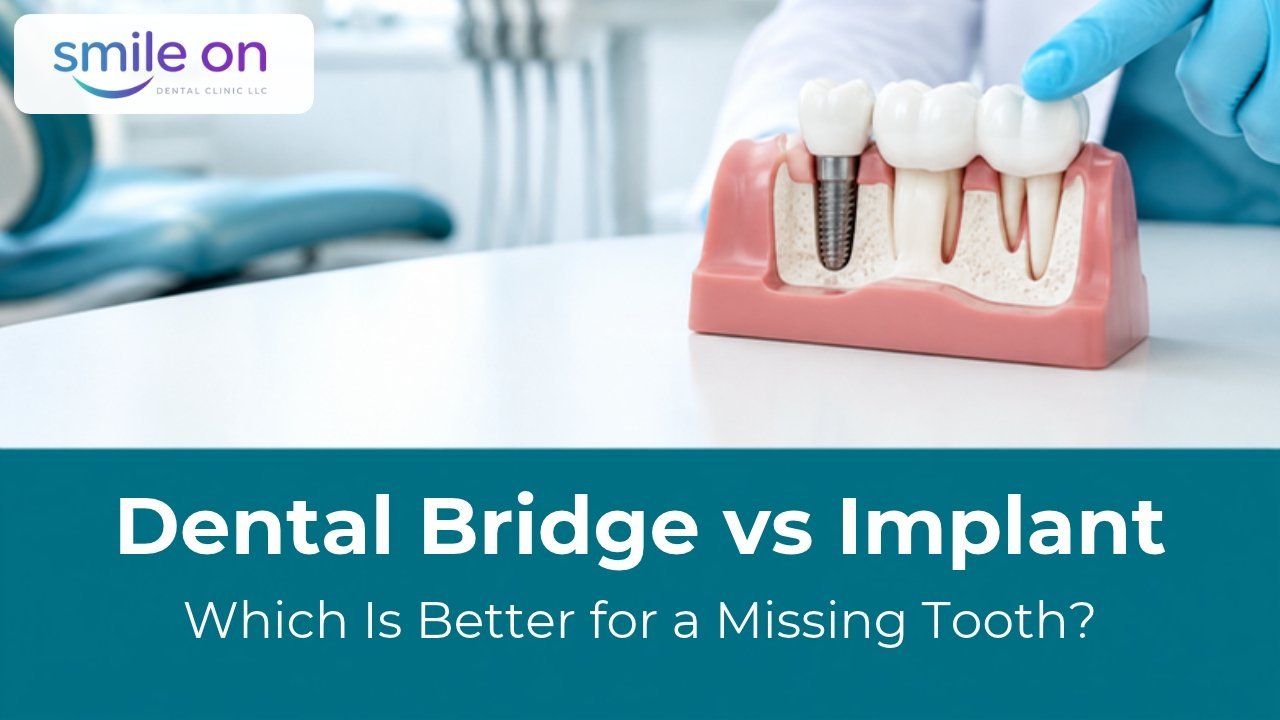
Dental Bridge vs Implant: Which Is Better for a Missing Tooth?
6 min read Share: If you have lost a tooth, the two most common ways to replace it are a dental bridge and a dental implant. Both give you a fixed, natural-looking tooth that you do not take out at night. The main difference is that a bridge is supported by the teeth on either side of the gap, while an implant replaces the tooth root and stands on its own. For most healthy adults with enough bone, an implant is the longer-lasting option and protects the neighbouring teeth. A bridge is quicker, needs no surgery and can be the better choice when the teeth next to the gap already need crowns. This guide compares bridges and implants side by side, covering how each works, how long they last, cost in Dubai, and who each option suits. Dental bridge vs implant at a glance Dental bridge Dental implant How it works A false tooth held in place by crowns on the teeth either side of the gap A small titanium post placed in the jawbone, topped with a crown Effect on neighbouring teeth The teeth either side are trimmed down to hold crowns Neighbouring teeth are not touched Surgery No Yes, a minor procedure under local anaesthetic Time to finish Usually two visits over 2 to 3 weeks Usually 3 to 6 months, as the implant fuses with the bone Typical lifespan Around 10 to 15 years The implant can last decades; the crown typically 10 to 15 years Bone loss in the gap Continues slowly, as nothing stimulates the bone Helps preserve the bone Cleaning Needs a floss threader or special brush under the false tooth Brush and floss like a natural tooth Price at Smile On AED 800 per unit (a typical 3-unit bridge for one missing tooth is AED 2,400) From AED 3,500 (Neodent) or AED 5,500 (Straumann) per implant How a dental bridge works A traditional bridge replaces one or more missing teeth by joining a false tooth to crowns on the healthy teeth on either side of the gap. Those supporting teeth are shaped down so the crowns fit over them, and the whole bridge is cemented in place as one piece. For a single missing tooth, a standard bridge has three units: two crowns on the supporting teeth and the false tooth in the middle. Other designs exist, such as a bridge supported on one side only or a bonded bridge that attaches to the back of the neighbouring teeth with minimal trimming, and your dentist will advise which suits your bite and gap. Advantages of a bridge. No surgery, a shorter treatment time, a lower upfront cost than an implant in many cases, and a good result when the neighbouring teeth already have large fillings or need crowns anyway. Disadvantages of a bridge. Healthy neighbouring teeth have to be trimmed, the supporting teeth carry extra load, it is harder to clean underneath, and the bone under the false tooth continues to shrink slowly over time. If one supporting tooth develops decay or a problem, the whole bridge may need replacing. How a dental implant works A dental implant replaces the root of the missing tooth with a small titanium post placed into the jawbone. Over a few months the bone bonds to the implant, a process called osseointegration. A connector and a custom crown are then fitted on top, giving you a tooth that looks, feels and functions much like a natural one. Advantages of an implant. Neighbouring teeth are left untouched, the implant helps preserve the jawbone, it is easy to clean, and with good care the implant itself can last for decades. It also stands alone, so a problem with another tooth does not affect it. Disadvantages of an implant. It needs a minor surgical procedure, takes longer from start to finish, and needs enough healthy bone, which sometimes means bone grafting first. The upfront cost is usually higher than a bridge. Some patients are suitable for same day dental implants, where a temporary tooth is fitted on the day the implant is placed, which shortens the time spent with a gap. Which lasts longer: a bridge or an implant? An implant usually lasts longer. The titanium implant can last a lifetime with good oral hygiene and regular check-ups, and the crown on top typically lasts 10 to 15 years before it may need replacing. A bridge typically lasts around 10 to 15 years, and when it fails, it is often because the supporting teeth develop decay or gum problems. That difference matters over time. A bridge may need replacing more than once over a lifetime, and each replacement can involve the supporting teeth again. With an implant, usually only the crown needs replacing. Cost of a dental bridge vs implant in Dubai At Smile On Dental Clinic, a dental bridge costs AED 800 per unit, so a standard three-unit bridge to replace one missing tooth is AED 2,400. A single dental implant starts from AED 3,500 with Neodent or AED 5,500 with Straumann, and the final cost depends on whether you need extra steps such as bone grafting and on the crown chosen. Your treatment plan will confirm exactly what is included before you start. When comparing cost, it helps to think long term: For a detailed breakdown of implant pricing in Dubai, see our guide to dental implant cost in Dubai. Who is a bridge better for? A bridge can be the better choice if: Who is an implant better for? An implant is often the better choice if: Heavy smoking and uncontrolled diabetes raise the risk of implant problems, so the dentist will check these before recommending an implant. What if you are missing several teeth? For several missing teeth in a row, a longer bridge or an implant-supported bridge may be suggested. An implant-supported bridge uses two implants to hold three or four teeth, so no natural teeth need trimming. For patients missing most or all
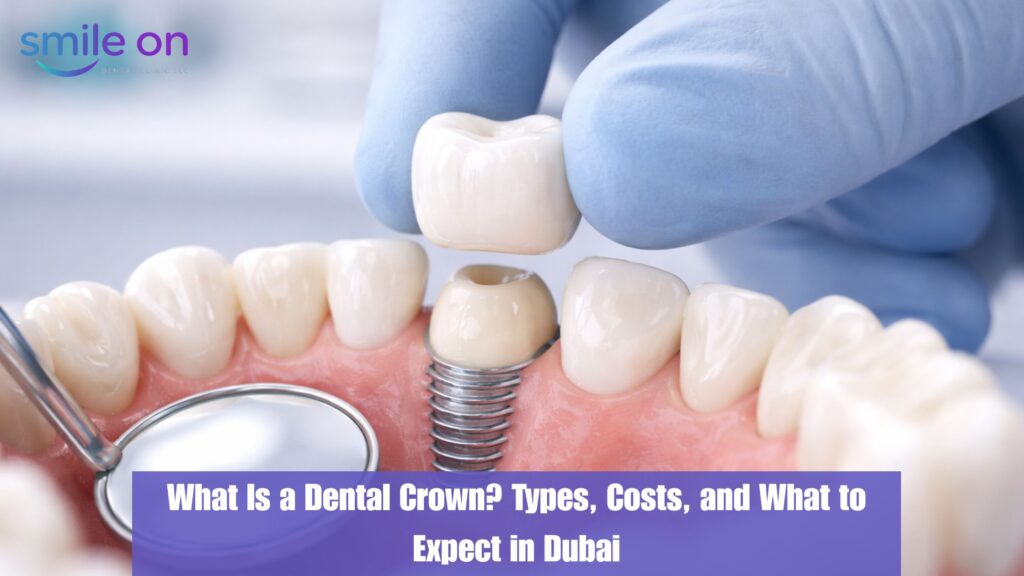
What Is a Dental Crown? Types, Costs, and What to Expect in Dubai
6 min read Share: A dental crown is a tooth-shaped cap that fits over a damaged, weakened, or decayed tooth to restore its shape, strength, and appearance. Once cemented in place, it covers the entire visible portion of the tooth above the gum line and functions just like a natural tooth. If your dentist in Dubai has recommended a crown, or you are trying to understand whether you need one, this guide covers everything. You will learn how crowns work, what types are available, what the procedure involves, how much it costs in the UAE, and how long you can expect one to last Why Would You Need a Dental Crown? A crown becomes necessary when a tooth is too damaged for a filling to do the job, but extraction is not yet required. There are several clinical situations where a crown is the right call. Severely decayed teeth. When a cavity takes up too much of the tooth’s structure, a filling alone cannot restore its integrity. A crown covers and protects what remains. Cracked or fractured teeth. A cracked tooth is unpredictable. It may feel fine now but split further with normal chewing. A crown holds the tooth together and prevents the crack from spreading. After root canal treatment. A tooth that has had a root canal becomes brittle over time. A crown placed over it provides the structural protection it needs to survive long-term. Without one, the tooth is at high risk of fracturing. Worn-down teeth. Teeth grinding (bruxism) or acid erosion can wear teeth down significantly. Crowns rebuild lost tooth structure and restore a proper bite. Broken cusps. A large piece of tooth breaking off, whether from biting down on something hard or an old failing filling giving way, typically requires a crown rather than a patch repair. Supporting a dental bridge. Crowns anchor both ends of a dental bridge, which replaces one or more missing teeth. The neighbouring teeth receive crowns to hold the bridge firmly in place. Covering a dental implant. After a dental implant is placed and has integrated with the jawbone, a crown is attached on top to act as the visible, functional tooth. Crowns are also used in cosmetic cases, to reshape a malformed tooth, cover severe discolouration that whitening cannot fix, or as part of a full smile makeover. That said, purely cosmetic use is less common than restorative use. Types of Dental Crowns Not all crowns are made from the same material, and the right choice depends on where the tooth sits in your mouth, your aesthetic preferences, and your budget. Here is what is available at dental clinics in Dubai. Ceramic (porcelain) crowns Ceramic crowns, also called porcelain crowns, give a very natural look. They match the colour, translucency, and texture of real teeth closely enough that most people cannot tell the difference. They are the standard choice for front teeth where appearance matters most. The trade-off is that they are slightly less durable than metal-based options and can chip if subjected to heavy biting force. Zirconia crowns Zirconia is now a very common crown material. It combines the strength of metal with the look of ceramic. Zirconia crowns are strong, biocompatible, and tooth-coloured. They work well for both front and back teeth. In Dubai, zirconia crowns are often recommended for patients who want longevity without compromising on appearance. Porcelain-fused-to-metal (PFM) crowns PFM crowns have a metal substructure with a porcelain coating on the outside. They were the standard for many years before zirconia became widely available. They are strong and look reasonably natural, but over time the porcelain can chip, and a dark line may appear at the gum line as the gum recedes slightly. They remain a cost-effective option in many cases. Metal crowns (gold or alloy) Pure metal crowns, typically gold or a base metal alloy, are the most durable option available. They rarely chip, require minimal removal of tooth structure, and last for decades. The obvious drawback is aesthetics. Most patients opt for metal crowns only on back molars where they are not visible during normal conversation or smiling. E-max (lithium disilicate) crowns E-max crowns are pressed ceramic crowns known for their strength and natural look. They sit between standard porcelain and zirconia in terms of durability and are a popular choice for front teeth restorations where both appearance and strength matter. The Dental Crown Procedure: Step by Step Getting a dental crown in Dubai typically takes two appointments, though same-day crowns are possible at clinics with in-house milling technology. First appointment: preparation and impressions Your dentist will numb the area with a local anaesthetic. The tooth is then filed down on all sides to create space for the crown to sit over it. How much tooth is removed depends on the crown material. Metal crowns require less reduction than ceramic ones. Once the tooth is shaped, an impression is taken. This can be a physical mould using dental putty or a digital scan using an intraoral camera. The impression is sent to a dental laboratory where your permanent crown is fabricated. This process typically takes 7 to 14 days. A temporary crown is fitted to protect the prepared tooth while you wait. Temporary crowns are made from acrylic or composite and are not as strong as the final restoration, so avoid sticky or hard foods during this period. Second appointment: fitting the permanent crown When the permanent crown arrives, the temporary is removed. Your dentist will check the fit, the bite, and the shade match before cementing it permanently. Minor adjustments can be made chairside. Once you are both satisfied with the result, the crown is bonded into place with dental cement. The entire second appointment usually takes 30 to 45 minutes. You may experience some sensitivity for a few days afterwards, particularly to temperature, but this settles as the tooth adjusts. How Much Does a Dental Crown Cost in Dubai? Dental crown cost in the UAE varies based on the material used,