The answer is not whichever felt more comfortable to discuss at your last consultation. It depends on your specific case type, how reliably you will wear a removable device, and what your treatment needs to achieve.
Clear aligners have improved significantly and now handle a much broader range of cases than they did a decade ago. Fixed braces haven’t gone anywhere: they still offer more precise mechanical control for certain case types and remove the compliance variable entirely.
This guide is written for patients in Dubai who are weighing both options and want an honest clinical comparison, not marketing copy for either system.
Ready to find out which is right for your teeth?
Book a consultation at Smile On Dental Clinic in Al Satwa. We assess your teeth properly and give you a written recommendation with rationale before you decide anything.
The Short Answer
Invisalign is the stronger choice for mild to moderate crowding and spacing in adult patients who will reliably wear aligners for 20-22 hours every day. Fixed braces are the stronger choice for complex bite correction, cases requiring precise three-dimensional tooth movement, children and teenagers, or any patient whose compliance with a removable device is uncertain.
Most cases fall somewhere in the middle, which is why the consultation matters more than any comparison article.
How Each System Actually Moves Teeth
Understanding the mechanism helps you ask better questions at your appointment.
How Invisalign moves teeth:
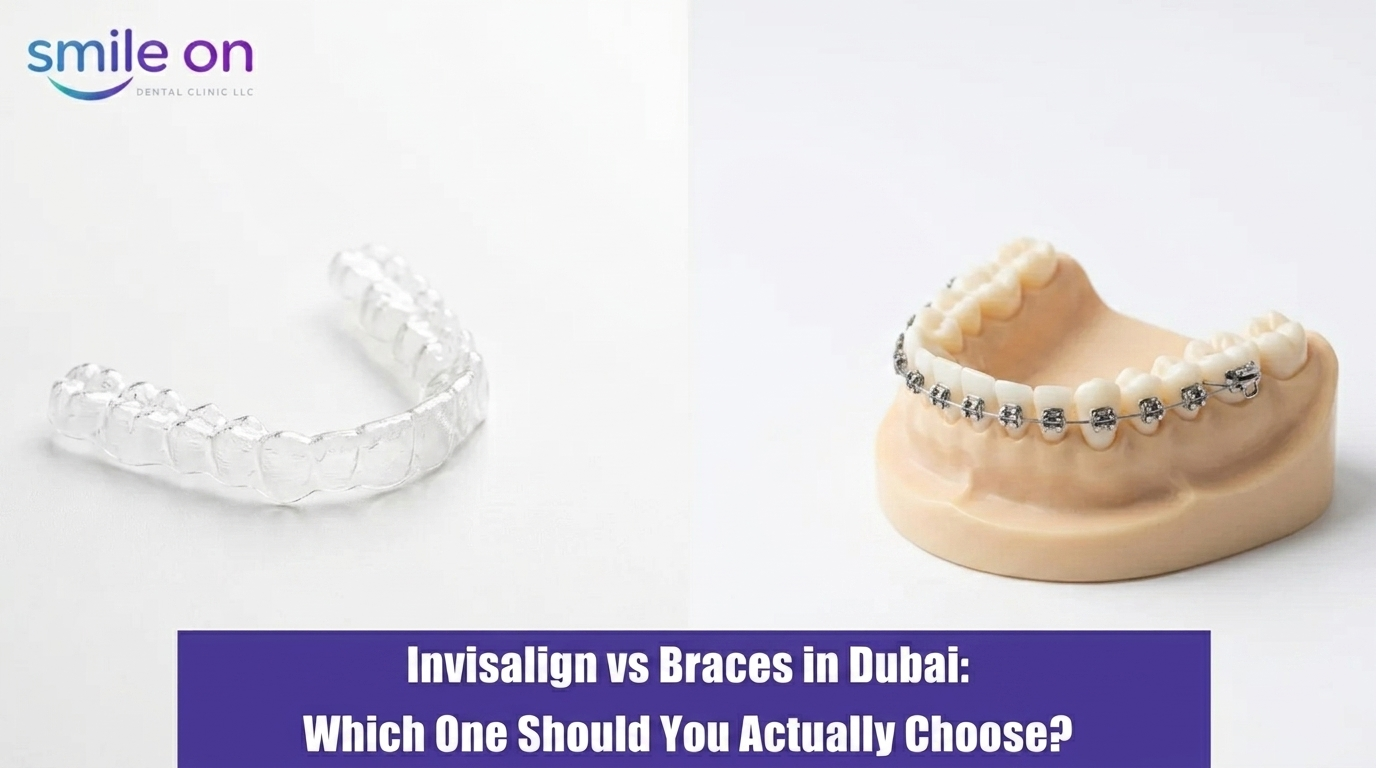
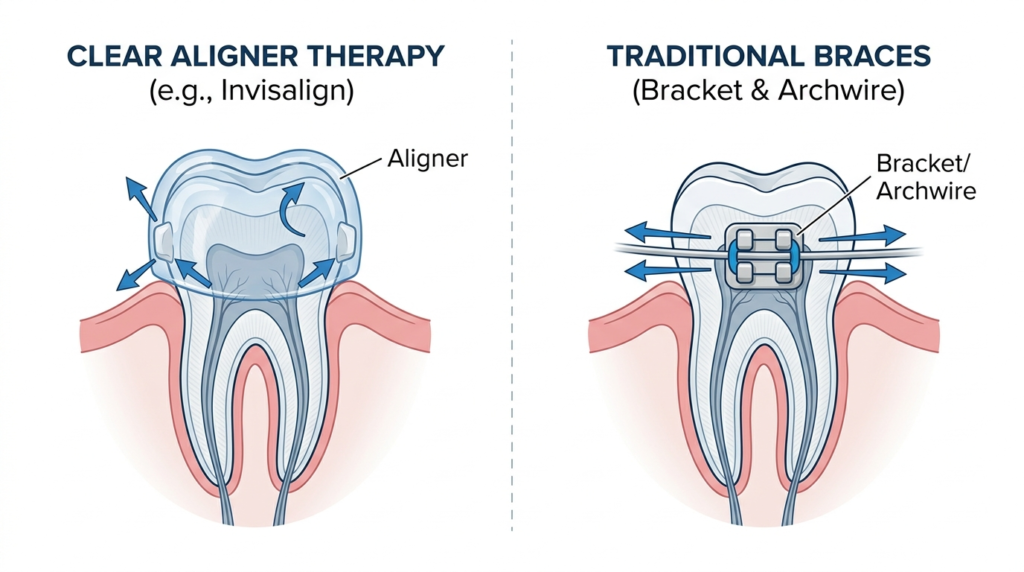
Invisalign produces a series of custom-fitted clear plastic trays using a 3D digital scan of your teeth. Each tray is slightly different from the last, designed to nudge teeth incrementally toward the target position. You wear each tray for 1-2 weeks, then advance to the next. The total number of trays depends on case complexity. Small tooth-coloured composite attachments are often bonded to specific teeth to help the aligners grip for more demanding movements.
How fixed braces move teeth:
Metal, ceramic, Damon, or lingual braces all operate on the same principle: brackets bonded directly to the tooth surfaces, connected by an archwire. The orthodontist applies progressive tension to the wire at each adjustment appointment, moving teeth through the bone over time. The bracket-and-wire system gives direct mechanical control over each tooth’s position, angle, and rotation throughout the treatment period.
Head-to-Head: The Full Comparison
| Factor | Invisalign (Clear Aligners) | Fixed Braces |
|---|---|---|
| Visibility during treatment | Nearly invisible | Visible (lingual braces are the exception) |
| Removability | Removed for eating and cleaning | Fixed for the entire treatment period |
| Case complexity range | Mild to moderate (best results) | Mild to severe |
| Compliance requirement | High — 20-22 hours daily wear required | None — fixed in place |
| Cleaning your teeth | Straightforward — remove tray, brush normally | More involved — interdental brushing around brackets |
| Comfort after adjustments | Lower initial soreness when changing trays | Tightness for 24-48 hours after wire adjustment |
| Adjustment visits | Less frequent for tray progression | Every 4-8 weeks depending on brace type |
| Complex bite correction | Less predictable | More predictable |
| Treatment time (mild cases) | Comparable to fixed braces | Comparable |
| Treatment time (complex cases) | Longer, less predictable | Faster, more predictable |
| What happens if you lose it | Disrupts programmed movement | N/A — nothing to lose |
| Cost in Dubai (AED) | 7,000 – 18,000 | 5,000 – 25,000 (varies by type) |
For a full price comparison by braces type, see: How Much Do Braces Cost in Dubai?
When Invisalign Produces Better Results
Mild to moderate crowding. Clear aligners handle cases where teeth are mildly overlapping or misaligned very effectively. Invisalign’s ClinCheck planning software allows the orthodontist to model the exact expected tooth movements before treatment begins, so you can see the planned digital result before any trays are produced.
Spacing between teeth. Gaps between teeth, including diastema (the space between upper front teeth), respond well to aligner treatment across most case types.
Lifestyle-conscious adults who will actually comply. If you are in a client-facing role, travel regularly, or have personal reasons where fixed hardware during treatment is genuinely difficult, and you are the kind of person who will wear the aligners for 20-22 hours every day for 12-18 months, Invisalign delivers excellent results on appropriate cases.
Oral hygiene priority. Because aligners are removed for eating and brushing, maintaining gum and tooth health during treatment is considerably easier than with fixed braces. For patients with a history of gum sensitivity or previous gum treatment, this is a meaningful clinical advantage.
Certain relapse cases. Patients who have had orthodontic treatment before and experienced mild relapse (teeth moving back slightly) often use a shorter Invisalign Lite course for correction.

When Fixed Braces Produce More Predictable Results
Complex bite correction. Overbite, underbite, crossbite, and open bite cases that have a skeletal component, or that require significant bite change alongside tooth movement, are handled more predictably with fixed braces. The mechanical control available with bonded brackets exceeds what aligners can reliably achieve for three-dimensional bite correction.
Significant tooth rotation. Rotating round-rooted teeth, particularly lower premolars, requires sustained torquing force that fixed braces apply continuously. Aligners apply rotational force intermittently, which can make full rotation of certain teeth less reliable.
Vertical tooth movement. Intruding a tooth (pushing it further into the jaw) or extruding it (pulling it down) is a movement that fixed braces handle more directly than aligners in most cases.
Children and teenagers. Fixed braces are the standard recommendation for younger patients because compliance with removable aligners at this age is genuinely unreliable. One forgotten aligner tray sets treatment back. Braces on the teeth remove that variable. Invisalign First is designed for younger patients with specific jaw development needs, but fixed braces remain the primary recommendation for most children.
Complex cases where budget is a constraint. Metal braces at AED 5,000-10,000 offer the most clinical capability per dirham. For cases where aligners may struggle, fixed braces are both more effective and more affordable.
The Compliance Issue Nobody Explains Clearly
This is the part of the Invisalign decision that clinic websites often downplay.
Invisalign works as planned when worn for 20-22 hours per day, every day. Not 18 hours. Not “most days.” Consistent full-duration wear is what produces the tooth movement that the ClinCheck software predicted.
In practice, patients underestimate how frequently the trays come out: meals, drinks other than water, social events, moments of forgetfulness. Each hour below the recommended wear time slows the programmed tooth movement. Cumulative under-wear leads to teeth not matching the tray at the scheduled point in treatment, requiring refinements (additional aligner sets), and extending the overall treatment time beyond the original estimate.
This is not a criticism of Invisalign as a system. It is a realistic description of the compliance requirement. Orthodontists who discuss this before starting treatment, not after the patient has committed, are the ones worth trusting.
The question to ask yourself honestly before choosing aligners: Am I the kind of person who will wear a removable device for 20-22 hours every single day for 12-18 months? If the honest answer involves uncertainty, fixed braces remove that variable and deliver more predictable results.
Cases Where Patients Switch Mid-Treatment
It happens. A patient starts Invisalign on a case that appears moderate, but mid-treatment the planned tooth movements are not progressing as expected. The orthodontist assesses that fixed braces would handle the remaining movement more efficiently and reliably, and the patient transfers.
The reverse is less common, because fixed braces can typically handle whatever Invisalign was managing, though some patients transfer for personal reasons.
Mid-treatment transfers are not ideal. They add cost and can add treatment time. The cleaner outcome is choosing the right system after a thorough case assessment from the start. A specialist orthodontist who offers both options and has no financial incentive to push one over the other is the right place to make this decision.
What the Consultation Looks Like at Smile On Dental Clinic
At Smile On Dental Clinic in Al Satwa, Dubai, orthodontic consultations are carried out by Dr. Jeffrey Manuel, a DHA-licensed specialist orthodontist. The clinic offers the full range: metal braces, ceramic braces, Damon braces, lingual braces, and Invisalign.
Because all options are available, the recommendation at your consultation is driven by what your case actually needs, not by which system the practice is more commercially incentivised to sell.
The consultation involves a clinical examination, digital X-rays (OPG panoramic and lateral cephalometric), and intraoral photographs. After that, Dr. Manuel presents which options your case clinically supports, what each involves, and what the likely outcomes are.
For Invisalign candidates, a ClinCheck digital preview can be arranged so you see the expected result before any aligner sets are produced or any payment is made.
Book a Dental Consultation
Al Satwa, Dubai
Frequently Asked Questions
Is Invisalign as effective as braces for straightening teeth?
For mild to moderate crowding and spacing, Invisalign achieves results comparable to fixed braces when worn as required. For complex bite correction, significant tooth rotations, and vertical tooth movement, fixed braces provide more reliable mechanical control. Effectiveness is case-specific, not universal.
Does Invisalign hurt less than braces?
Both cause discomfort as teeth move. Invisalign aligners typically cause less soreness during the first 24-48 hours after changing to a new tray, compared to the tightness following a brace adjustment. However, some patients report consistent pressure from continuous aligner wear, while brace discomfort tends to be more episodic. Neither option is pain-free throughout treatment.
Can Invisalign fix an overbite?
Mild to moderate overbites can be addressed with Invisalign using precision cuts and specific attachments. Significant overbite correction with a skeletal component is handled more predictably with fixed braces, often in combination with elastics. The severity of your overbite determines which approach is more appropriate.
How long does Invisalign take compared to braces in Dubai?
For mild cases, Invisalign can match or slightly beat conventional braces on treatment time. For moderate to complex cases, fixed braces are typically faster and more predictable. Invisalign Full treatment ranges from 12-18 months for moderate cases. Metal or Damon braces for comparable cases run 12-24 months. The comparison is case-dependent.
What happens if I lose an Invisalign tray?
Wear the previous tray and contact your clinic immediately for a replacement. Replacement tray production takes time, during which the programmed tooth movement is disrupted. This is one practical disadvantage of removable aligners versus fixed braces, where there is nothing to misplace.
Can I eat normally with Invisalign?
Yes, because the aligners are removed before eating. You eat normally, then clean your teeth before reinserting the tray. The discipline required is the cleaning step before reinsertion: inserting aligners over food debris damages the trays and significantly increases the risk of tooth decay in the covered areas.
Is Invisalign more expensive than braces in Dubai?
Invisalign typically costs AED 7,000-18,000 depending on case complexity (Lite versus Comprehensive). Metal braces cost AED 5,000-10,000. Ceramic or Damon braces run AED 7,000-14,000. Lingual braces (AED 15,000-25,000) are the most expensive option. For a complete price comparison by type, see our braces cost guide.