Porcelain veneers and composite bonding are both legitimate cosmetic dental treatments that can dramatically improve how your smile looks. They are not interchangeable options they serve different cases, carry different costs, and involve very different levels of commitment to your natural teeth.
The problem is that most Dubai clinic websites describe both treatments in glowing terms without telling you when one genuinely outperforms the other. This guide does that instead. Honest criteria, real trade-offs, and a clear framework for deciding which one makes sense for your specific situation.
Ready to find out which is right for your teeth?
Book a consultation at Smile On Dental Clinic in Al Satwa. We assess your teeth properly and give you a written recommendation with rationale before you decide anything.
What Each Treatment Actually Is
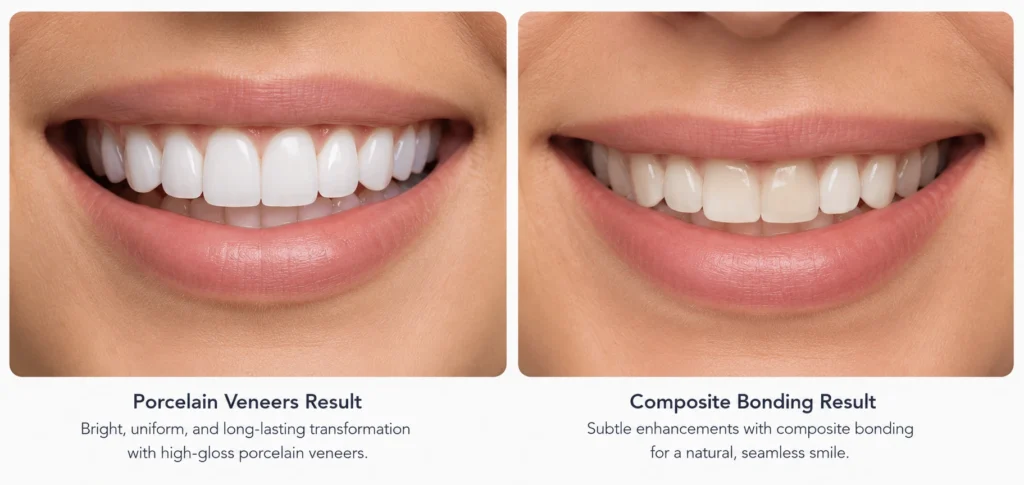
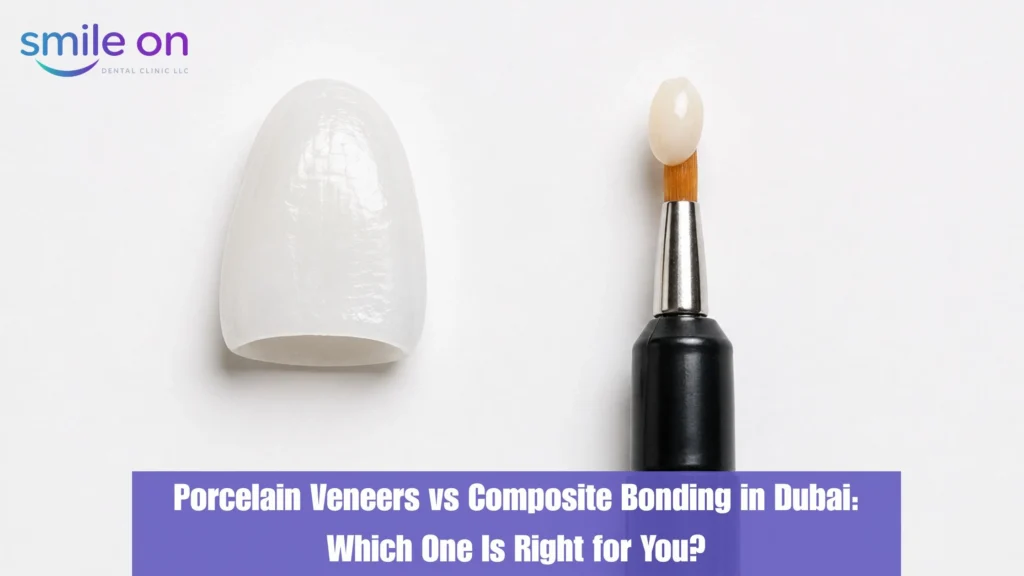
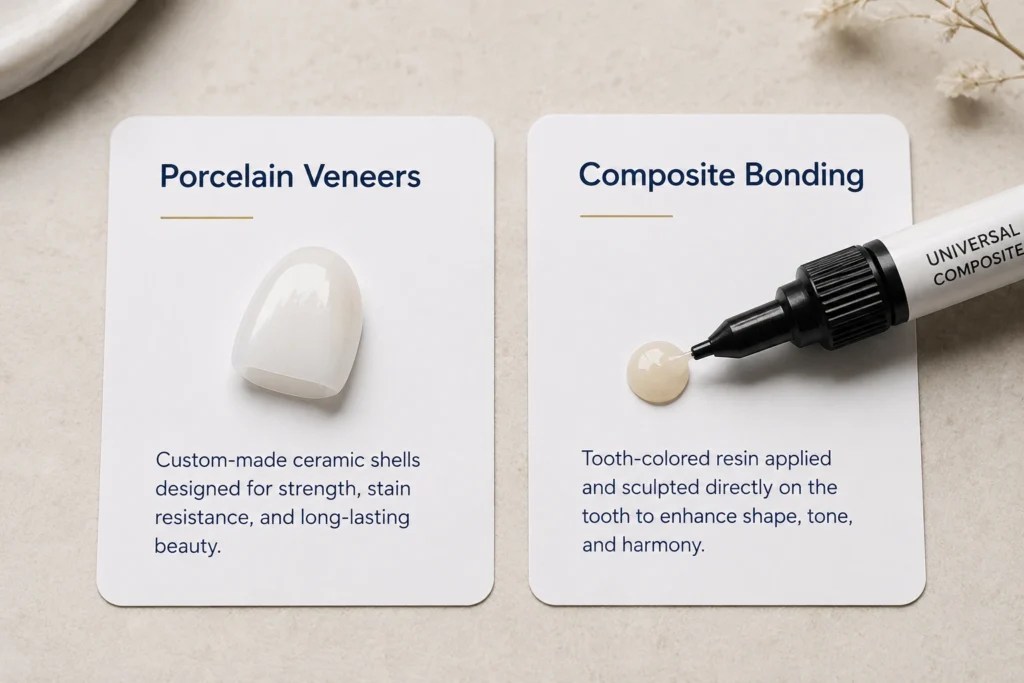
Porcelain veneers are thin ceramic shells typically 0.3 to 0.7mm thick custom-fabricated in a dental laboratory to precise specifications for your teeth. Each veneer is bonded to the front surface of a prepared tooth. To accommodate the veneer’s thickness, a thin layer of natural enamel is permanently removed from the tooth surface before bonding. The result is fixed, highly durable, and colour-stable over many years.
Composite bonding uses a tooth-coloured resin material applied directly to your tooth in the dental chair. The dentist builds it up by hand in layers, sculpts it to the desired shape, hardens it with a UV curing light, and polishes it to a natural finish. No laboratory is involved. In most cosmetic bonding cases, no enamel is removed the resin is applied on top of your existing tooth surface.
Both treatments change how your teeth look. The material, process, permanence, and cost are fundamentally different.
Head-to-Head Comparison
| Porcelain Veneers | Composite Bonding | |
|---|---|---|
| Material | Ceramic (lab-fabricated) | Composite resin (chair-side) |
| Appointments needed | 2–3 (consultation, prep, fit) | 1–2 |
| Enamel removal | Yes — irreversible | Usually none |
| Lifespan | 12–18 years | 4–7 years |
| Stain resistance | Excellent | Moderate (can stain over time) |
| Repairability | Cannot be patched — full replacement if damaged | Repairable chair-side |
| Reversibility | No — enamel removal is permanent | Yes — can be removed without damage |
| Cost per tooth (Dubai) | AED 2,000 – AED 4,500 | AED 600 – AED 1,800 |
| Best for | Full arch, dramatic colour change, long-term investment | Isolated repairs, younger patients, conservative cases |
Cost Comparison: What You’ll Actually Pay in Dubai
Cosmetic dental treatment is priced per tooth in Dubai, which means the total cost scales with how many teeth you’re treating.
Composite Bonding Cost in Dubai: A single tooth starts from around AED 600 for a minor repair. Full treatment of six upper front teeth typically runs AED 4,500–AED 10,000 depending on the extent of reshaping per tooth and the clinic.
Porcelain Veneers Cost in Dubai: A single porcelain veneer typically costs AED 2,000–AED 4,500 depending on the material (e-max vs zirconia vs feldspathic porcelain) and the clinic’s overhead. Six upper veneers therefore runs AED 12,000–AED 27,000. Full upper and lower veneer treatment (10–16 teeth) can reach AED 25,000–AED 45,000+.
The honest cost calculation isn’t just today’s price. If composite bonding needs replacing after five to six years (which it typically does for full arch treatment), the total ten-year cost can match or exceed porcelain veneers. For isolated one or two tooth repairs, composite is almost always the more economical choice even accounting for the occasional touch-up.
When Porcelain Veneers Are the Right Choice
Porcelain veneers make the most clinical and financial sense when:
You’re treating six or more teeth and want uniformity. Composite resin’s ability to maintain a consistent colour and translucency across multiple teeth diminishes over time as staining develops at slightly different rates. Porcelain stays consistent.
You need a dramatic colour change. If your natural teeth are significantly discoloured particularly tetracycline staining or intrinsic discolouration porcelain veneers can achieve a complete colour transformation that composite cannot sustain long-term.
You want a 15-year result, not a five-year result. For patients who want to make the investment once and not revisit it for over a decade, porcelain is the appropriate material.
You’re committed to the treatment. Porcelain veneers are not reversible. The enamel removed during preparation cannot grow back, so the teeth will always need to be covered. If you’re comfortable with that long-term commitment, porcelain offers the best durability.
You’re planning a full smile makeover. For Hollywood Smile cases involving eight or more teeth, porcelain veneers are the standard material of choice among specialist cosmetic dentists in Dubai.
When Composite Bonding Is the Right Choice
Composite bonding is the better clinical decision when:
The problem is isolated to one or two teeth. A chip, a gap between two front teeth, a slightly shorter tooth these are exactly the cases composite bonding was designed for. The result is seamless, the appointment is the same day, and no healthy enamel is touched.
You’re under 25 and want to preserve your options. Removing enamel for veneers is permanent. For younger patients whose aesthetic preferences may evolve, starting with reversible composite bonding preserves the choice to upgrade later without having already committed to permanent tooth preparation.
Your budget doesn’t support porcelain right now. Composite bonding can deliver a genuinely excellent cosmetic result for significantly less money. It is not a compromise treatment in the right hands and for the right case, composite bonding looks exceptional.
You want the result today. No laboratory involvement means no two-to-three-week wait between appointments. Most composite bonding cases are completed in a single session.
Your case is conservative. If the underlying teeth are healthy and structurally sound, starting with a treatment that doesn’t require their preparation is almost always the more sensible clinical choice.
Can You Combine Both Treatments?
Yes, and in practice many smile makeover cases at Smile On Dental Clinic do exactly this. Porcelain veneers on the upper front six teeth combined with composite bonding on less prominent teeth, or composite bonding to close a gap while the patient decides whether to proceed to a full veneer case these are common, practical approaches that balance aesthetics, cost, and clinical conservation.
The key is that the treatment plan should be driven by your teeth and your goals, not by which treatment the clinic is more set up to sell.
Questions to Ask at Your Consultation
Before you agree to either treatment, these questions will give you the information needed to make a confident decision:
Why are you recommending this specific treatment for my teeth?
A good cosmetic dentist will explain the clinical rationale, not just the result.
What would happen if I started with composite bonding and moved to veneers later?
If the answer is “that’s fine,” composite bonding is a safe starting point. If the dentist has a specific clinical reason that veneers are needed now, ask them to explain it.
Can I see real before and after cases from your clinic for this treatment?
For the treatment type being proposed, with patients who had a similar starting point.
Will whitening be done before the treatment?
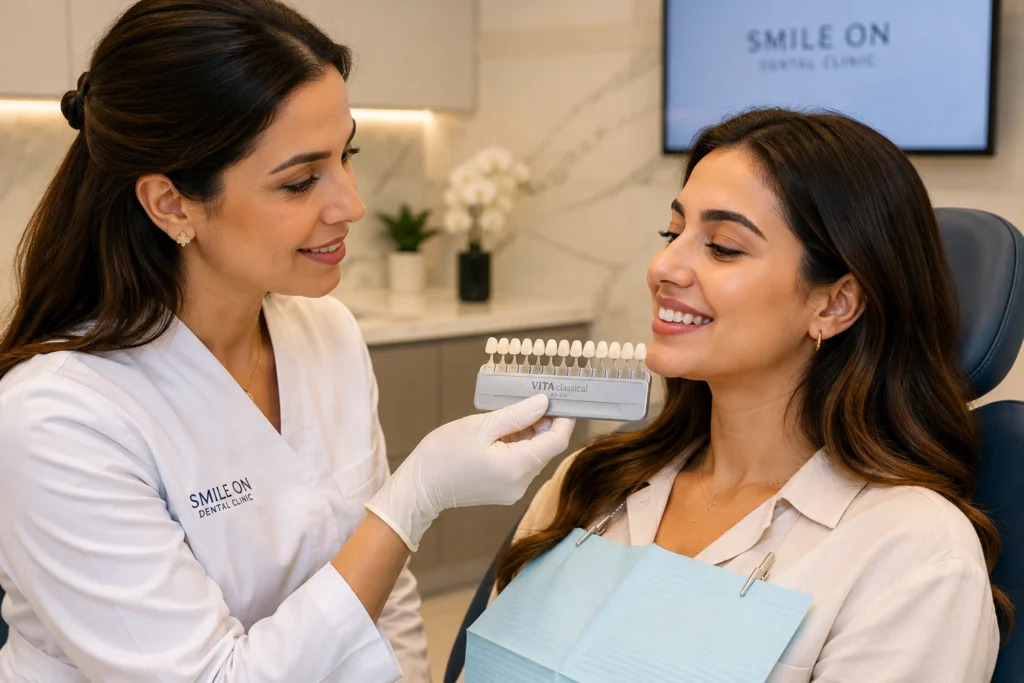
Both composite and porcelain are shade-matched at time of placement. Whitening natural teeth beforehand means a brighter shade match is possible and composite resin cannot be whitened after placement.
Frequently Asked Questions
Are porcelain veneers better than composite bonding?
Neither is universally better they suit different cases. Porcelain veneers offer superior durability, stain resistance, and longevity for full-arch treatment. Composite bonding is the better choice for isolated repairs, younger patients, conservative cases, and anyone who wants to preserve natural tooth enamel. The right choice depends on how many teeth are involved, the nature of the problem, and your budget.
How long do composite bonding and porcelain veneers last in Dubai?
Composite bonding typically lasts four to seven years before requiring touch-ups or replacement, depending on habits and the extent of work. Porcelain veneers last 12 to 18 years with proper care. Both lifespans can be extended with non-abrasive toothpaste, a night guard if you grind, and avoiding biting hard foods directly with the treated teeth.
Can composite bonding be upgraded to porcelain veneers later?
Yes. Because composite bonding doesn’t require enamel removal, it can be removed and replaced with porcelain veneers at any time without additional tooth preparation consequences. This makes it a genuine stepping-stone option for patients who want results now but plan to invest in porcelain later.
Does composite bonding stain over time?
Composite resin is more porous than porcelain, so it can develop surface staining over time particularly with regular consumption of coffee, tea, red wine, or smoking. The surface can be polished at hygiene appointments to extend its appearance, but over five to seven years, colour drift is expected. This is one of the reasons porcelain is recommended for full-arch treatment where long-term colour consistency matters.
Is there a cheaper alternative to porcelain veneers in Dubai that looks the same?
Not indefinitely. Composite bonding can closely approximate the look of porcelain veneers immediately after placement. Over time, the stain resistance and colour stability of porcelain make it the superior long-term option for full smile treatment. For isolated teeth, composite remains an excellent and genuinely comparable outcome at a significantly lower cost.
Do veneers or bonding hurt?
Neither procedure should cause pain. Composite bonding typically requires no anaesthetic. Porcelain veneers involve tooth preparation under local anaesthetic patients feel pressure but not pain. Some sensitivity to temperature in the days following veneer placement is common and resolves on its own.
Book a Cosmetic Consultation at Smile On Dental Clinic
If you’re trying to choose between veneers and bonding, the most useful thing is a proper clinical consultation with a cosmetic dentist who will look at your teeth and give you a genuine recommendation not just a quote for whichever treatment you mentioned first.
At Smile On Dental Clinic in Al Satwa, Dubai, our cosmetic consultations include a full assessment, treatment options with honest trade-offs, and a written cost breakdown. No pressure, no guesswork.
Book a Dental Consultation
Al Satwa, Dubai