If you have been putting off orthodontic treatment because you do not want a mouth full of metal, you are not alone. Most adults in Dubai who search for transparent braces already know they want straighter teeth. What they are not always clear on is that transparent braces is not a single product. It is a category that includes three genuinely different treatment types, each with distinct advantages, limitations, and price points. Understanding the difference before your consultation saves time and helps you ask better questions.
What Are Transparent Braces and What Types Are Available?
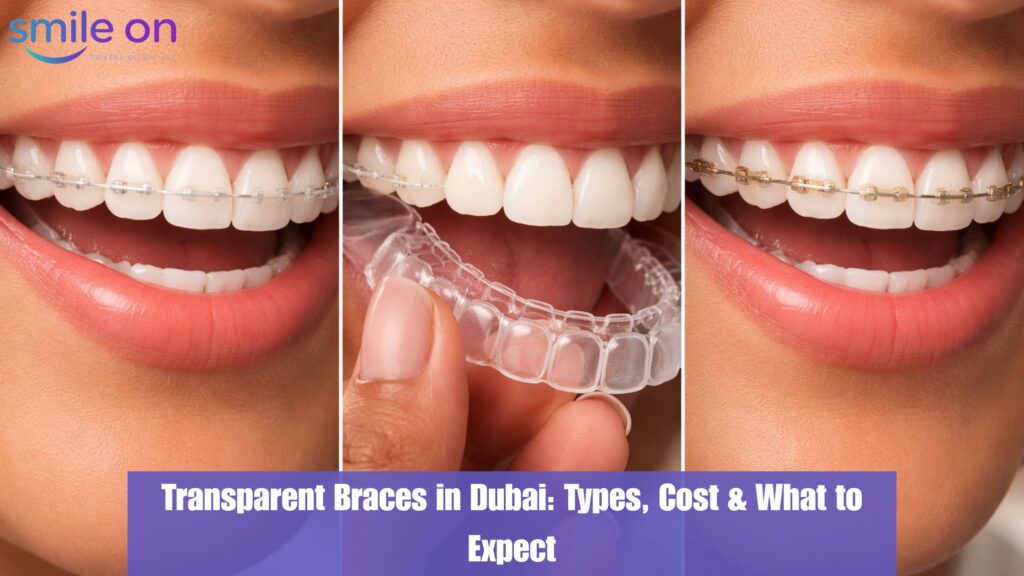
Transparent braces is a broad term that refers to any orthodontic system designed to be less visible than traditional metal brackets and wires. Within that category, there are three distinct options:
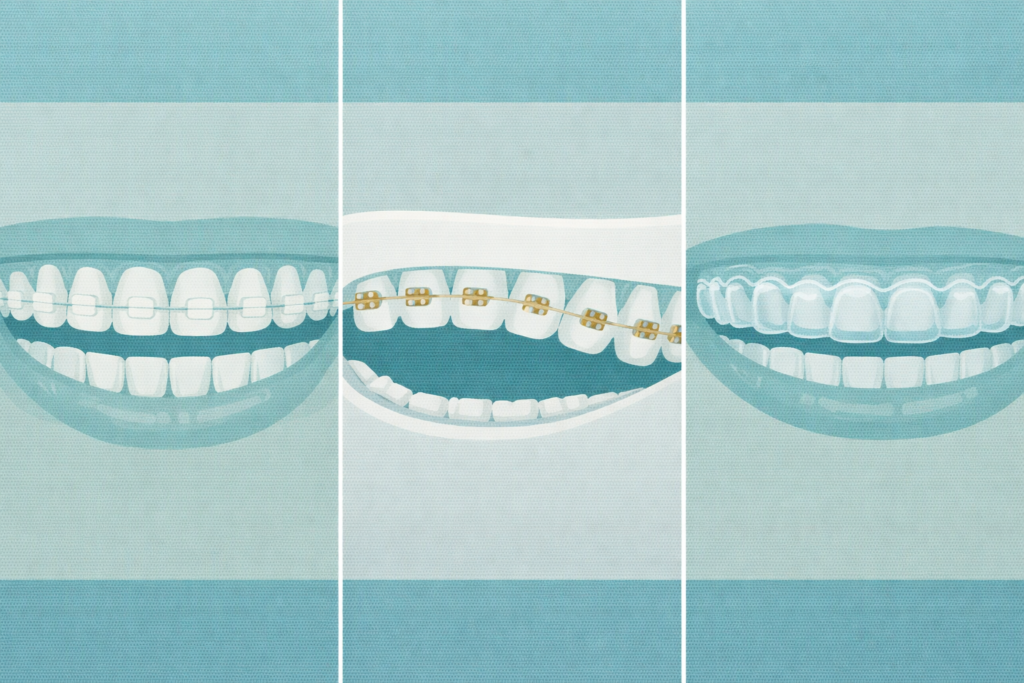
Ceramic braces are fixed brackets and wires bonded to the front of the teeth, just like metal braces. The difference is that the brackets are made from tooth-coloured ceramic or clear composite material, making them significantly less noticeable than metal. They are still visible on close inspection but blend with the natural tooth colour from normal conversational distance.
Lingual braces are fixed braces in the same mechanical sense, but the brackets and wires are bonded to the inside surfaces of the teeth, facing the tongue. From the outside, they are genuinely invisible. Nobody can see them when you speak, smile, or laugh.
Clear aligners are removable, transparent plastic trays worn over the teeth to gradually shift them into alignment. They are classified as transparent braces because they are virtually invisible when worn correctly. Invisalign is the most widely known system in Dubai, though several alternatives including Spark and ClearCorrect are available.
Each of these works differently, suits different clinical cases, and involves a different day-to-day experience. The right choice depends on what your teeth need corrected, how important complete invisibility is to you, and what lifestyle commitments you are prepared to make.
Ceramic Braces: What They Are and Who They Suit
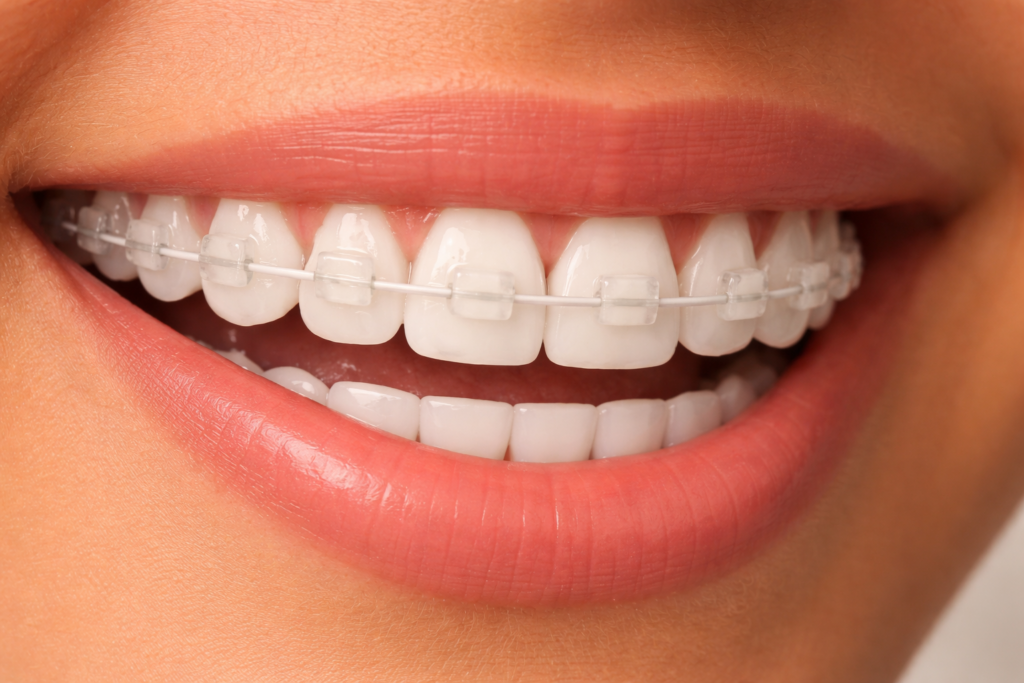
Ceramic braces work exactly the same way as metal braces. Brackets are bonded to the front surfaces of the teeth and connected by an archwire that is periodically adjusted to move the teeth progressively into the correct position. The only material difference is the bracket itself, which is made from tooth-coloured ceramic or clear composite rather than stainless steel.
The result is a bracket that blends with the natural enamel and is significantly less noticeable than metal, particularly from normal distances. Most ceramic braces also use white or tooth-coloured wires to reduce visibility further. Under close inspection or in certain lighting, they are visible. On a video call or across a conference table, most people would not notice them.
Ceramic braces suit patients who need fixed orthodontic treatment but want a less conspicuous look than metal. They handle the same clinical complexity as metal braces, including moderate to severe crowding, bite correction, and rotation of teeth, which is a broader range than most clear aligner systems manage reliably.
The main practical consideration is staining. The ceramic brackets themselves are stain-resistant, but the elastic ligatures holding the wire can pick up colour from coffee, tea, red wine, and certain foods. Regular appointments for adjustments manage this, but patients who consume a lot of staining drinks should be aware of it.
At Smile On Dental Clinic, ceramic braces are available as a clear fixed option for patients who need the clinical strength of braces with reduced visual impact. The Damon brace system, which uses self-ligating technology to reduce friction and bracket bulk, is also available and provides a notably lower-profile result than traditional ceramic brackets.
Lingual Braces: The Option Nobody Sees at All
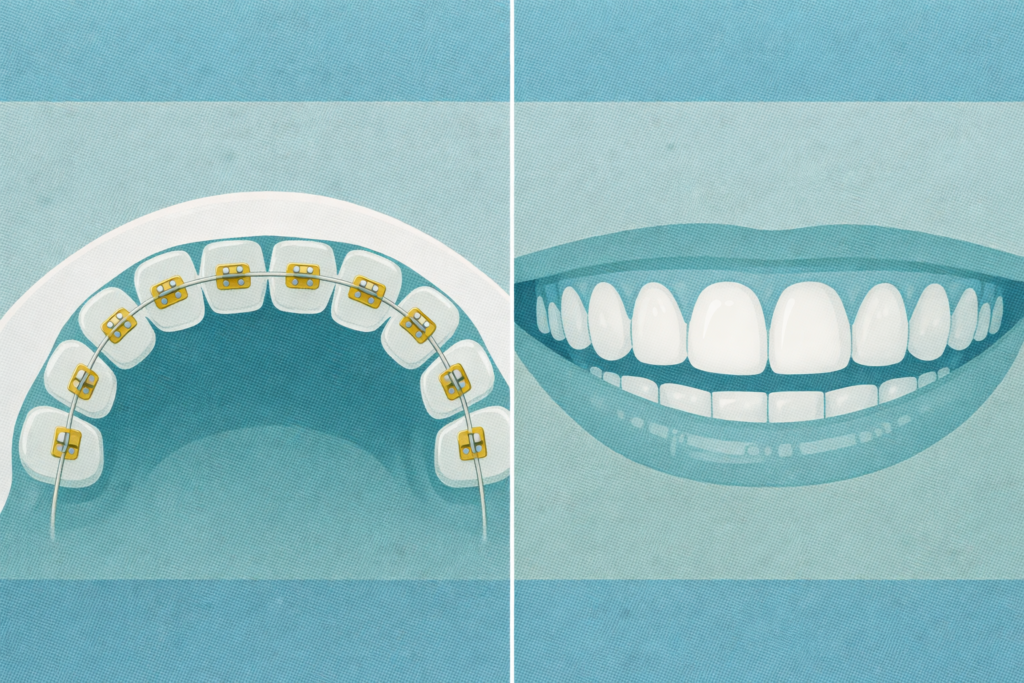
Lingual braces are the only fixed orthodontic treatment that is genuinely invisible from the outside. The brackets are custom-fabricated to fit the inside surface of each individual tooth, and the archwire runs along the back surfaces, facing the tongue. When you smile, speak, or open your mouth normally, nothing is visible.
This makes lingual braces particularly well suited to professionals, public speakers, performers, and anyone for whom visible orthodontic hardware during treatment is not acceptable. They are also the right choice for patients who want the clinical reliability of fixed braces for complex corrections while maintaining complete aesthetic discretion.
The trade-off is adjustment. Because the brackets are positioned close to the tongue, there is an initial adaptation period of one to three weeks during which speech may feel slightly different and the tongue needs time to adjust to the new contact points. Most patients move through this phase without lasting difficulty, but it is a genuine experience that ceramic braces and aligners do not create.
Lingual braces are more technically demanding to place and adjust than front-surface braces, which means they are typically performed by orthodontists with specific training in the system. They are priced higher than both metal and ceramic braces as a result.
Smile On Dental Clinic offers lingual braces as a discreet fixed treatment option. If complete invisibility during treatment is your priority and your case requires the control that only fixed braces can provide, lingual braces are the most appropriate choice.
Clear Aligners: When They Count as Transparent Braces
Clear aligners qualify as transparent braces because they are nearly invisible when worn. A properly fitted aligner tray sits snugly against the teeth and is visible only on very close inspection under direct light. In normal social, professional, and photographic contexts, most people will not notice them.
The defining characteristic that separates aligners from ceramic and lingual braces is removability. Aligners come out for eating, drinking anything other than water, brushing, and flossing. This makes them the most lifestyle-compatible orthodontic option for most adults. There are no food restrictions and oral hygiene is not complicated by brackets and wires.
The clinical trade-off is that removability creates a compliance dependency that fixed braces do not have. Aligners must be worn for twenty to twenty-two hours each day for treatment to progress as planned. Patients who remove them frequently, forget to reinsert them, or underestimate the discipline required will extend their treatment time, sometimes significantly beyond the original estimate.
Clear aligners are well suited to mild to moderate alignment concerns: crowding, spacing, minor rotations, and modest bite discrepancies. For complex bite corrections or cases requiring significant rotational control of multiple teeth, fixed braces typically produce more reliable results. An honest orthodontist will tell you which category your case falls into.
Smile On Dental Clinic offers Invisalign and Invisalign First (for younger patients) as the primary clear aligner systems. Your orthodontist will assess your case and confirm whether aligner treatment is clinically appropriate before any commitment is made.
How to Choose the Right Type for Your Teeth and Lifestyle
There is no universally best transparent brace. The right choice is the one that matches both your clinical needs and your real daily life. Here is the clearest summary:
Choose ceramic braces if your case is clinically moderate to complex, you want a fixed appliance you do not need to think about, and you are comfortable with something that is less noticeable than metal but not completely invisible.
Choose lingual braces if complete invisibility from the outside is non-negotiable and you are prepared for a slightly longer adjustment period. This is the best option for patients who cannot have visible orthodontic hardware for professional or personal reasons and whose case requires fixed brace mechanics.
Choose clear aligners if your case is mild to moderate, you are confident you will wear the trays as prescribed, and lifestyle flexibility is the most important factor for you.
If you are genuinely unsure, a clinical assessment is the only reliable way to find out which options are appropriate for your specific teeth. Not every case qualifies for every system.

Transparent Braces for Adults in Dubai: What You Need to Know
Adults make up a significant proportion of orthodontic patients in Dubai, and the demand for discreet treatment options has grown substantially in recent years. Several things are worth knowing specifically as an adult considering transparent braces.
Adult teeth and bone respond to orthodontic forces in the same way as adolescent teeth. There is no clinical reason why adults cannot achieve excellent results from any of the three transparent brace options discussed in this post. Treatment may in some cases take slightly longer than equivalent treatment in a teenager, but the outcome quality is the same.
Adults are more likely to have existing dental work such as crowns, bridges, or veneers within the smile zone. These restorations need to be assessed before treatment begins because they can affect which orthodontic options are suitable and how treatment is planned. Inform your orthodontist about all existing dental work at your first appointment.
Insurance coverage for orthodontic treatment in the UAE varies widely between plans. Some policies cover a portion of adult orthodontic treatment, particularly where a clinical need can be established. Contact your insurer before your consultation to understand your coverage, and ask the clinic whether they accept your insurance at the time of booking.
At Smile On Dental Clinic in Al Satwa, Dubai, adult orthodontic consultations cover all three transparent brace options. Your orthodontist will assess your teeth and give you a clear, honest recommendation based on what your clinical case requires, not what is easiest to sell.
Book Your Transparent Braces Consultation at Smile On
If you are ready to find out which transparent brace option is right for you, the next step is a clinical assessment. Smile On Dental Clinic in Al Satwa, Dubai offers ceramic braces, lingual braces, and Invisalign, giving your orthodontist the full range of options to recommend what genuinely suits your teeth and lifestyle.
Book your consultation at Smile On Dental Clinic, Al Satwa, Dubai. Call us or WhatsApp today to confirm your appointment.
Frequently Asked Questions
What are transparent braces?
Transparent braces is an umbrella term for orthodontic treatments designed to be less visible than traditional metal braces. The three main types are ceramic braces, which use tooth-coloured brackets on the front of the teeth; lingual braces, which are fixed to the inside surfaces of the teeth and invisible from outside; and clear aligners, which are removable transparent plastic trays. Each works differently and is suited to different types of cases.
Are ceramic braces or clear aligners better?
Neither is universally better. Ceramic braces are fixed, require no compliance decisions from the patient, and can handle moderate to complex alignment and bite cases reliably. Clear aligners are removable, virtually invisible, and better suited to mild to moderate cases where the patient is willing and able to maintain consistent wear. For straightforward cases, both produce comparable results. For complex cases, ceramic braces typically give the orthodontist more control. The correct choice depends on your specific teeth.
How much do transparent braces cost in Dubai?
The cost depends on the type of treatment and the complexity of your case. Ceramic braces in Dubai typically range from AED 8,000 to AED 15,000. Lingual braces are more expensive due to their custom fabrication and technical placement, typically ranging from AED 15,000 to AED 25,000. Clear aligner treatment ranges from AED 7,000 to AED 25,000 depending on the system and case complexity. All prices are case-specific and should be confirmed at a consultation with a full assessment.
Do transparent braces take longer than metal braces?
Ceramic braces take a similar duration to metal braces because they use the same mechanics, typically eighteen to twenty-four months for moderate cases. Lingual braces also follow a similar timeline. Clear aligners for mild to moderate cases are often quoted at six to eighteen months, though cases that require more movement or where compliance falls short can extend beyond this. Treatment duration is driven more by case complexity and patient compliance than by the brace type.
Can I switch from one type to another mid-treatment?
Switching mid-treatment is sometimes possible but involves clinical implications that need to be assessed case-by-case. Moving from metal to ceramic braces is relatively straightforward. Moving from fixed braces to clear aligners mid-treatment is more complex and may not be appropriate depending on how much movement has already been achieved. Discuss your options thoroughly with your orthodontist before starting treatment to choose the right system from the beginning rather than changing course later.