Root Canal Treatment in Dubai — Save Your Natural Tooth

Gentle, Pain-Free Root Canal Therapy for Lasting Tooth Preservation

Tooth pain that lingers, sensitivity that will not go away, or swelling around a tooth are signs that the inside of your tooth may be infected or inflamed. Root canal treatment is the procedure that resolves this. It removes the source of the problem, relieves the pain, and lets you keep the tooth rather than having it pulled.

At Smile On Dental Clinic in Al Satwa, Dubai, root canal treatment is carried out by an experienced endodontic specialist using modern rotary instruments and digital imaging. Most cases are completed in one or two visits. This page covers how the procedure works, who needs it, what it costs in Dubai, and what to expect before, during, and after treatment.

This field is for validation purposes and should be left unchanged.
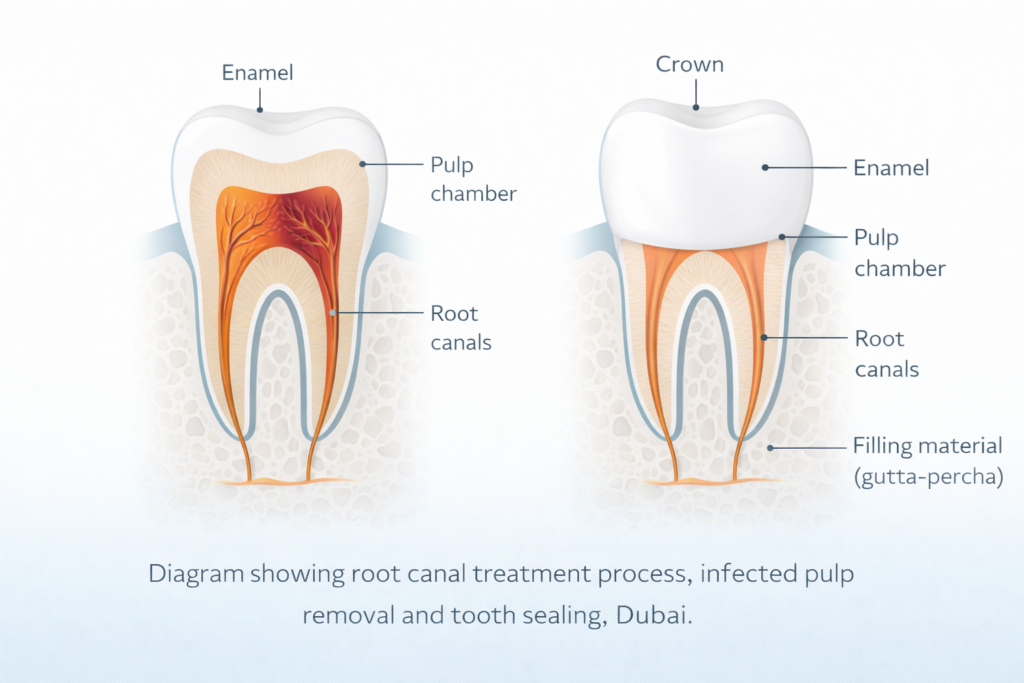
Root canal treatment diagram, Dubai

What Is Root Canal Treatment and How Does It Work?

Root canal treatment, also called endodontic therapy, is a procedure that removes infected or inflamed pulp tissue from inside a tooth. The pulp is the soft inner layer containing nerves and blood vessels. Once it becomes infected, it cannot heal on its own, and the infection can spread to the surrounding bone if left untreated. The tooth is then cleaned, shaped, and sealed to prevent reinfection, preserving it as a functional part of your mouth.

The procedure is not the painful experience most people imagine. With modern anaesthesia and technique, most patients report that root canal treatment feels no different from having a routine filling. The pain people associate with root canals is almost always the pain from the infection itself. The treatment ends it.

Root canal treatment is the only alternative to extraction when a tooth’s pulp is infected or irreversibly damaged. Saving the natural tooth avoids the need for an implant or bridge, keeps the jaw bone intact, and maintains your bite and alignment. Extraction costs less upfront but almost always requires a more expensive replacement later.

Who Needs Root Canal Treatment? Signs You Should Not Ignore

Root canal treatment is needed when the pulp inside a tooth has become infected, inflamed, or has died. This can happen for several reasons, and certain symptoms are reliable indicators that something is wrong inside the tooth.

You likely need root canal treatment if you are experiencing one or more of the following: a persistent toothache that is deep, throbbing, or radiating to your jaw or ear; severe sensitivity to hot or cold that lingers for more than a few seconds after the stimulus is removed; pain when biting or chewing on that tooth; swelling or a small pimple-like bump on the gum near the tooth; discolouration of the tooth, typically a greyish or darkening shade; or a cracked tooth that has allowed bacteria to reach the inner pulp.

In some cases, a tooth with a dead or dying pulp causes no pain at all. This is why routine X-rays matter. An infected tooth can be identified before it becomes an abscess. If you have been told by a dentist that a tooth shows signs of pulp involvement on an X-ray, even without symptoms, you should not wait.

Root canal treatment is suitable for adults and older teenagers whose permanent teeth are fully developed. It is not appropriate if the tooth is so severely broken down that it cannot be restored afterward, or if the surrounding bone loss is too extensive. In those situations, extraction followed by an implant is typically the better path, and your dentist will explain why during the consultation.

What Happens During Root Canal Treatment at Smile On Dental Clinic, Al Satwa?

  • Consultation and Digital X-Ray

    Your appointment begins with a clinical examination and a digital periapical X-ray, which is a close-up image of the individual tooth. In some complex cases, a 3D CBCT scan provides a more detailed view of the root anatomy. This imaging tells the endodontist exactly how many canals the tooth has, how curved they are, and how far the infection has spread. The consultation takes around 20 to 30 minutes.

  • Local Anaesthesia

    Before any instruments touch the tooth, the area is numbed completely with a local anaesthetic injection. Most patients are surprised by how comfortable this part is. Once anaesthesia takes effect, usually within a few minutes, you should feel no pain during the procedure. Patients with dental anxiety can discuss sedation options at the time of booking.

  • Isolation and Access

    A small rubber sheet called a dental dam is placed around the tooth to keep it clean and dry throughout the procedure. The endodontist then makes a small opening through the top of the tooth to access the pulp chamber.

  • Pulp Removal and Canal Cleaning

    Using very fine rotary instruments, the infected or damaged pulp tissue is removed from the pulp chamber and from each root canal. The canals are then shaped and cleaned using irrigating solutions, including sodium hypochlorite, that flush out remaining bacteria and debris. This is the most technically involved part of the procedure. Depending on the number of canals and the complexity of the case, this takes between 45 minutes and 90 minutes.

  • Canal Filling and Sealing

    Once the canals are clean and dry, they are filled with a biocompatible rubber-like material called gutta-percha and sealed with a dental cement. This seals the canals permanently and prevents bacteria from re-entering.

  • Crown or Restoration Placement

    A tooth that has had root canal treatment becomes more brittle over time because it no longer has a blood supply. For back teeth such as molars and premolars, a dental crown is placed over the tooth to protect it from fracturing under biting force. Front teeth may only require a filling if enough tooth structure remains. The crown is typically placed in a separate appointment, one to two weeks after the root canal.

  • Aftercare

    Some mild soreness and sensitivity around the treated tooth is normal for two to five days after the procedure. This is inflammation from the surrounding tissues, not the tooth itself, and it responds well to over-the-counter pain relief like ibuprofen. Avoid chewing hard food on that side until the crown is placed. Most patients return to normal activity the same day or the day after treatment.

Why Choose Smile On Dental Clinic for Root Canal Treatment in Dubai?

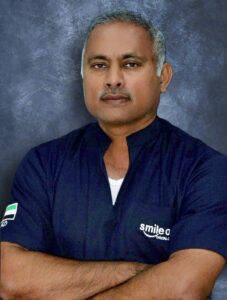
Specialist Endodontist, Not a General Dentist Root canal treatment at Smile On Dental Clinic is performed by Dr. Arun Devarajan, a specialist with dedicated endodontic training and extensive clinical experience. This matters because complex cases, including curved canals, calcified canals, and retreatment of failed root canals, require a level of skill that goes beyond general dentistry. [VERIFY: Dr. Devarajan’s specific credentials and years of experience]

Advanced Rotary Instrumentation The clinic uses motorised rotary nickel-titanium files for canal shaping. Compared to older hand-filing techniques, rotary instruments are faster, more precise, and more consistent in cleaning the canal walls. The result is a cleaner canal, a better seal, and a lower chance of reinfection.

Digital Imaging and CBCT Where Needed Accurate imaging before and during treatment determines the outcome. The clinic uses digital periapical X-rays as standard, and CBCT scanning is available for complex anatomy or retreatment cases. [VERIFY: confirm CBCT is available in-house or via referral]

Central Dubai Location With Easy Access Smile On Dental Clinic is located in Al Satwa, one of the most accessible areas in central Dubai. It is reachable from Sheikh Zayed Road, Jumeirah, Downtown Dubai, and DIFC within a short drive. For patients experiencing acute tooth pain, proximity matters. Same-day appointments are accommodated where possible.

Transparent Pricing Before Treatment Begins The cost of root canal treatment is communicated clearly after the X-ray assessment and before any work begins. You will know the full cost of the root canal and any planned crown before you commit.

What Happens During Root Canal Treatment at Smile On Dental Clinic, Al Satwa​

Root Canal Treatment Cost in Dubai: What Affects the Price?

Root canal treatment costs in Dubai vary, and the variation is not arbitrary. It reflects real differences in the complexity of each case. Understanding what drives the cost helps you compare quotes accurately and avoid being misled by a low headline figure that excludes the crown.

The main factors that affect root canal treatment price in Dubai are the number of root canals in the tooth (a front incisor typically has one canal while a molar can have three or four), the difficulty of the root anatomy such as curved or calcified canals that take longer to treat, whether the case is a first-time treatment or a retreatment of a previously filled tooth, and the type of restoration placed afterward. A crown costs more than a composite filling but provides far better protection for back teeth.

As a general reference in the Dubai market, root canal treatment fees typically range from AED 800 to AED 1,200 for a single-canal front tooth and from AED 1,500 to AED 2,500 or more for a multi-canal molar. Crowns are priced separately. 

Smile On Dental Clinic accepts major insurance plans and can advise on what your policy covers during the consultation. Instalment payment options may also be available. Ask at the time of booking.

The most reliable way to get an exact figure for your specific tooth is to book a consultation. The X-ray is taken first, the endodontist assesses the case, and you receive a clear cost breakdown before any treatment begins.


Meet Your Endodontist at Smile On Dental Clinic, Al Satwa, Dubai

Dr. Arun Devarajan brings specialist-level endodontic training to his practice at Smile On Dental Clinic in Al Satwa, Dubai. His focus is on saving teeth that patients have been told may need to be extracted, through precise diagnosis, advanced instrumentation, and careful case planning. He is experienced in managing complex root canal anatomy including curved canals, calcified canals, and retreatment of previously failed cases. Dr. Devarajan works closely with the clinic’s restorative team to ensure that every tooth treated endodontically is then protected with a well-fitted crown or restoration.

Other Dental Services You May Be Interested In

Endodontist Dubai: Our endodontics hub page covers the full scope of specialist root-related dental care available at Smile On Dental Clinic, including when to see a specialist versus a general dentist and what conditions endodontists treat.

Dental Crowns and Bridges Dubai: After root canal treatment, most back teeth need a crown to prevent fracturing. This page explains the types of crowns available at Smile On Dental Clinic, the materials used, and what the crown placement process involves.

Dental Implants Dubai: If a tooth is too damaged to save and extraction is unavoidable, a dental implant is the closest replacement to a natural tooth. Learn about the implant options available at Smile On Dental Clinic and whether you are a suitable candidate.

What Our Patients Have to Say

Our Latest Blogs

  • All Posts
  • Dental
  • Dental Implants
  • Invisalign
  • PROSTHODONTICS
Load More

End of Content.

Save your natural tooth and stop the pain with precise root canal treatment at Smile On Dental Clinic, the faster, smarter alternative to extraction.

Root Canal Treatment FAQs: What Dubai Patients Ask Most

No, root canal treatment itself is not painful. The procedure is performed under local anaesthesia, which numbs the tooth and surrounding area completely before any instruments are used. Most patients feel only mild pressure during the treatment. The pain people associate with root canals is the toothache caused by the infection before treatment. The root canal is what ends that pain. Some mild soreness is normal for a few days afterward and is easily managed with standard over-the-counter pain relief like ibuprofen.

Most straightforward root canal treatments at Smile On Dental Clinic are completed in one or two appointments. The first visit covers the X-ray assessment, pulp removal, and canal cleaning. In cases where infection is severe or the anatomy is complex, the canals may be medicated and temporarily sealed before the final filling is placed in a second visit. The crown, if needed, is usually fitted separately, one to two weeks after the root canal is complete.

Root canal treatment cost in Dubai depends on the tooth being treated, the number of canals, and the complexity of the case. Front teeth with single canals are less expensive than molars with three or four canals. As a general market reference, fees range from AED 800 for a front tooth to AED 2,500 or more for a complex molar, before the cost of a crown. At Smile On Dental Clinic, you receive a clear, itemised cost estimate after your X-ray and before any treatment begins.

Leaving an infected tooth untreated allows the infection to spread. The bacteria in the pulp can move through the root tip into the surrounding jaw bone, causing an abscess. From there, the infection can spread to other teeth, the sinuses, or in severe cases, the deeper tissues of the face and neck. Beyond the health risk, a tooth that could have been saved with root canal treatment may eventually need to be extracted, leading to the additional cost and complexity of an implant or bridge.

You should avoid eating on the treated side until any temporary filling has been replaced with a permanent restoration or crown. The tooth is more vulnerable in the period between the root canal and the crown, and hard foods can crack it. Once the crown is in place, the tooth functions normally and you can eat without restrictions. For the first 24 to 48 hours after the root canal itself, stick to soft foods and avoid very hot or very cold items.

Many uncomplicated root canal cases at Smile On Dental Clinic in Al Satwa are completed in a single visit. The clinic is located centrally in Dubai and is easily accessible from Jumeirah, Downtown Dubai, and Sheikh Zayed Road. Same-day appointments are available where clinically appropriate. If your case requires a follow-up visit, the team will let you know clearly after the initial assessment.

A filling is appropriate when tooth decay is limited to the outer layers of the tooth, specifically the enamel and dentine, and the pulp remains healthy. Root canal treatment is needed when the decay or damage has reached the pulp. The distinction is made by clinical examination and X-ray, not symptoms alone. Some teeth with pulp damage cause no pain until the infection is advanced. If you have persistent sensitivity, a deep cavity, or a dentist has flagged pulp involvement on an X-ray, get an endodontic assessment before assuming a filling will be sufficient.

Root canal treatment saves the natural tooth by removing the infected pulp and sealing the tooth. Extraction removes the entire tooth. Keeping your natural tooth is almost always the better outcome. It preserves jaw bone, maintains your bite, and avoids the need for an implant or bridge. Extraction is typically cheaper in the short term but leads to greater cost and complexity later if the gap is not restored. At Smile On Dental Clinic, the approach is to save the tooth wherever the prognosis is good. Extraction is recommended only when the tooth truly cannot be preserved.