3D Guided Implant Surgery in Dubai: Precision Planning for Safer, More Predictable Results

Computer-Guided Implant Placement for Greater Accuracy and Faster Recovery at Smile On Dental Clinic

The outcome of a dental implant depends heavily on where it is placed. An implant positioned at the correct angle, depth, and distance from adjacent anatomical structures integrates predictably and supports a restoration that looks and functions exactly as planned. An implant placed without precise pre-surgical planning carries a higher risk of nerve involvement, sinus perforation, inadequate bone contact, or a final crown that does not sit correctly on the implant.

3D guided implant surgery eliminates most of the guesswork from implant placement by transferring a digitally planned surgical map directly into the operating field through a custom-fabricated surgical guide. At Smile On Dental Clinic in Al Satwa, Dubai, 3D guided surgery is available for all implant cases from single tooth replacements to full arch All-on-4 and All-on-6 procedures, and is performed by Dr. Amit Gupta, a DHA-licensed specialist in oral and maxillofacial surgery.

This page explains how 3D guided implant surgery works, why it produces better outcomes than freehand placement, who benefits most, and what patients in Dubai can expect from the process.

This field is for validation purposes and should be left unchanged.

What Is 3D Guided Implant Surgery and How Does It Work?

3D guided implant surgery is a technique in which the entire implant procedure is planned digitally before any surgery takes place, and a physical surgical guide is manufactured to transfer that plan precisely into the patient’s mouth during the operation.

The process works in three stages:

  • Stage 1: CBCT Scanning and Digital Treatment Planning

    A cone beam computed tomography scan, commonly called a CBCT or 3D scan, is taken of the patient's jaw. Unlike a conventional dental X-ray which produces a two-dimensional image, a CBCT scan creates a full three-dimensional model of the jaw bone showing bone volume and density at every point, the location of the inferior alveolar nerve in the lower jaw, the floor and anatomy of the sinuses in the upper jaw, and the roots of any remaining teeth. This data is imported into specialist implant planning software. Dr. Amit Gupta uses the software to plan the exact position, angle, diameter, and depth of each implant digitally, working within the available bone and around all anatomical structures with a margin of safety built in. The planned positions can be viewed from any angle and adjusted until the optimal placement is confirmed. The restorative outcome is also factored into the planning: Dr. Rahul Patel's input on the crown or prosthesis position informs the implant angle and depth, ensuring the surgical plan and the restorative plan are aligned before a single incision is made.

  • Stage 2: Surgical Guide Fabrication

    Once the digital plan is finalised, a custom surgical guide is manufactured from the planning data. This is a clear acrylic device that fits precisely over the patient's remaining teeth or gum tissue and contains metal sleeves at each planned implant position. These sleeves act as physical constraints that direct the surgical drill to the exact planned angle and depth when the guide is seated in the patient's mouth during surgery. The guide is fabricated in a dental laboratory or using in-house CAD/CAM technology and is ready for the surgical day.

  • Stage 3: Guided Implant Placement Surgery

    On the day of surgery, the guide is seated in the patient's mouth and the implants are placed through the guide sleeves. The guide restricts the drill to the planned trajectory at every step, from the initial pilot drill through to the final implant placement. Because the position and angulation are controlled by the guide, the surgery is more precise than freehand placement regardless of visibility or operator variation. In suitable cases, flapless surgery is performed: the implant is placed through a small punch in the gum tissue without cutting and reflecting the gum flap, which significantly reduces post-operative swelling, bleeding, and recovery time.
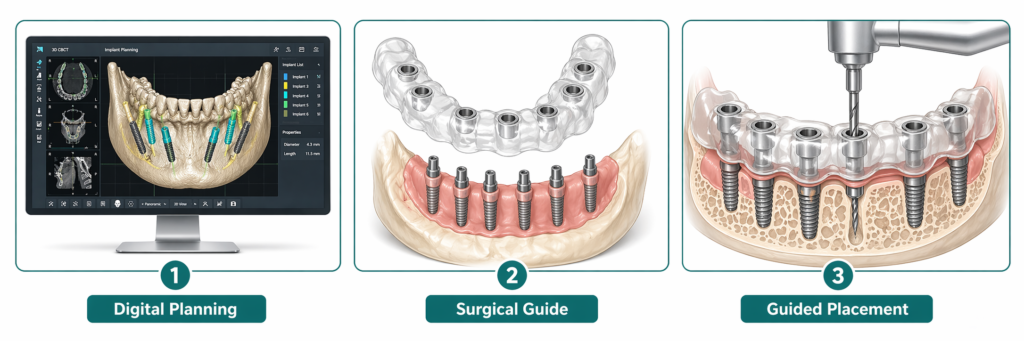
Digital implant workflow steps

How Does 3D Guided Surgery Compare to Freehand Implant Placement?

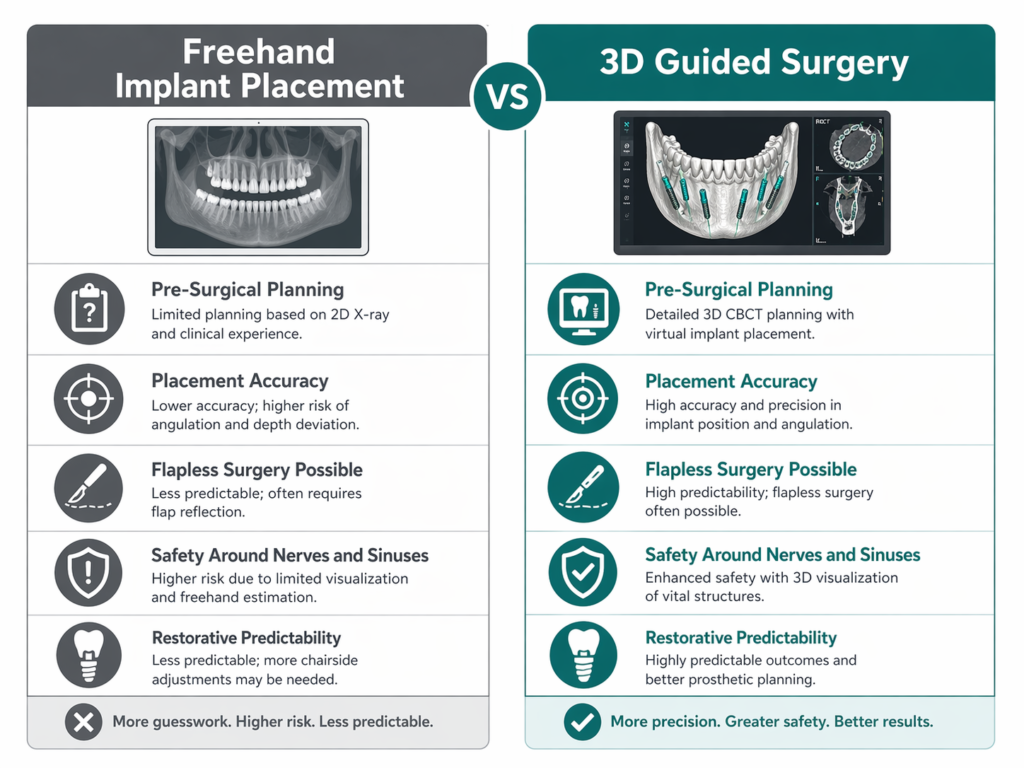
Freehand implant placement relies on the surgeon’s interpretation of two-dimensional X-rays and their tactile judgment during surgery to position the implant correctly. In the hands of an experienced specialist this produces good results in straightforward cases, but it has inherent limitations that guided surgery directly addresses.

Here is how the two approaches compare:

Pre-surgical planning: Freehand placement is planned using conventional X-rays and clinical examination, which provide a two-dimensional view of a three-dimensional structure. Guided surgery is planned using a CBCT scan that shows the bone in three dimensions, allowing the surgeon to identify and avoid anatomical structures with a precision that no two-dimensional X-ray can match.

Accuracy of implant positioning: Clinical studies comparing guided and freehand implant placement consistently show that guided placement produces significantly smaller deviations between the planned and actual implant position, both in terms of angulation and depth. For cases where the implant position directly determines the fit of the final crown, particularly in cosmetically visible areas, this accuracy difference matters.

Flapless surgery possibility: Guided surgery enables flapless implant placement in suitable cases, where the implant is inserted through a small tissue punch without cutting and lifting the gum. Freehand placement almost always requires a full flap, meaning the gum tissue is cut and reflected to provide surgical visibility. Flapless surgery results in less post-operative swelling, less bleeding, less discomfort, and a faster return to normal function.

Safety around anatomical structures: The inferior alveolar nerve in the lower jaw and the sinus floor in the upper jaw are the two most critical structures to avoid during implant surgery. Guided surgery plans a specific safety margin around both structures based on three-dimensional measurements, which is more reliable than the surgeon’s estimation from a two-dimensional image.

Predictability of the restorative outcome: Because the implant position is planned with the final crown in mind from the outset, guided surgery produces implant positions that make the restorative phase more straightforward. Poorly angulated freehand implants sometimes require angled abutments to compensate, which increases complexity and cost at the restorative stage.

Freehand vs 3D guided surgery

Who Benefits Most From 3D Guided Implant Surgery?

3D guided surgery is beneficial for all implant cases because it improves accuracy and safety regardless of complexity. However, the advantage is most significant in the following situations:

  • Cases near the inferior alveolar nerve or sinus floor: Where the margin between the planned implant and a critical anatomical structure is small, guided surgery provides a measurable safety advantage over freehand placement
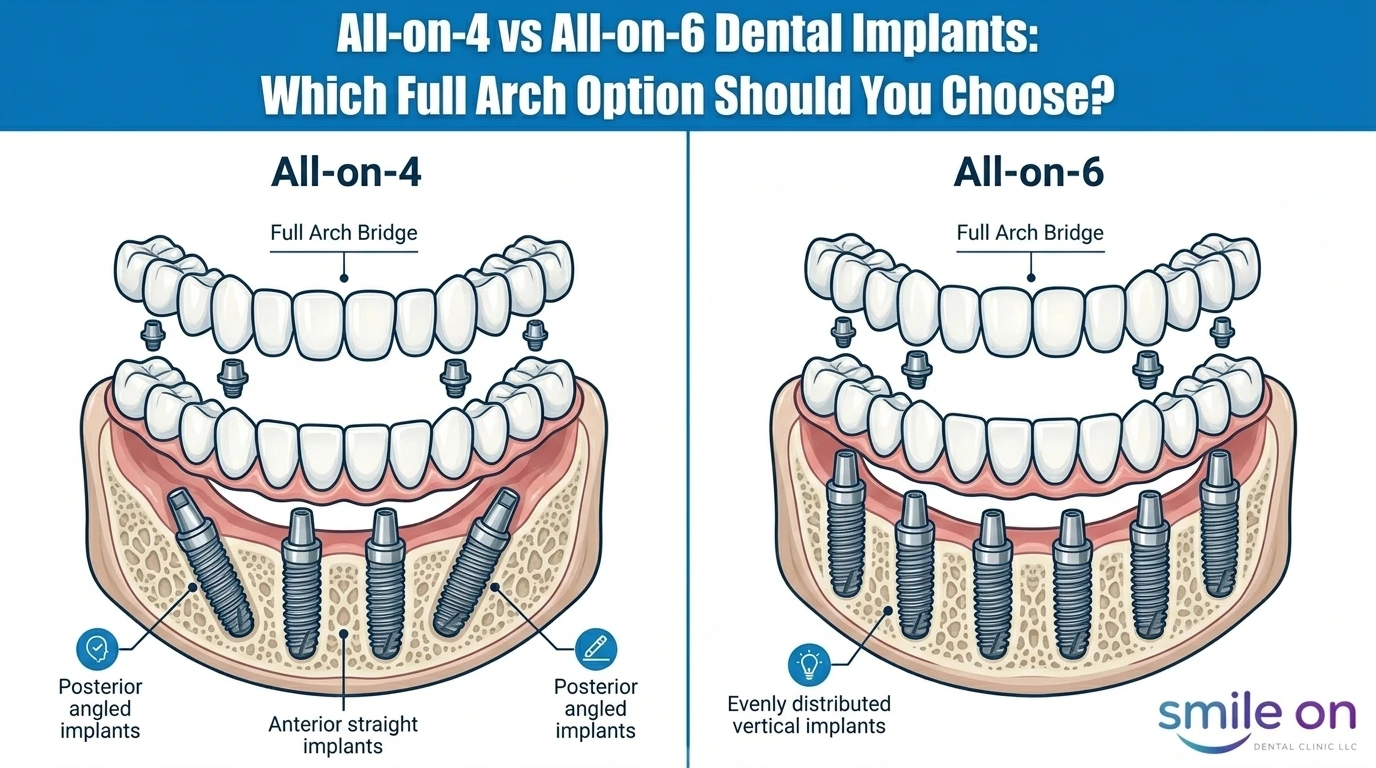
  • Multiple implant cases: For All-on-4 and All-on-6 full arch procedures where four or six implants need to be placed at specific angles relative to each other, guided surgery ensures each implant is in the correct position for the full arch prosthesis to fit correctly
  • Flapless surgery candidates: Patients who want the fastest possible recovery, particularly those who need to return to work or normal activities quickly, benefit significantly from the flapless technique that guided surgery enables
  • Cosmetically critical positions: Front teeth implants where the position of the implant directly determines the aesthetic outcome of the crown benefit from the millimetre-level accuracy of guided placement
  • Complex bone anatomy: Patients with unusual bone shape, post-extraction socket defects, or areas of reduced bone where the available surgical corridor is narrow benefit from the three-dimensional pre-surgical mapping of guided surgery

Same day implant cases: Where immediate loading is planned, the implant position and angle need to be exactly right for the temporary crown to fit correctly on the day of surgery. Guided placement makes this significantly more predictable

Why Choose Smile On Dental Clinic for 3D Guided Implant Surgery in Dubai?

DHA-Licensed Specialist Oral Surgeon 

3D guided implant surgery at Smile On Dental Clinic is performed by Dr. Amit Gupta, a DHA-licensed specialist in oral and maxillofacial surgery. Guided surgery still requires a surgeon who understands the anatomical context the digital plan is based on and who can manage any intraoperative variation from the plan if it arises. Specialist surgical training is what provides that clinical judgment.

In-House CBCT Scanning 

The CBCT scan that underpins the entire guided surgery process is available at Smile On Dental Clinic in Al Satwa. Patients do not need to attend an external imaging centre and return with files on a disc. The scan is taken, reviewed, and used for planning within the clinic, which streamlines the process and reduces the time between assessment and surgery.

Joint Surgical and Restorative Planning 

At Smile On Dental Clinic, Dr. Amit Gupta and Dr. Rahul Patel plan each guided surgery case together. The implant positions are planned with the restorative outcome as the starting point, meaning the crown or prosthesis that needs to sit on the implant determines where the implant is placed, not the other way around. This prosthetically driven approach to implant planning is the standard of care in specialist implant dentistry and is what ensures the final restoration fits, looks, and functions correctly.

Available for All Implant Case Types 

3D guided surgery at Smile On Dental Clinic is available for single tooth implants, multiple tooth implants, same day implants, All-on-4, and All-on-6 cases. Patients do not need to attend a specialist referral centre for complex guided cases. The full capability is available within the clinic in Al Satwa, Dubai.

Accessible Central Dubai Location 

Smile On Dental Clinic is located in Al Satwa, easily accessible from Jumeirah, Downtown Dubai, Sheikh Zayed Road, and DIFC. Initial consultations including the CBCT scan can be arranged at a single appointment, and the clinic offers same-day consultation availability for patients who want to begin the implant assessment process promptly.

Meet the 3D Guided Implant Surgeon at Smile On Dental Clinic

Dr. Amit Gupta, Specialist Oral and Maxillofacial Surgery

Dr. Amit Gupta is the specialist oral and maxillofacial surgeon at Smile On Dental Clinic in Al Satwa, Dubai. He performs all dental implant surgeries at the clinic, including 3D guided cases across the full range of complexity from single tooth placements to full arch All-on-4 and All-on-6 procedures. His specialist surgical training covers the anatomical knowledge, the digital planning workflow, and the intraoperative technique that guided implant surgery requires.

Dr. Gupta works directly with Dr. Rahul Patel from the planning stage of every guided case, ensuring that the surgical plan is aligned with the restorative requirements before the surgical guide is fabricated. This collaboration between the surgeon and the prosthodontist is what distinguishes a properly planned guided implant case from a surgery-first approach where the restorative outcome is figured out after the implants are placed.

Other Dental Services You May Be Interested In

Dental Implants Dubai: The full dental implants hub page at Smile On Dental Clinic covering all implant types, candidacy criteria, the complete treatment process, and what dental implants cost in Dubai across all treatment categories.

Same Day Dental Implants Dubai: 3D guided surgery is particularly valuable for same day implant cases where the implant position directly determines the fit of the temporary crown placed on the day of surgery. This page covers same day implants at Smile On Dental Clinic in detail.

All-on-4 Dental Implants Dubai: Full arch All-on-4 cases at Smile On Dental Clinic are planned and executed using 3D guided protocols. This page covers the full All-on-4 treatment process, who it suits, and what results to expect.

What Our Patients Have to Say

Our Latest Blogs

  • All Posts
  • Dental
  • Dental Implants
  • Invisalign
  • PROSTHODONTICS
Load More

End of Content.

Book your 3D guided implant surgery consultation with Dr. Amit Gupta at Smile On Dental Clinic, Al Satwa, Dubai, and get a CBCT assessment and digital treatment plan before any procedure begins.

3D Guided Implant Surgery Dubai FAQs: What Patients Ask Most

3D guided implant surgery is a technique where the entire dental implant procedure is planned digitally using a CBCT three-dimensional scan before any surgery takes place, and a custom surgical guide is made from that plan to control the position, angle, and depth of each implant during surgery. The surgical guide fits over the patient’s teeth or gum tissue and contains metal sleeves that direct the drill to the exact planned trajectory. The result is that the implant is placed at the position that was planned on the computer before the patient entered the surgical chair, with significantly less deviation than freehand placement.

Yes. At Smile On Dental Clinic, 3D guided surgery is available for single tooth implants, multiple tooth implants, same day immediate load implants, All-on-4, and All-on-6 full arch procedures. The guidance system is particularly valuable for full arch cases where multiple implants need to be placed at specific angles relative to each other, and for same day cases where the implant position must be precise for the temporary crown to fit correctly on the day of surgery.

In suitable cases, yes. When the guided surgery protocol allows for flapless implant placement, meaning the implant is inserted through a small tissue punch without cutting and reflecting the gum, patients experience significantly less post-operative swelling, bleeding, and discomfort compared to conventional open-flap surgery. Many patients who have flapless guided implants placed return to normal activities within one to two days. Not every case is suitable for flapless surgery, and Dr. Amit Gupta confirms at the planning stage whether your case meets the criteria.

Yes. CBCT dental scans use a significantly lower radiation dose than medical CT scans. The dose from a CBCT scan is comparable to a small number of conventional dental X-rays and is well within the accepted safety parameters for routine dental diagnostic imaging. The scan takes less than a minute and requires no injections or contrast agents. At Smile On Dental Clinic the CBCT scan is taken in-house as part of the implant planning appointment.

Yes, slightly. The additional cost reflects the CBCT scan, the implant planning software, and the fabrication of the custom surgical guide, all of which are required for guided surgery but not for freehand placement. For most patients this additional investment is worthwhile given the improved accuracy, reduced risk of complications, and the possibility of flapless surgery with faster recovery. At Smile On Dental Clinic the complete cost including guided surgery components is presented after the assessment appointment before any commitment is made.

Clinical research on guided implant surgery consistently shows that the deviation between the planned and actual implant position is significantly smaller with guided placement than with freehand techniques. In published studies, mean deviations at the implant apex with guided surgery are typically in the range of 0.5 to 1.5 millimetres, compared to deviations of 2 millimetres or more with freehand placement. In the context of implant surgery, where a 2-millimetre error can mean the difference between a safe placement and nerve or sinus involvement, this level of accuracy is clinically meaningful.

Yes. The presence of existing implants does not prevent new guided surgery being planned and performed. Dr. Amit Gupta reviews the CBCT scan data for each case individually, and existing implants, bridges, or other restorations are visible in the scan and factored into the planning. If you are replacing a failed implant or adding implants to complement existing ones, guided surgery can plan the new placement around the existing hardware with the same precision as a first-time case.