You’ve probably noticed more adults around you wearing braces than you’d expect. At the office, at brunch, on the metro. That’s not a coincidence. Orthodontic braces have changed dramatically, and in Dubai’s image-conscious, professionally driven population, demand for tooth alignment treatment has grown across all age groups.
Quick answer: Orthodontic braces are dental appliances that apply gentle, consistent pressure to move teeth and correct bite alignment over time. They treat crowding, spacing, overbites, underbites, and crossbites. In Dubai, treatment typically takes 12 to 24 months and costs between AED 5,000 and AED 18,000, depending on the type and case complexity.
This guide covers every type of orthodontic braces available in Dubai, how they work, what they cost, how long treatment takes, and what your daily life will actually look like from the first fitting to the final retainer.
What Are Orthodontic Braces and What Problems Do They Fix?
Orthodontic braces are appliances used to correct the alignment of teeth and jaws. They work by applying controlled, sustained pressure to teeth over a period of months or years, gradually guiding them into better positions and correcting how the upper and lower jaws meet.
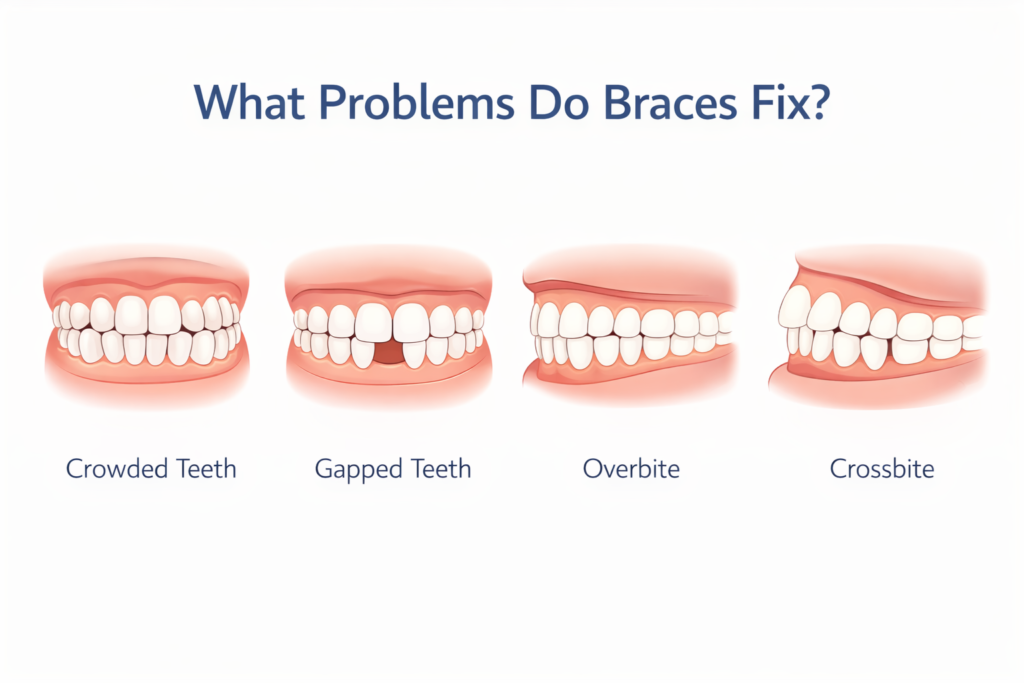
Braces treat a wide range of conditions. Dental crowding happens when teeth overlap because there isn’t enough space in the arch. Spacing refers to gaps between teeth. An overbite is when the upper front teeth cover too much of the lower teeth vertically. An underbite is when the lower teeth sit in front of the upper teeth. A crossbite means upper and lower teeth don’t align correctly on one or both sides. An open bite means the front teeth don’t meet when the mouth is closed.
These aren’t just cosmetic concerns. Crowded teeth are harder to brush and floss, increasing the risk of cavities and gum disease. Bite problems can cause uneven wear on enamel, jaw discomfort, and, in some cases, headaches. Correcting alignment with orthodontic braces often makes long-term dental health significantly easier to maintain, not just your smile more appealing. Results vary by individual case, and a clinical assessment is always the starting point.
How Do Orthodontic Braces Actually Work?
This is one of the most searched questions about braces and one that most clinic pages surprisingly skip over. Understanding the mechanics helps you stay committed through the process.
Orthodontic braces work by exerting a continuous, gentle force on your teeth in a specific direction. This pressure stimulates a biological process in the surrounding bone called bone remodelling. On the side of the tooth being pushed, bone cells called osteoclasts break down existing bone tissue. On the tension side, osteoblasts form new bone to fill the space. This is how a tooth physically moves through solid jaw bone without damage to the surrounding structure, provided the forces are carefully controlled by a trained orthodontist.
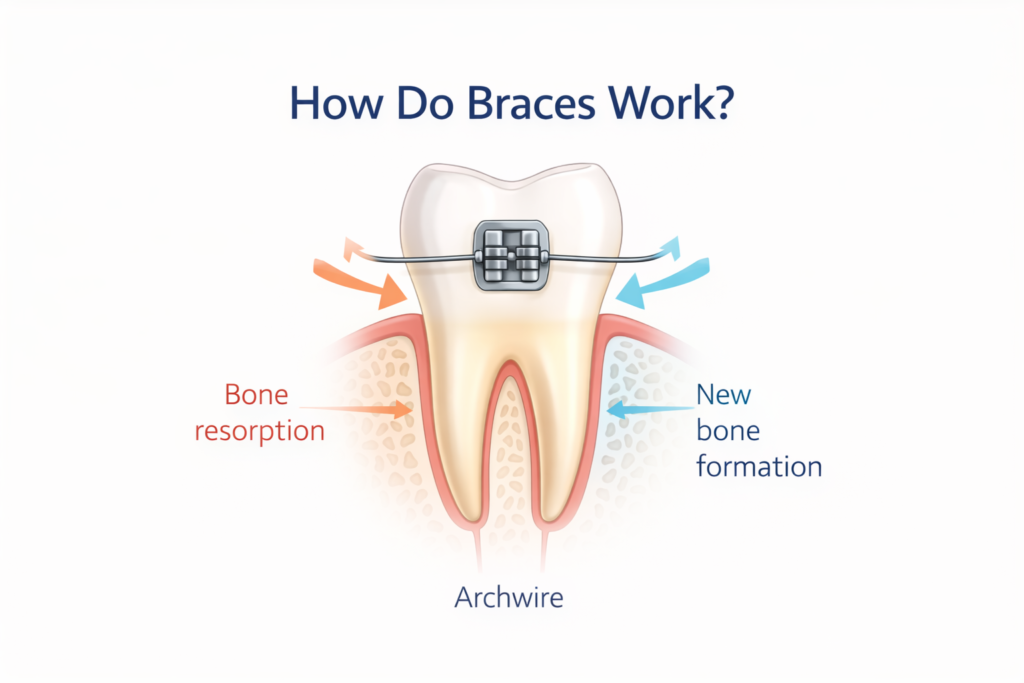
For fixed braces, brackets bonded to each tooth act as handles. The archwire threaded through them is the engine. When your orthodontist adjusts the wire at each appointment, they’re calibrating the direction and amount of force applied. For clear aligners, each tray in the series is manufactured slightly differently from the last, with micro-movements built in so each new tray nudges teeth incrementally closer to the planned final position.
The soreness you feel after an adjustment or when switching to a new aligner is your body responding to that new pressure. It typically settles within 48 to 72 hours. It is not a sign that something is wrong; it’s confirmation that the process is working.
What Are the Types of Orthodontic Braces Available in Dubai?
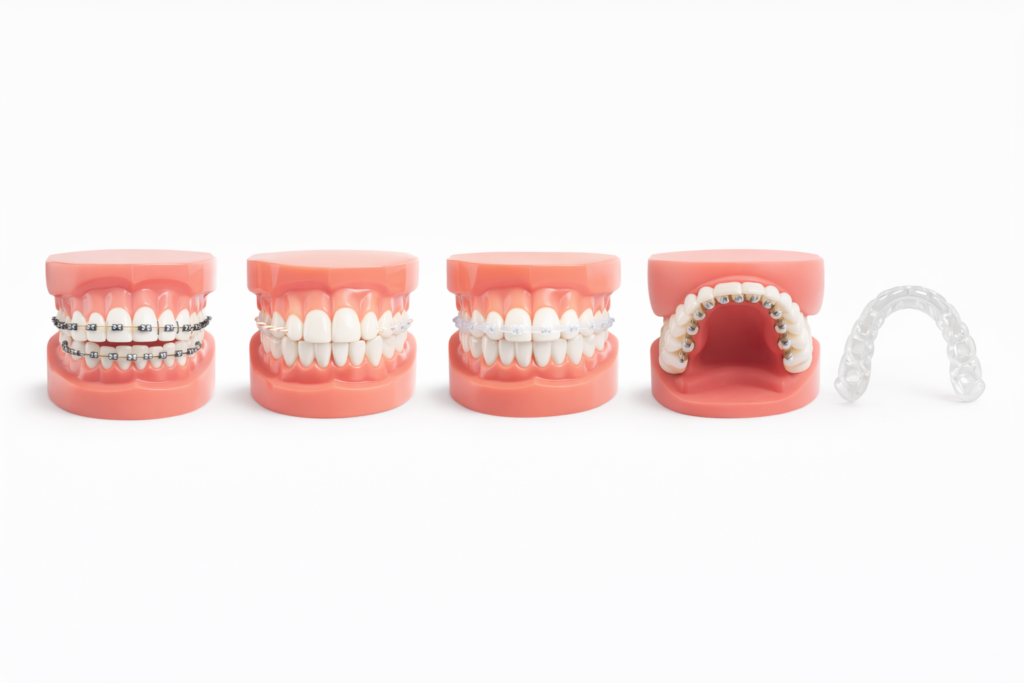
Dubai clinics offer the full spectrum of modern orthodontic options. The right choice depends on the complexity of your case, your lifestyle, and how much visibility matters to you during treatment.
Metal Braces
Metal braces remain the most clinically reliable and cost-effective option, particularly for complex cases. Stainless steel brackets are bonded to the front of each tooth and connected by an archwire that your orthodontist tightens at regular intervals. Modern metal braces are significantly smaller and more comfortable than older versions. They are the most affordable type available in Dubai and handle the widest range of cases including severe crowding, significant bite corrections, and longer treatment timelines. For children and teenagers, metal braces are the most commonly recommended starting point.
Ceramic Braces
Ceramic braces use the same mechanical system as metal braces but with tooth-coloured or clear brackets. They are much less noticeable at a normal conversational distance, which is a meaningful advantage for adults and teenagers who are conscious of their appearance during treatment. The trade-off: ceramic brackets are slightly more fragile, can stain from coffee, tea, or turmeric-heavy food (very relevant in Dubai’s dining culture), and may add marginally to treatment time in some cases. They cost slightly more than metal braces. If you want a fixed brace with less visual impact, ceramic is the established middle-ground option.
Damon Braces (Self-Ligating)
Damon braces use a built-in sliding mechanism to hold the archwire instead of elastic ties, which reduces friction as teeth move. Many patients find them more comfortable and the reduced friction can mean fewer adjustment appointments. They are available in both metal and clear versions. At Smile On Dental Clinic, Damon braces are one of the fixed brace options available under specialist care.
Lingual Braces
Lingual braces are bonded to the back surfaces of your teeth, making them completely invisible from the front. For professionals in client-facing roles, people who appear publicly, or anyone for whom visible braces genuinely aren’t an option, lingual braces offer the effectiveness of a fixed appliance with total discretion. There is a real adaptation period: your tongue will notice them immediately, and speech may be slightly affected for one to two weeks. They are the most technically demanding type to fit and adjust, which is why they cost more and require an orthodontist with specific experience in lingual systems.
Invisalign and Clear Aligners
Invisalign uses a series of custom-made, removable clear trays to move teeth gradually, with each set worn for one to two weeks before moving to the next. Because they’re removable, eating and oral hygiene are unaffected. There are no brackets to clean around and no food restrictions. Invisalign works well for mild to moderate crowding, spacing, and some bite corrections, and is the most popular choice among adults in Dubai’s professional community. For complex rotations or significant bite issues, fixed braces typically provide more precise control. Your orthodontist will tell you honestly whether your case qualifies.
How Much Do Orthodontic Braces Cost in Dubai?
Orthodontic brace costs in Dubai vary by appliance type, case complexity, and the clinic you choose. Below are realistic market ranges for 2025 based on what reputable specialist clinics typically charge for a full course of treatment.
Metal Braces: AED 5,000 to AED 10,000 Ceramic Braces: AED 7,000 to AED 14,000 Damon Braces (metal or clear): AED 8,000 to AED 14,000 Lingual Braces: AED 12,000 to AED 25,000+ Invisalign / Clear Aligners: AED 8,000 to AED 18,000
These ranges cover the full treatment course including adjustment appointments. They may or may not include initial X-rays, dental records, or the retainer phase. Always ask for a written quote that clearly itemises what is and isn’t included before committing. Hidden costs are one of the most common patient complaints in Dubai’s dental market.Many clinics, including Smile On Dental Clinic, offer payment plans that spread the cost over the treatment period, making budgeting more manageable. Some UAE insurance plans provide partial orthodontic coverage, particularly for children and for cases where treatment is medically indicated. Check your policy directly and confirm before your first appointment. Adult orthodontic treatment is often not covered, but it’s always worth asking.
How Long Does Orthodontic Treatment Take?
Treatment duration depends on the complexity of your case, the type of brace used, your age, and your compliance. Here are the real-world timelines you can plan around.
Mild cases involving minor crowding or small gaps, particularly with clear aligners, can be completed in six to twelve months. Moderate cases, which represent the majority of orthodontic patients, typically take twelve to twenty-four months. Complex cases involving significant bite correction, jaw discrepancies, or those requiring extraction before braces begin can take two to three years.
Teenagers tend to move through treatment faster than adults because bone density is lower during development and teeth respond more readily to orthodontic pressure. Adult treatment is slightly slower but the outcomes are equally strong. Starting at thirty-five and finishing at thirty-seven still leaves decades of better-aligned, easier-to-maintain teeth ahead. Age is rarely a valid reason to delay.
Compliance is the factor most within your control. With fixed braces, keeping every appointment and avoiding foods that damage brackets keeps treatment on schedule. With removable aligners, wearing them for the required 20 to 22 hours per day is non-negotiable. The single most common reason treatment runs longer than planned is patients not wearing their aligners consistently.
Step-by-Step: What Happens During Orthodontic Treatment?
Many patients feel uncertain about the process before they start. Here is what the clinical journey from first visit to final result actually looks like.
Step 1: Initial Consultation and Records Your orthodontist examines your teeth, gums, and bite. Digital X-rays, photographs, and in many cases a 3D intraoral scan are taken to get a full picture of your dental anatomy. This is the information base for your treatment plan. For Invisalign cases, the 3D scan is used to generate a digital simulation of your tooth movement from start to finish.
Step 2: Treatment Planning Your orthodontist presents your personalised treatment plan, covering which type of brace is recommended, why, how long treatment is expected to take, how many appointments you’ll need, and the full cost. This is the right time to ask every question you have.
Step 3: Fitting Your Braces For fixed braces, brackets are bonded to the teeth using a dental adhesive and the archwire is placed. This appointment typically takes one to two hours and is not painful, though you may feel pressure. For Invisalign, your first set of trays is fitted and you’re shown how to insert and remove them correctly.
Step 4: Active Treatment and Adjustments You attend the clinic approximately every four to eight weeks for adjustment appointments. The orthodontist checks progress, adjusts wires or switches aligner trays, and monitors that teeth are moving as planned. Most adjustments take thirty to forty-five minutes.
Step 5: Debonding (Removing the Braces) When treatment is complete, brackets are carefully removed and any adhesive residue is polished off. Your teeth are cleaned and final photographs are taken to document the result.Step 6: Retention Retainers are fitted immediately after braces are removed. This phase is permanent. Teeth have a natural tendency to drift back toward their original positions, especially in the months following treatment. Most orthodontists recommend wearing a removable retainer every night indefinitely, or having a fixed retainer wire bonded behind the front teeth. Skipping retention is the leading cause of orthodontic relapse.
Life With Orthodontic Braces: The Practical Reality
Most consultations cover the plan, the cost, and the timeline. Fewer orthodontists spend enough time preparing patients for what daily life with braces actually involves. Here’s the honest version.
The first week is the hardest. Whether you’ve had metal, ceramic, or lingual braces fitted, you will feel pressure and mild soreness for the first two to four days. Over-the-counter pain relief manages this well, and it settles quickly. Lingual brace wearers often notice temporary speech changes, which typically resolve within two weeks.
Food restrictions are real and important. With fixed braces, you need to avoid hard, sticky, and crunchy foods for the entire duration of your treatment. Hard foods like nuts, raw carrots, crusty bread, and hard candy can snap brackets or bend wires. Sticky foods like toffee, caramel, chewing gum, and gummy sweets cling to the appliance and are very difficult to clean. Popcorn is notorious for lodging under wires and causing gum irritation. A broken bracket means an extra appointment and adds time to your treatment.
Oral hygiene requires more effort. You need to brush after every meal, not just twice a day. An interdental brush is essential for cleaning around brackets and under archwires. A water flosser makes a significant difference for back teeth. Patients who neglect hygiene during treatment risk white spot lesions (early decay marks) on their teeth that become visible when braces are removed.The retention phase never ends. After your braces come off, a retainer keeps your results stable. This is not a temporary phase. Teeth drift naturally and without a retainer, orthodontic relapse happens. Most orthodontists recommend wearing a removable retainer nightly, indefinitely, or having a fixed wire bonded behind the front teeth. Patients who stop wearing retainers often see noticeable regression within twelve to twenty-four months.
Getting Orthodontic Braces in Dubai: Choosing the Right Clinic
With a large number of clinics in Dubai offering orthodontic treatment, the most important distinction is whether your care will be led by a qualified specialist orthodontist rather than a general dentist offering braces as an additional service. Specialist orthodontists complete several years of postgraduate training specifically in tooth and jaw alignment, beyond their general dental qualification. For complex cases, this difference matters significantly.
At Smile On Dental Clinic in Al Satwa, orthodontic treatment is led by Dr. Jeffrey Manuel, a Specialist Orthodontist with formal postgraduate training in the field. The clinic offers the full range of orthodontic options including Invisalign, Damon Braces, and lingual braces, with personalised treatment plans based on clinical assessment rather than a one-size approach.
The clinic also works alongside Dr. Vineetha Varughese, Specialist in Periodontics, which is particularly relevant for adult patients who need a gum health check before beginning orthodontic work. This multi-specialty environment is worth looking for when comparing clinics, especially if you’re an adult with any history of gum sensitivity or previous dental work.
You can learn more about the orthodontic team at Smile On Dental Clinic’s doctors page or book a consultation directly online. The clinic is open Wednesday to Monday from 9:00 AM to 9:00 PM, located at Unit 213, AMKM Investment Building, 2nd December Street, Al Satwa, Dubai.
Conclusion
Orthodontic braces are one of the most impactful dental decisions you can make, improving both how your teeth look and how they function for the rest of your life. Whether you’re exploring metal braces for a teenager, weighing up Damon versus ceramic for yourself, or considering lingual braces because discretion is non-negotiable, the right path starts with a proper specialist assessment.If you’re in Dubai and ready to take that first step, the team at Smile On Dental Clinic in Al Satwa is a straightforward place to start. Dr. Jeffrey Manuel and the orthodontic team provide specialist assessments with honest timelines, transparent costs, and no pressure. Call 04 347 2102, email info@smileondc.com, or book your consultation online today.
FAQs About Orthodontic Braces in Dubai
What are orthodontic braces?
Orthodontic braces are dental appliances that apply gentle, sustained pressure to move teeth into better alignment and correct bite problems. They treat crowding, spacing, overbites, underbites, crossbites, and open bites. Types include metal, ceramic, Damon, lingual, and clear aligners like Invisalign. Treatment is carried out by a specialist orthodontist over a period of months to years.
How much do orthodontic braces cost in Dubai in 2026?
Metal braces in Dubai range from AED 5,000 to AED 10,000. Ceramic braces range from AED 7,000 to AED 14,000. Damon braces are typically AED 8,000 to AED 14,000. Lingual braces start from AED 12,000. Invisalign ranges from AED 8,000 to AED 18,000. Costs depend on case complexity, and most clinics offer payment plans.
How long do orthodontic braces take to work?
Mild cases take six to twelve months. Moderate cases, which are the most common, typically take twelve to twenty-four months. Complex bite corrections can take two to three years. Treatment is faster in teenagers than adults due to lower bone density. Compliance with appointments and instructions is the biggest factor within a patient’s control.
Do orthodontic braces hurt?
Braces are not acutely painful. You will feel pressure and mild soreness for two to four days after fitting and after each adjustment. This is normal and settles quickly. Over-the-counter pain relief is typically enough. Lingual braces may cause temporary tongue discomfort for one to two weeks during adaptation.
Can adults get orthodontic braces in Dubai?
Yes. There is no upper age limit for orthodontic braces, as long as your teeth and gums are healthy. Adults make up a large and growing proportion of orthodontic patients in Dubai. Clear aligners and lingual braces are particularly popular with adult professionals who want discreet treatment. Any gum disease or active decay should be treated before orthodontic treatment begins.
What is the difference between braces and Invisalign?
Braces are fixed appliances bonded to the teeth that cannot be removed during treatment. Invisalign uses removable clear trays changed every one to two weeks. Braces are generally more effective for complex cases. Invisalign offers more flexibility and discretion, with no food restrictions, and suits mild to moderate alignment issues. A specialist orthodontist will recommend which is appropriate for your specific case.